Definition:
CONVERGENCE (or ABSOLUTE CONVERGENCE) is the situation in which POOR COUNTRIES TEND TO GROW FASTER THAN RICH COUNTRIES. In other words, it is the situation in which there is a NEGATIVE RELATION BETWEEN THE LEVEL OF INCOME OF AN ECONOMY AND ITS GROWTH RATE.
Notice that if poor economies tend to grow faster than rich economies, then they tend to get closer together or converge. This is why this phenomenon is called convergence
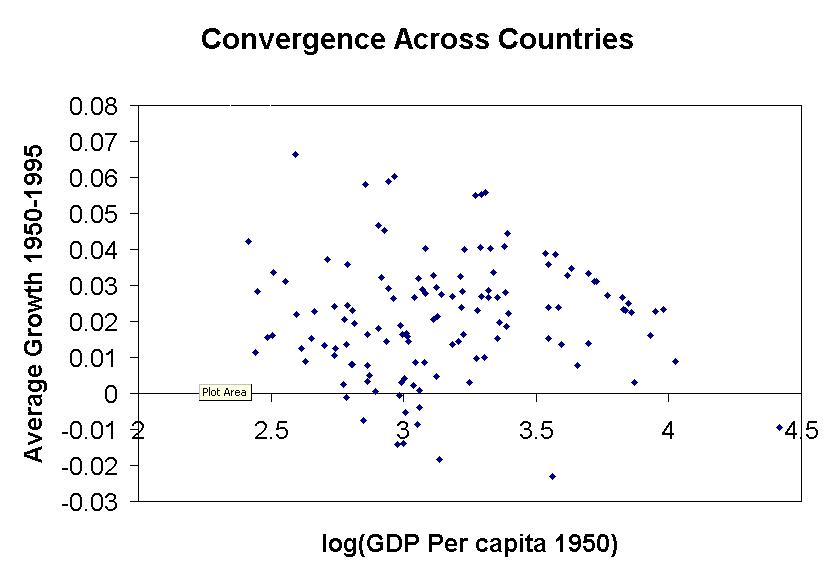
We can see in the following picture that, if we look at the world as a whole, it is not true that over the period 1950-1995 CONVERGENCE has existed.
Definition: The concept of CONDITIONAL CONVERGENCE says that POOR ECONOMIES GROW FASTER THAN RICH ECONOMIES ONLY IF THEY HAVE SIMILAR SAVINGS RATES, LEVELS OF TECHNOLOGY AND POPULATION GROWTH RATES. In other words, they converge only if they have SIMILAR STEADY STATES.
The NEOCLASSICAL MODEL OF SOLOW AND SWAN predicts that there is CONDITIONAL CONVERGENCE, not ABSOLUTE CONVERGENCE.
Obviously, it is not true that African economies have the same savings rates and levels of technology than the USA, Europe or Japan. On the other hand, it is true that the USA has similar savings rates and technologies to Europe and Japan. Hence, if the neoclassical model is correct and we look ONLY at these economies, we should be able to observe a negative relation between their growth rates and the level of income. The following picture shows that this is true (NOTE: OECD economies are the rich economies of the world: USA, Canada, Western Europe, Japan, Korea, Australia and New Zealand).
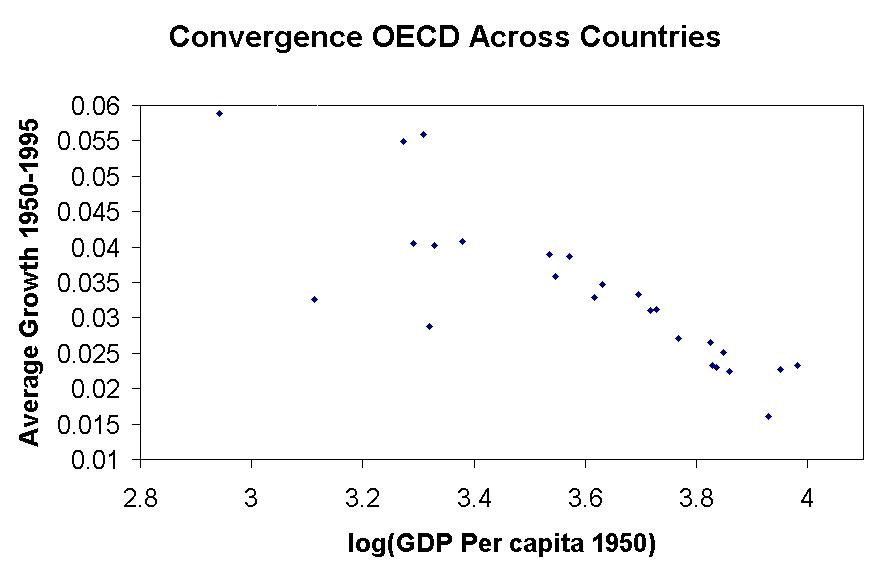
Similarly, we can imagine that the States within the United States also have similar savings rates and similar technologies (or at least, more similar than those of Zambia or Senegal). If we look at the behavior of the States of the US, we see that there is clear evidence of convergence.

We conclude that, even though the world does not exhibit CONVERGENCE, there is clear evidence of CONDITIONAL CONVERGENCE, as predicted by the neoclassical theory of Solow and Swan.