 Columbia College. Economics W3213
 Columbia College. Economics W3213
Professor Xavier
Problem Set 5
THE LITTLE
MERMAID

(1) FLOUNDER
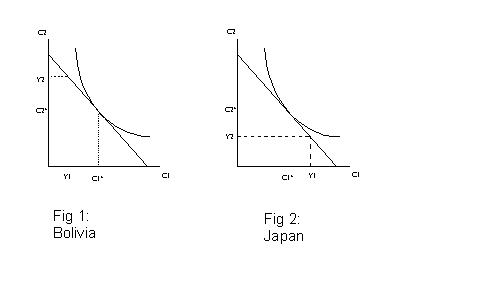
In this problem we consider the aggregate consumption behavior of two OPEN economies. The first economy is called Bolivia. Bolivia, is a poor economy where everybody believes that income in the future will be much larger than in the present. The optimal consumption in period 1 and period 2 is displayed in Figure 1. Bolivia has access to international credit markets because there are other countries in this world like Japan.
Japanese income is huge today but is expected to fall in the
future. The behavior of the Japanese economy is displayed in Figure 2.
(i) Who is borrowing and who is lending? Why did we say in class that the macroeconomy as
a whole cannot borrow or lend and now we say the opposite?
(ii) Bolivia is a well known producer of Tin. Imagine that the price of Tin increases temporarily so today's income increases by 10 million dollars, but tomorrow's remains the same. What will happen to Bolivian aggregate consumption today? (Today is period 1) Explain your answer intuitively.
(iii) Suppose that there is an increase in world real interest
rates. What is the behavior of aggregate consumption today and tomorrow for both Bolivia
and Japan? (Make sure you decompose the overall effects into intertemporal wealth and
substitution effect). Is this the same answer we derived in class? Why?
(3) Suppose that Bolivia does NOT have access to international
credit markets but Y1 and Y2 are still the ones displayed in Figure
1. What will C1 and C2 be in this case? What would the increase in C1
when Bolivia experiences a temporary increase in income as described in question (2.ii)?
Is your answer different from the one you gave in (2.ii)? Why?
(2) ARIEL
Consider a consumer who receives the amount of income and
and in periods 1 and 2 respectively. Imagine that
there is a government who levies a tax on this individual. The total taxes paid in period
1 and 2 are
in periods 1 and 2 respectively. Imagine that
there is a government who levies a tax on this individual. The total taxes paid in period
1 and 2 are and
and respectively. The
individual has access to banks so he can borrow and
respectively. The
individual has access to banks so he can borrow and lend any amount he
desires at the interest rate r. Imagine that the amount of bonds he inherits when he
starts is zero and he wants to leave no assets when he dies after period 2. The individual
needs to choose the amount of consumption in periods 1 and 2 that maximize his utility
subject to a budget constraint.
lend any amount he
desires at the interest rate r. Imagine that the amount of bonds he inherits when he
starts is zero and he wants to leave no assets when he dies after period 2. The individual
needs to choose the amount of consumption in periods 1 and 2 that maximize his utility
subject to a budget constraint.
(i) Write the dynamic budget constraints for periods 1 and 2.
(ii) Write the intertemporal budget constraint for his lifetime. Provide an interpretation.
(iii) Draw the budget constraint in a
diagram that has and
and in the axis.
(iv) Imagine that the individual likes to smooth consumption. How would his indifference curves look like? Why?
(v) What would be his optimal choice of consumption for period 1 and 2 respectively?
(vi) Imagine that he starts in a situation where he is borrowing. What would be his reaction to a decline in the interest rate? Would he consume more or less in period 1? Would he consume more or less in period 2?
(vii) Imagine that the government decreases the tax rate in period 1 and in period 2 both by one dollar. Would his consumption in period 1 change? By how much?
(viii) Imagine that the government decreases the tax rate in period 1 only by one dollar. Would his consumption in period 1 change? By how much?
(ix) Imagine that the government decreases the tax rate in period 2 only by one dollar. Would his consumption in period 1 change? By how much?
(x) Imagine that the government decreases the tax rate in period 1 by ONE dollar AND it increases the tax in period 2 by (1+r) dollars. Would his consumption in period 1 change? By how much?
(xi) Imagine now that,
because of liquidity constraints, the individual can LEND but he CANNOT BORROW. Consider
the case when the government decreases the tax rate in period 1 by ONE dollar AND
it increases the tax in period 2 by (1+r) dollars. Would his consumption in
period 1 change? By how much? Is your answer here different from your answer in (x)? If
so, explain why?

(3) URSULA
 Consider
The Consumption Theory we discussed in class when there are MANY periods (say, a person
who is going to live for 70 years). This is what we called the Permanent
Income Hypothesis (PIH).
Consider
The Consumption Theory we discussed in class when there are MANY periods (say, a person
who is going to live for 70 years). This is what we called the Permanent
Income Hypothesis (PIH).
(i) What is the marginal propensity to consumer out of temporary income? What does it depend upon?
(ii) What is the marginal propensity to
consume out of permanent income? Does it depend on the same factors you mentioned in the
previous question?
Consider the Keynesian Liquidity Constrained consumer (LCC).
(iii) What is the marginal propensity to consumer out of temporary income? What does it depend upon?
(iv) What is the marginal propensity to consume out of permanent income? Does it depend on the same factors you mentioned in the previous question?
(v) Why are your answers for the PIH, and
LCC models different?
(4) SEBASTIAN 
In Class we considered the case in which
the consumer can borrow and lend freely and the interest rat r and the case in which the
individual can lend at rate r but cannot borrow at all. Consider now the intermediate case
in which the interest rate charged by the bank for borrowing is larger than the interest
rate paid by the bank to the consumer for the money they deposit in the bank. In other
words, the consumer can SAVE at the rate  and can BORROW at rate
  with
with  . The individual receives
 and
and in periods 1 and 2
respectively.
in periods 1 and 2
respectively. 
(i) Graph the budget constraint for the individual.
(ii) Add to your graph the consumer's indifference curves. Show three possible outcomes: one in which the consumer saves, one in which he borrows , and one in which he neither borrows nor saves.
(iii) Consider the case in which he SAVES.
How does consumption in period 1 change when the interest rate increases a little bit?
How does consumption in period 1 change when the interest rate
increases a little bit?
How does consumption in period 1 change when the interest rate increases a little bit?
(iv) Consider the case in which he
BORROWS. How does consumption in period 1 change when the interest rate increases a little
bit? How does consumption in period 1 change when the interest rate
increases a little
bit? How does consumption in period 1 change when the interest rate increases a little bit?
(v) Finally, consider the case in which he
does NOT BORROW OR SAVE. How does consumption in period 1 change when the interest rate increases a little bit?
How does consumption in period 1 change when the interest rate
increases a little bit?
How does consumption in period 1 change when the interest rate increases a little
bit?
increases a little
bit?
(5) Scuttle
Find the 12 Differences in the following two Pictures of Ariel.