
Columbia University
Macroeconomics Analysis I G6215
Fall 2009
Professor Xavier Sala-i-Martin
Problem Set 3
(I) q-Theory: an example.
Consider the neoclassical firm with internal adjustment costs we studied in class. Imagine that the production function (in per capita terms) takes the specific form

where A is the level of technology. Imagine also that the unit adjustment
cost function takes the form

where  is an exogenous parameter.
The firm maximizes its value subject to the usual accumulation constraint.
Assume no depreciation.
is an exogenous parameter.
The firm maximizes its value subject to the usual accumulation constraint.
Assume no depreciation.
(i) Interpret the parameter  .
.
(ii) Find and interpret the F.O.C.
(iii) Display the phase diagram in the q, K space.
(iv) What happens to the  schedule
  when there is an increase in A? What happens
to the steady state value of capital and q? Compare with the neoclassical case
when there are no adjustment costs.
when there is an increase in A? What happens
to the steady state value of capital and q? Compare with the neoclassical case
when there are no adjustment costs.
(v) What happens to the  schedule
  when there is an increase in
  ? What happens to the steady state value of
capital and q? Compare with the neoclassical case when there are no adjustment
costs.
? What happens to the steady state value of
capital and q? Compare with the neoclassical case when there are no adjustment
costs.
(vi) What happens to the  schedule
  when there is an increase in the interest rate
r? What happens to the steady state value of capital and q? Compare with the
neoclassical case when there are no adjustment costs.
when there is an increase in the interest rate
r? What happens to the steady state value of capital and q? Compare with the
neoclassical case when there are no adjustment costs.
(vii) Using the phase diagram, describe the time paths of K, I/K and q when
there is a permanent and UNANTICIPATED increase in the parameter  . Interpret economically.
(viii) Using the phase diagram, describe the time paths of K, I/K and q when
there is a permanent and ANTICIPATED increase in the parameter (that is, at time 0 we learn that the
parameter will increase at time T). Interpret economically.
(that is, at time 0 we learn that the
parameter will increase at time T). Interpret economically.
(ix) Using the phase diagram, describe the time paths of K, I/K and q when there
is a TEMPORARY increase in the parameter (that is,
at time 0 we learn that the parameter has increased, but at time T it will go
back to the original level). Interpret economically.
(that is,
at time 0 we learn that the parameter has increased, but at time T it will go
back to the original level). Interpret economically.
(x) (The response to this question is the response to Maxim's question in
Class) Now let's see what happens to the model as the parameter approaches zero (notice that =0 is the Neoclassical case with no adjustment
costs). What is the relationship between q and I/K as gets
smaller? What is the relationship as tends to
zero? We said in class that, in the neoclassical model, an anticipated increase
in A at time T is solved by a future jump in K, which implies IT =+∞.
How are all first order conditions derived in (ii) satisfied at time T
when =0?
(II) Housing Markets
(A) The Baby Boom
Let Hd be a demand function for housing. It is proportional to
the amount of adult people in the economy, N, and it is a decreasing function
of the rental price of a housing unit, R:
(a) 
where f is a monotonic function with f'(R)<0. Let as assume that the housing
market is efficient so there is no arbitrage opportunities:

where r is the real interest on bonds, P is the price of a standardized unit of
housing, h is the stock of houses per adult person, h=H/N, and R(h) is the rent
function which can be derived from (a).
The producers of houses face a decreasing returns technology. Maximization of profits yields the following function for the housing supply

where  and
and  is the
constant depreciation rate. Let n be the rate of growth of adult population
is the
constant depreciation rate. Let n be the rate of growth of adult population ,
,
(i) Interpret equations (a), (b), and (c).
(ii) Rewrite the dynamic model in terms of P and h (note, this is a lower case h, housing per adult person). Display a phase diagram in P and h.
(iii) Suppose that we are in 1960 and that we know that we are having a baby boom: a temporary increase in n. To be specific, in 1960 we announce that, between 1980 and 1989, the growth rate of adult population will increase from n to n' > n. Use the phase diagram to show what should be the effects on housing prices, residential investment, and stock of houses between 1960 and today? Explain intuitively the behavior of all variables.
(v) Mankiw and Weil (1989) show that housing prices were low in the 1960's
and where huge in the 1980's. They also forecasted a fall in housing prices for
the 1990's (which, in fact, seems to be confirmed). Can you explain this price
behavior with the model above? Can you find an explanation NOT based on
irrationality of the constructors?
(B) Rent Controls.
We can now use the model above to study the effects of rent controls. Imagine that we are in the steady state position with a constant price P* and a constant stock of houses per person, h*. Imagine that, all of a sudden, the government imposes rent controls. The immediate effect is the shift down of the rental function R(h) (that is, for the same stock of houses, constructors can now get a much smaller rent). The rent control policy is applied UNEXPECTEDLY and is expected to be PERMANENT.
(i) What are the immediate effects of the rent controls on the price of houses? Why? (Explain economically).
(ii) What are the long run effects on the stock of houses? Why?
(iii) Rent controls are thought to help the poor because they reduce the
rent that homeowners can charge to poor people. In the light of your answer to
(ii), do you think that rent controls are always good for the poor? Explain
with words.
(III) q-Theory with a Different Specification
In class we assumed that the unit adjustment cost function is a function of
the ration I/K (that is,  ). Imagine now that the unit
adjustment cost function takes the form
). Imagine now that the unit
adjustment cost function takes the form  instead. Notice that what we
studied in class is a particular case of this when
instead. Notice that what we
studied in class is a particular case of this when  )
)
(i) Imagine that  . If the firm could, do you
think it would like to break itself into many pieces in order to save on
adjustment costs every time it wants to invest?
. If the firm could, do you
think it would like to break itself into many pieces in order to save on
adjustment costs every time it wants to invest?
(ii) Imagine that  . If the firm could, do you
think it would like to break itself into many pieces in order to save on
adjustment costs every time it wants to invest?
. If the firm could, do you
think it would like to break itself into many pieces in order to save on
adjustment costs every time it wants to invest?
(iii) Imagine that .
If the firm could, do you think it would like to break itself into many pieces
in order to save on adjustment costs every time it wants to invest?
(iv) Solve the optimization problem for a firm that faces these adjustment
costs. Construct a phase diagram in the K-q space and discuss its
stability properties (HINT: first write the FOC in terms of q, K and  , and
then eliminate to construct a system of ODEs in
q and K only).
, and
then eliminate to construct a system of ODEs in
q and K only).
(IV) Steady State and Technological Progress
Consider an economy with a Constant Elasticity Production Function:

where  is a
constant parameter different from zero. The terms At, Bt
and Dt represent different forms of technological progress.
The growth rates of these three terms are constant and we denote them by
is a
constant parameter different from zero. The terms At, Bt
and Dt represent different forms of technological progress.
The growth rates of these three terms are constant and we denote them by  ,
,  , and
, and  respectively. For the rest of this problem, we
assume that population is constant, Lt=1, and we normalize
the initial levels of the three technologies to one (so A0=B0=D0=1).
respectively. For the rest of this problem, we
assume that population is constant, Lt=1, and we normalize
the initial levels of the three technologies to one (so A0=B0=D0=1).
In this economy, capital accumulates according to the usual differential equation

(A) Show that in a steady state (defined as the state in which all variables
grow at a constant, perhaps different, rate) the growth rates of Y, K, and
C are the same: 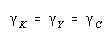 .
.
(B) Imagine first that  and that
  . Show that the steady state must have
  (and
therefore,
(and
therefore, 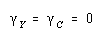 ).
[Hint: show first that
).
[Hint: show first that 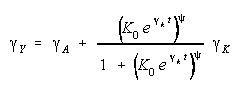 ].
].
(C) Using your results in (A) and (B), what is the only growth rate of At,
 ,
consistent with a steady state? What is, therefore, the only possible steady
state growth rate of Y?
,
consistent with a steady state? What is, therefore, the only possible steady
state growth rate of Y?
(D) Imagine now that 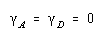 and that
  . Show that in steady state, it must be true
that
. Show that in steady state, it must be true
that  (Hint:
show first that
(Hint:
show first that 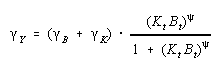 ).
).
(E) Using your results in (A) and (D), show that the only growth rate of B
consistent with a steady state is  .
.
(F) Finally, imagine that 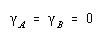 and that
  .
Show that in steady state, the growth rates must satisfy:
.
Show that in steady state, the growth rates must satisfy: 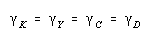 . [Hint: show first that
 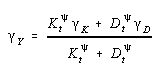 ]
]
(G) What would be the steady-state growth rate in (F) if population is not
constant but, instead, it grows at rate n>0?
(V): HARROD-DOMAR.
Consider the Solow-Swan model with constant savings rate, s. Imagine that the technology is Leontief so:

(1) Draw Indifference Curves in the K-L space.
(2) Write down y=Y/L as a function of k.
(3) Write down y/k as a function of k
(4) If the rate of population growth is zero (n=0), show that the growth rate of capital follows:

Draw the savings line as a function of k. Draw the depreciation line as a function of k.
(5) Suppose . What is the steady state
capital stock, k*? What are the dynamics of k over time? Do you see any
problems with this steady state? (Hint: to see what the potential problem is,
try to display the steady state (K/L)* in the indifference map you drew in (1))
. What is the steady state
capital stock, k*? What are the dynamics of k over time? Do you see any
problems with this steady state? (Hint: to see what the potential problem is,
try to display the steady state (K/L)* in the indifference map you drew in (1))
(6) Suppose  . What is the steady state?
What are the dynamics? Do you see any problems with this steady state?
. What is the steady state?
What are the dynamics? Do you see any problems with this steady state?
(7) Suppose . What is the steady state?
What are the dynamics? Do you see any problems with this steady state?
. What is the steady state?
What are the dynamics? Do you see any problems with this steady state?
After considering (5), (6), and (7), Harrod and Domar said that capitalist economies like the one just described deliver inherently "bad" steady states. Do you agree?
(VI) SOLOW-SWAN WITH PHYSICAL AND HUMAN CAPITAL. (Material Covered in TA session)
Consider the Solow-Swan model with Cobb-Douglas technology

 and
the accumulation constraint
and
the accumulation constraint
where
sk is the constant savings rate and  is
the constant rate of depreciation. Assume that the rate of technological
progress is zero so At is a constant and we normalize A0=1.
Suppose that the rate of population growth is constant,
is
the constant rate of depreciation. Assume that the rate of technological
progress is zero so At is a constant and we normalize A0=1.
Suppose that the rate of population growth is constant, .
.
(A) Write down the growth rate of capital per person, k=K/L, as a function of the logarithm of k, ln(k).
(B) Using (A) and using the production function, write the growth rate of output per capita, y=Y/L, as a function of the logarithm of y, ln(y).
(C)
Log-linearize this equation around the steady state, ln(y*). What is the
speed of convergence of output per capita around the steady state? (Note: the
speed of convergence is ).
).
(D)
Consider the parameters  =0.3,
A=1, s=0.20, =0.10,
and n=0.01. What is the speed of convergence predicted by the model?
=0.3,
A=1, s=0.20, =0.10,
and n=0.01. What is the speed of convergence predicted by the model?
(E) (Note: in this question you CANNOT assume that the marginal product of k is equal to the marginal product of h because the investment processes are not driven by returns but, instead, are exogenously determined by the savings rates). Consider now the production function with human capital:

where physical capital accumulates according to (2) and human capital accumulates according to:

Define capital per worker as k=K/L, human capital per worker by h=K/L. Write down output per worker, y, as a function of k, and h. Write down the growth rates of k and h as functions of k and h.
(F)
Write the growth rate of y as a function of ln(h) and ln(k).
Log-linearize the growth rate of y around the steady state value of ln(y)*.
What is the speed of convergence of output per capita now? Imagine that  =0.5.
What is the predicted speed of convergence now? How does it compare with the data?
=0.5.
What is the predicted speed of convergence now? How does it compare with the data?
(G) Describe potential econometric issues which may arise when one tries to estimate the speed of convergence with actual data. Can you describe the results that researchers tend to get when they estimate this speed? How do they relate to the results you got in (F) and (D).