Cambridge-Columbia Graduate Student Symposium
The Cambridge-Columbia Graduate Student Symposium in the History of Art brings together students from the University of Cambridge and Columbia University to present their research, share ideas with one another, and foster a transatlantic dialogue. Since 2011, the Symposium has taken place annually, with the two universities alternating as hosts. Each event centers on a theme which encompasses a range of art historical topics. The Symposium is made possible by a generous grant from Dr. John Weber.
Spring 2019
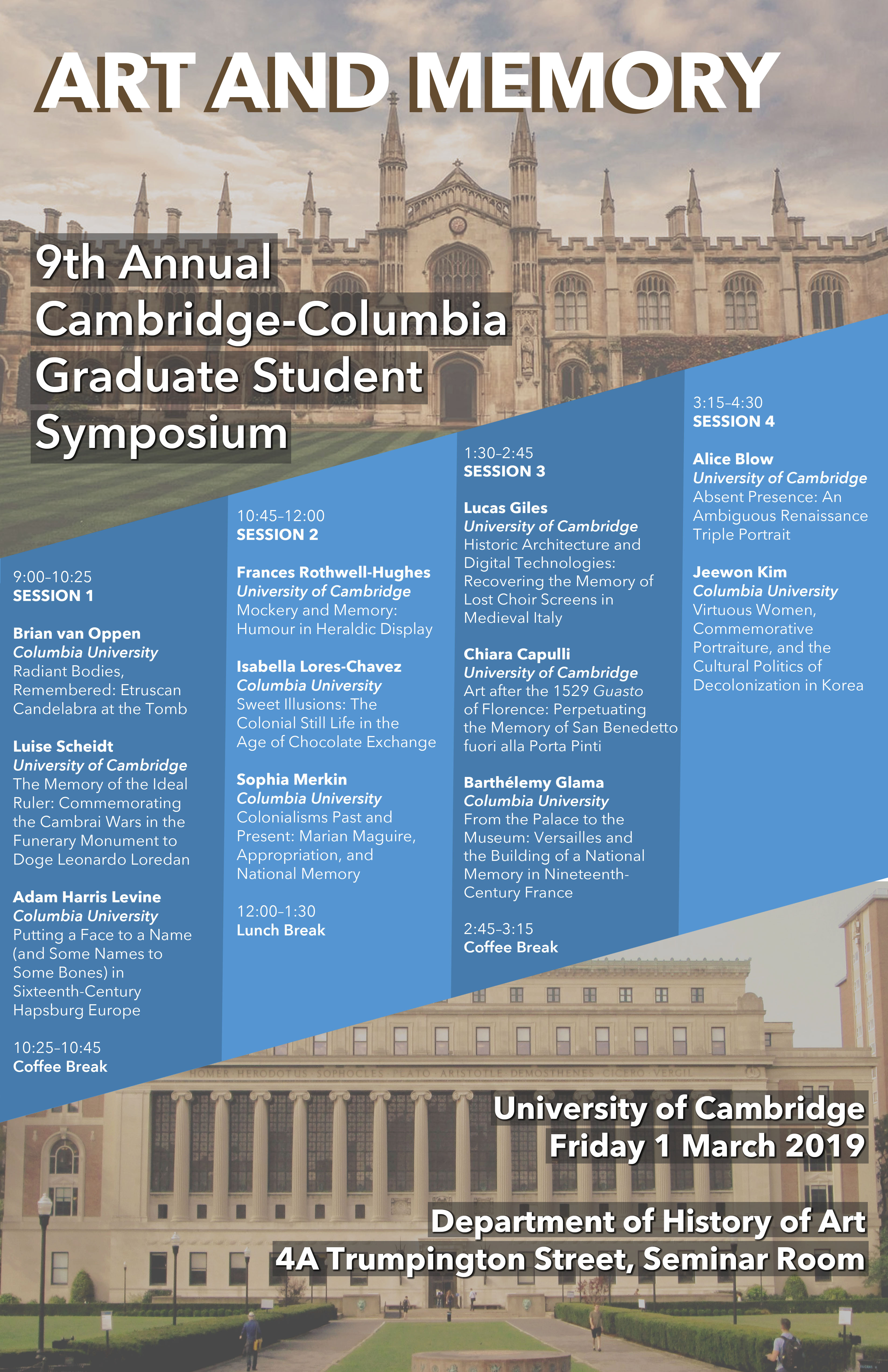
Art and Memory
University of Cambridge
March 1, 2019
Organized by William Aslet (University of Cambridge) and Katherine Fein (Columbia University)
Session 1
Brian van Oppen, Columbia University
Radiant Bodies, Remembered: Etruscan Candelabra at the Tomb
Luise Scheidt, University of Cambridge
The Memory of the Ideal Ruler: Commemorating the Cambrai Wars in the Funerary Monument to Doge Leonardo Loredan
Adam Harris Levine, Columbia University
Putting a Face to a Name (and Some Names to Some Bones) in Sixteenth-Century Habsburg Europe
Session 2
Frances Rothwell-Hughes, University of Cambridge
Mockery and Memory: Humour in Heraldic Display
Isabella Lores-Chavez, Columbia University
Sweet Illusions: The Colonial Still Life in the Age of Chocolate Exchange
Sophia Merkin, Columbia University
Colonialisms Past and Present: Marian Maguire, Appropriation, and National Memory
Session 3
Lucas Giles, University of Cambridge
Historic Architecture and Digital Technologies: Recovering the Memory of Lost Choir Screens in Medieval Italy
Chiara Capulli, University of Cambridge
Perpetuating the Memory of San Benedetto fuori alla Porta Pinti after the 1529 Guasto of Florence
Barthélemy Glama, Columbia University
From the Palace to the Museum: Versailles and the Building of a National Memory in Nineteenth-Century France
Session 4
Alice Blow, University of Cambridge
Absent Presence: An Ambiguous Renaissance Triple Portrait
Jeewon Kim, Columbia University
Virtuous Women, Commemorative Portraiture, and the Cultural Politics of Decolonization in Korea
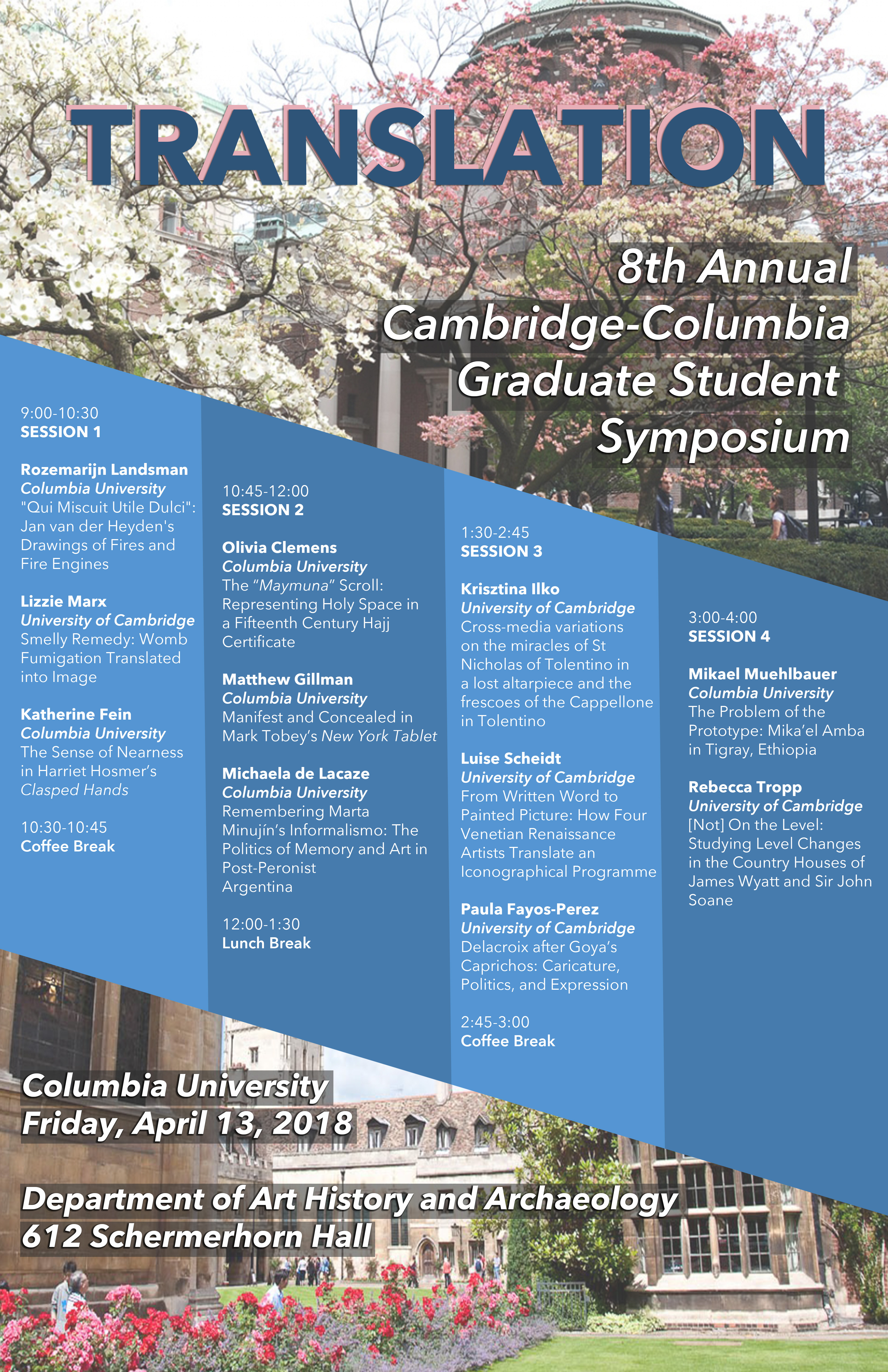
Translation
Columbia University
April 13, 2018
Organized by Kathryn Kremnitzer (Columbia University) and Rebecca Tropp (University of Cambridge)
Session 1
Rozemarijn Landsman, Columbia University
“Qui Miscuit Utile Dulci”: Jan van der Heyden’s Drawings of Fires and Fire Engines
Lizzie Marx, University of Cambridge
Smelly Remedy: Womb Fumigation Translated into Image
Katherine Fein, Columbia University
The Sense of Nearness in Harriet Hosmer’s Clasped Hands
Session 2
Olivia Clemens, Columbia University
The “Maymuna” Scroll: Representing Holy Space in a Fifteenth-Century Hajj Certificate
Matthew Gillman, Columbia University
Manifest and Concealed in Mark Tobey’s New York Tablet
Michaela de Lacaze, Columbia University
Remembering Marta Minujín’s Informalismo: The Politics of Memory and Art in Post-Peronist Argentina
Session 3
Krisztina Ilko, University of Cambridge
Cross-media variations on the miracles of St Nicholas of Tolentino in a last altarpiece and the frescoes of the Cappellone in Tolentino
Luise Scheidt, University of Cambridge
From Written Word to Painted Picture: How Four Venetian Renaissance Artists Translate an Iconographical Programme
Paula Fayos-Perez, University of Cambridge
Delacroix after Goya’s Caprichos: Caricature, Politics, and Expression
Session 4
Mikael Muehlbauer, Columbia University
The Problem of Prototype: Mika’el Amba in Tigray, Ethiopia
Rebecca Tropp, University of Cambridge
[Not] On the Level: Studying Level Changes in the Country Houses of James Wyatt and Sir John Soane
The Materiality of Art
University of Cambridge
March 3, 2017
Welcome
Dr. Rosalind P. Blakesley
Session 1: Material Objects
Chair: Professor Caroline van Eck
Sofia Gans, Columbia University
Models of Collaboration: Brass Casting in Fifteenth-Century Nuremberg
Matthew Gillman, Columbia University
A Tale of Two Ivories: Elephant and Walrus
Tom Young, University of Cambridge
The Delights of Association: Art as Networking in the East India Company's “Familial Proto-State,” 1797–1824
Session 2: Material Surfaces
Chair: Dr. Alexander Marr
Amy Jeffs, University of Cambridge
From Space to Surface: the art historical ramifications of piercing the image to punish traitors in medieval books of secular legend
Siddhartha Shah, Columbia University
Plumage, Paradise, and Power: The Peacock Dress of Lady Mary Curzon
Kamila Kociałkowska, University of Cambridge
Gustav Klucis and the Materiality of Censorship
Session 3: Material Affects
Chair: Dr. Donal Cooper
Lizzie Marx, University of Cambridge
The Materiality of Smelling Salts in Rembrandt's Art
Lorraine de la Verpillière, University of Cambridge
“The Ink of Melancholy”: A New Interpretation of Jean Duvet's Plate of the Despair and Suicide of Judas (c. 1550/60)
Session 4: Material Effects
Chair: Dr. Alyce Mahon
Clare Kobasa, Columbia University
Between Material, Word, and Image: Absent Objects in Print
Kathryn Kremnitzer, Columbia University
Manet's Watercolors: Transition and Translation in the 1860s
Roxanne Smith, Columbia University
Art and Parody in the “Plastic Tableaux” Films of Georges Méliès
Concluding Remarks
Dr. Frank Salmon
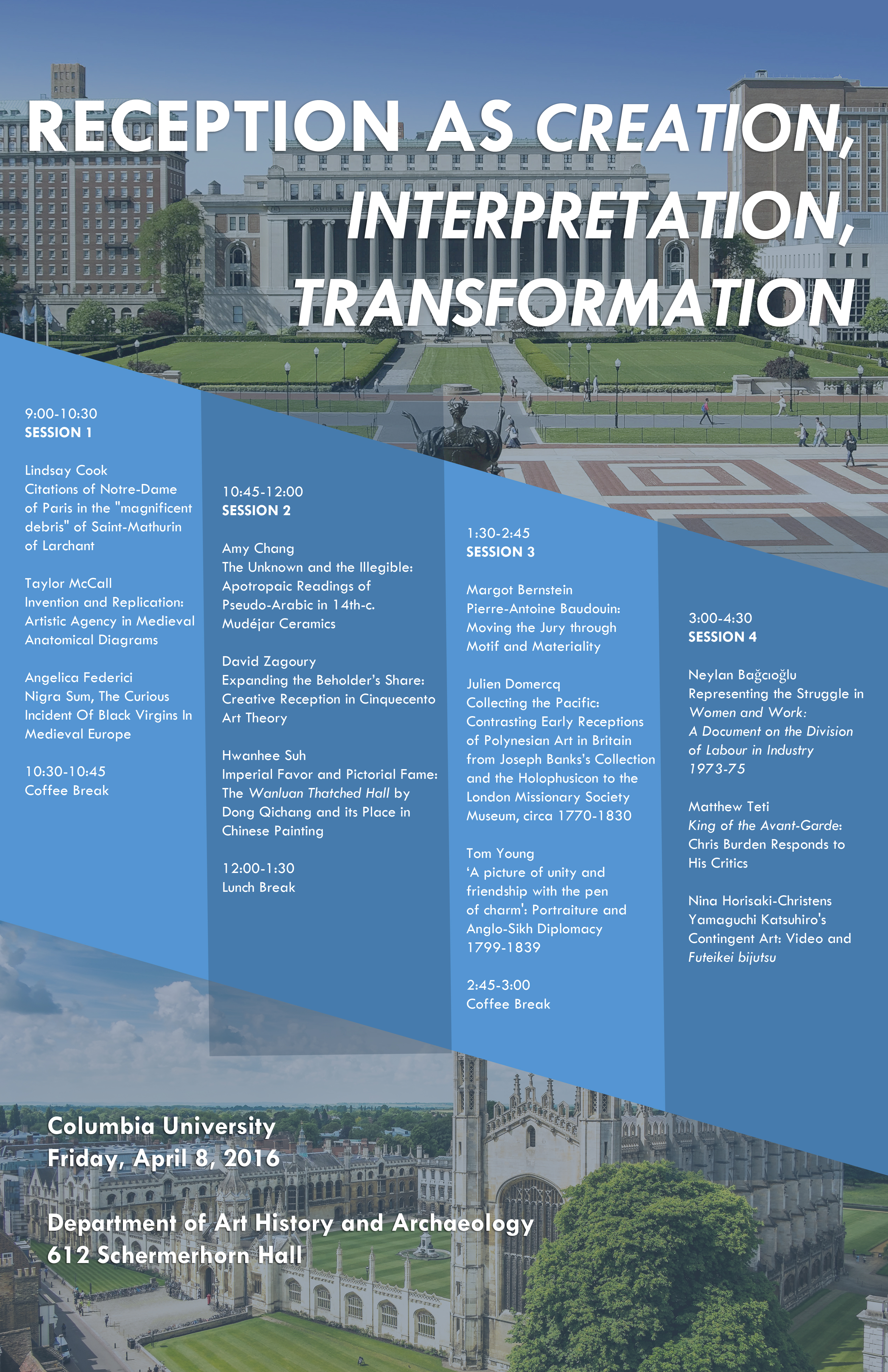
Reception as Creation, Interpretation, Transformation
Columbia University
April 8, 2016
Session 1
Lindsay Cook, Columbia University
Citations of Notre-Dame of Paris in the “magnificent debris” of Saint-Mathurin of Larchant
Taylor McCall, University of Cambridge
Invention and Replication: Artistic Agency in Medieval Anatomical Diagrams
Angelica Federici, University of Cambridge
Nigra Sum, The Curious Incident of Black Virgins in Medieval Europe
Session 2
Amy Chang, Columbia University
The Unknown and the Illegible: Apotropaic Readings of Pseudo-Arabic in Fourteenth-Century Mudéjar Ceramics
David Zagoury, University of Cambridge
Expanding the Beholder's Share: Creative Reception in Cinquecento Art Theory
Hwanhee Suh, Columbia University
Imperial Favor and Pictorial Fame: The Wanluan Thatched Hall by Dong Qichang and its Place in Chinese Painting
Session 3
Margot Bernstein, Columbia University
Pierre-Antoine Baudouin: Moving the Jury through Motif and Materiality
Julien Domercq, University of Cambridge
Collecting the Pacific: Contrasting Early Receptions of Polynesian Art in Britain from Joseph Banks' Collection and the Holophusicon to the London Missionary Society Museum, circa 1770–1830
Tom Young, University of Cambridge
“A picture of unity and friendship with the pen of charm”: Portraiture and Anglo-Sikh Diplomacy, 1799–1839
Session 4
Neylan Bağcıoğlu, University of Cambridge
Representing the Struggle in Women and Work: A Document on the Division of Labour in Industry, 1973–75
Matthew Teti, Columbia University
King of the Avant-Garde: Chris Burden Responds to His Critics
Nina Horisaki-Christens, Columbia University
Yamaguchi Katsuhiro's Contingent Art: Video and Futeikei bijutsu
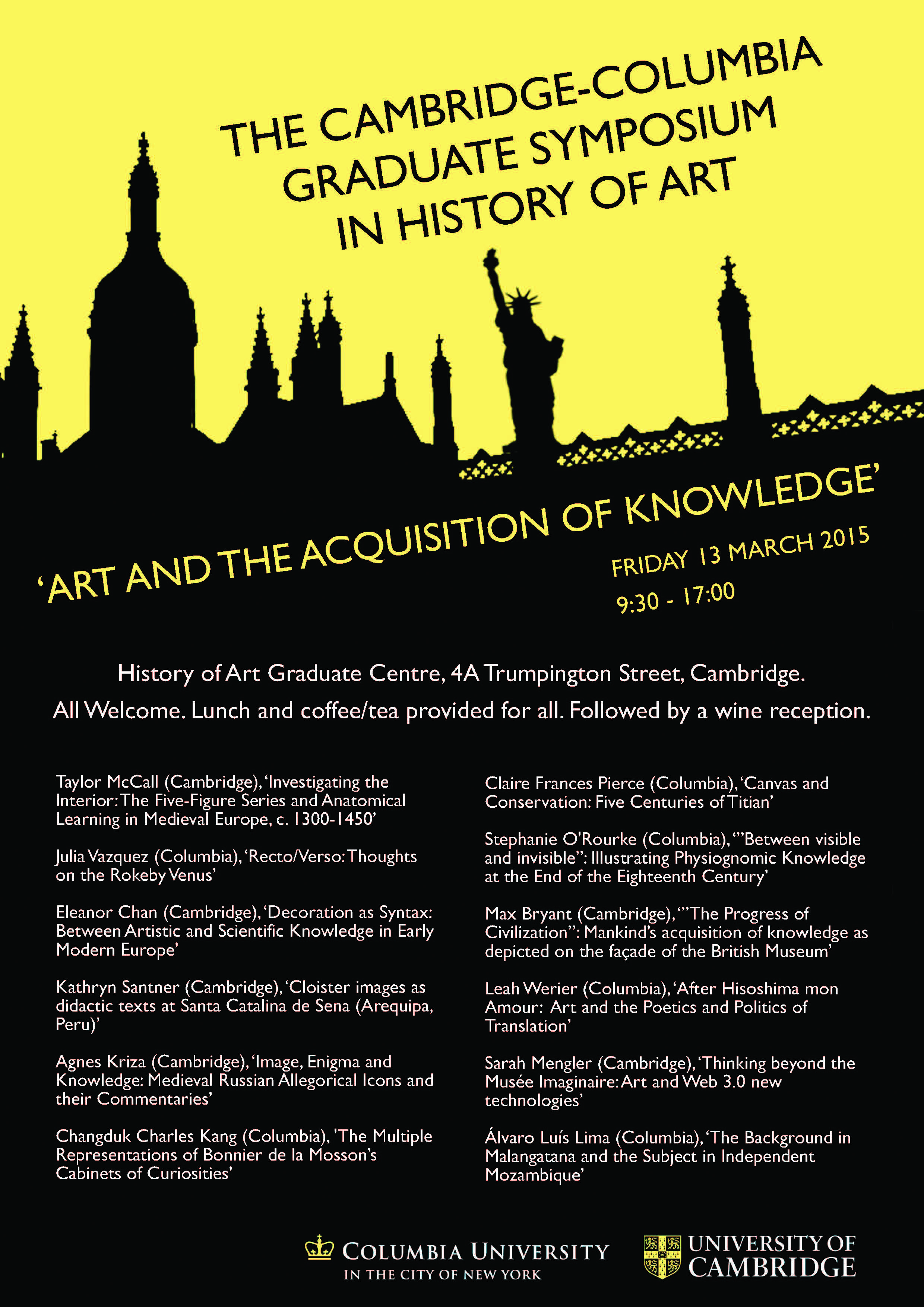
Art and the Acquisition of Knowledge
University of Cambridge
March 13, 2015
Welcome
Professor Paul Binski
Session 1
Chair: Professor Paul Binski
Taylor McCall, University of Cambridge
Investigating the Interior: The Five-Figure Series and Anatomical Learning in Medieval Europe, c. 1300–1450
Julia Vazquez, Columbia University
Recto/Verso: Thoughts on the Rokeby Venus”
Eleanor Chan, University of Cambridge
Decoration as Syntax: Between Artistic and Scientific Knowledge in Early Modern Europe
Session 2
Chair: Dr. Alexander Marr
Kathryn Santner, University of Cambridge
Cloister Images as Didactic Texts at Santa Catalina de Sena (Arequipa, Peru)
Agnes Kriza, University of Cambridge
Medieval Russian Allegorical Icons and Their Commentaries
Claire Frances Pierce, Columbia University
Canvas and Conservation: Five Centuries of Titian
Session 3
Chair: Dr. Frank Salmon
Changduk Charles Kang, Columbia University
Enlightenment Toys for the Orléans Children
Stephanie O’Rourke, Columbia University
“Between Visible and Invisible”: Illustrating Physiognomic Knowledge at the End of the Eighteenth Century
Max Bryant, University of Cambridge
“The Progress of Civilization”: Mankind’s Acquisition of Knowledge as Depicted on the Façade of the British Museum
Session 4
Chair: Katie Reinhart
Leah Werier, Columbia University
After Hiroshima Mon Amour: Art and the Poetics and Politics of Translation
Sarah Mengler, University of Cambridge
Thinking Beyond the Musée Imaginaire: Art and Web 3.0 New Technologies
Álvaro Luís Lima, Columbia University
The Background in Malangatana and the Subject in Independent Mozambique
Closing Remarks
Professor Paul Binski
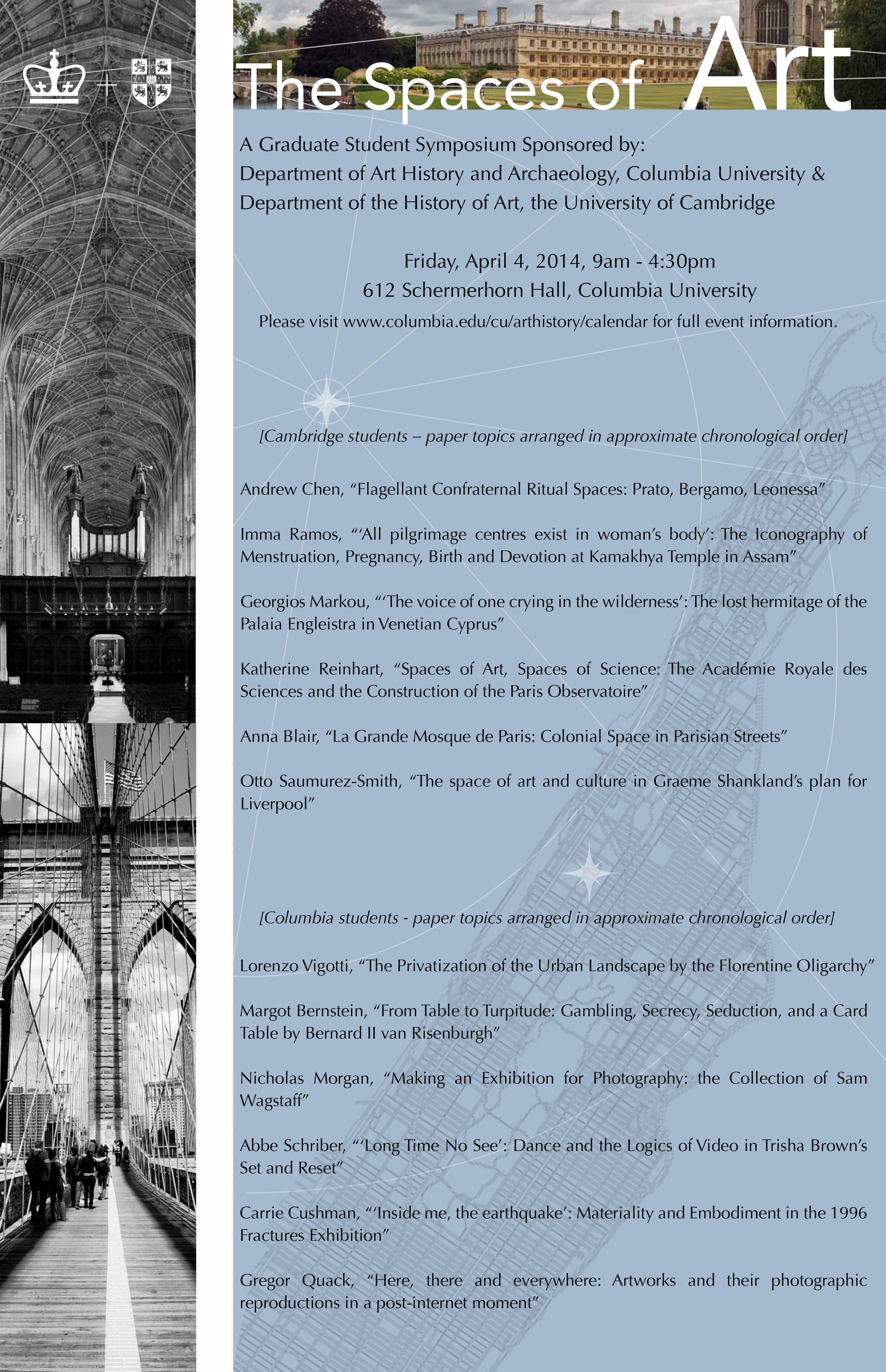
The Spaces of Art
Columbia University
April 4, 2014
Session 1
Imma Ramos, University of Cambridge
“All Pilgramige Centres Exist in Woman’s Body”: The Iconography of Menstruation, Pregnancy, Birth, and Devotion at Kamakhya Temple in Assam
Georgios Markou, University of Cambridge
“The Voice of One Crying in the Wildnerness”: The Lose Grotto of the Palaia Enkleistra in Venetian Cyprus
Andrew Chen, University of Cambridge
Flagellant Confraternal Ritual Spaces: Prato, Bergamo, Leonessa
Session 2
Lorenzo Vigotti, Columbia University
The Privatization of the Urban Landscape by the Florentine Oligarchy
Katherine Reinhart, University of Cambridge
Spaces of Art, Spaces of Science: The Académie Royale des Sciences and the Construction of the Paris Observatoire
Margot Bernstein, Columbia University
From Table to Turpitude: Gambling, Seduction, and a Card Table by Bernard II van Risenburgh
Session 3
Anna Blair, University of Cambridge
La Grande Mosquée de Paris: Colonial Space in Parisian Streets
Otto Saumurez-Smith, University of Cambridge
The Space of Art and Culture in Graeme Shankland’s Plan for Liverpool
Nicholas Morgan, Columbia University
Making an Exhibition for Photography: The Collection of Sam Wagstaff
Session 4
Abbe Schriber, Columbia University
“Long Time No See”: Dance and the Logics of Video in Trisha Brown’s Set and Reset
Carrie Cushman, Columbia University
“Inside Me, the Earthquake”: Materiality and Embodiment in the 1996 Fractures Exhibition
Gregor Quack, Columbia University
Here, There, and Everywhere: Artworks and Their Photographic Reproductions in a Post-Internet Moment
The Persistence of Tradition in Art and Art History
University of Cambridge
March 8, 2013
Session 1
Laura Slater, University of Cambridge
Maintaining or Reinventing Tradition? The Beresford Shroud Tomb
Rachel Boyd, Columbia University
From Futurism to the Trecento: Carlo Carrà and Giotto
Daniel Zamani, University of Cambridge
Resurrecting Camelot: Andre Breton's Chivalric Medievalism
Session 2
Sonia Coman, Columbia University
Painting as Bridge Between Literary Traditions: Tosa Mitsunobu and the Bamboo of the Four Seasons
Anna Blair, University of Cambridge
French Modernity and Cambodian Tradition: The Politics of Interwar Travel
Alexandra Helprin, Columbia University
Painting and the Lubok Tradition: Argunov's Portrait of Praskovia Sheremeteva
Session 3
Catherine Damman, Columbia University
A Postscript to Transgression: Carolee Scheemann and the “Primitive” 1960s
Nicholas Fitch, Columbia University
Allegories of the Plague in the Work of Clorindo Testa, 1975–1978
Session 4
Max Bryant, University of Cambridge
The Neoclassical Pediment: Re-contextualising the Antique in Late Eighteenth- and Early Nineteenth-Century Europe and America
Brigid von Preussen, Columbia University
The ancien régime in the New World: Henry Clay Frick's Fragonard Room and French Style in Gilded Age America
Bridget Hembree, University of Cambridge
Eschewing Tradition: Aesthetic Politics at Belmead Plantation
Richard Butler, University of Cambridge
Architecture and the “Triumph” of Catholic Ireland: A Case Study of Church Building in Rural Cork, 1953–55
Modernism and Cross-Cultural Exchange
Columbia University
March 31, 2012
Megan McCarthy, Columbia University
German Applied Arts at the Newark Museum: Transatlantic Politics and Exhibition Practice Before the Great War
Louise Hardiman, University of Cambridge
Beyond the “World of Art”: The Writings of Netta Peacock and Frank Rinder for Modernist Artistic Journals in Russia, c. 1900
Chloe Kroeter, University of Cambridge
Did the German War Machine Power British Politics? Images of the Foreign Threat on Covers of the New Age, 1910
Nicola Kozicharow, University of Cambridge
“Byzantine Pure and Simple”: The British Reception of Dmitrii Stelletskii at the Second Post-Impressionist Exhibition of 1912
Lauren Weinberg, University of Cambridge
Man Ray, the “Great Hunter”? Capturing the Women of the Avant-Garde
Maggie Mustard, Columbia University
Suspension and Possibility: Yamawaki Iwao and the Trajectory of Bauhaus Photography
Alastair Meredith, University of Cambridge
Jan Juta in the 1920s: Paris, Eze, and New York
Esther Polonyi, Columbia University
Invisible Man: Microcinematography in Early Twentieth-Century Europe
Josephine Baark, University of Cambridge
Saga: Danish-Inuit Modernism and Ethnographic Collecting at the Sugartop Mountain
Michaela de Lacaze, Columbia University
Turn Off the TV and Drop Some Acid: Psychedelic Participation, Politics, and Mass Media in Marta Minujín’s Art of the Sixties
Michael Sanchez, Columbia University
Andre Cadere in Circulation
Sonia Coman, Columbia University
Wataru Matsumara: Microcosms in Ink
Architectural History
University of Cambridge
March 2011