
Edward F. Leonard
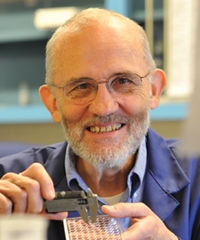
812 Mudd, Mail Code: 4721
Phone: +1 212-854-4448
Fax: +1 212-854-3054
Email:
Education:
BS, Chem Eng, Mass. Inst. Tech., 1953
MS, Chem Eng, Univ. of Pennsylvania, 1955
PhD, Chem Eng, Univ. of Pennsylvania, 1960
Research interests:
Professor Leonard's principal area of interest is transport and rate processes in biological systems. He is director of the Artificial Organs Research Laboratory, a component of the Department of Chemical Engineering since 1968. Its mission has grown with the evolution of modern biology and with the increasing sophistication available for the construction of medical devices. Thus, current projects have a wide range: Innovations to traditional artificial organs effecting transport (kidney, liver, lung, cardiovascular implants) with special emphasis on the artificial kidney, to regenerative medicine, especially the development and study of methods for introducing stem cells into adult tissue.
Professor Leonard directs the NSF-sponsored course cluster in Genomic Engineering, and is a member of the Columbia Genome Center. He and his students are engaged in building models of intracellular activity that incorporate both signal transduction and gene networks. Two systems are currently under study: single-molecule excitation of olfactory neurons, and the proposed prion model of plasticity in the interneurons of Aplysia californica. Further details and links are available on the Leonard homepage (link above). Prof. Leonard is teaching or has recently taught undergraduate chemical engineering courses in transport phenomena, three graduate courses in chemical engineering - mathematics for chemical engineers, "Artificial Organs" and "The Genome and the Cell"- and a biomedical engineering course entitled "Transport and Rate Phenomena in Artificial Organs".
Selected Publications:
Leonard EF, Cortell S, Vitale NG., Membraneless dialysis--is it possible? Contrib Nephrol. 2005; 149:343-53.
Zhu F, Leonard EF, Levin NW. Body composition modeling in the calf using
an equivalent circuit model of multi-frequency bioimpedance analysis.
Physiol Meas. 2005 Apr; 26(2):S133-43. Epub 2005 Mar 29.
Zhu F, Kuhlmann MK, Sarkar S, Kaitwatcharachai C, Khilnani R, Leonard
EF, Greenwood R, Levin NW. Adjustment of dry weight in hemodialysis
patients using intradialytic continuous multifrequency bioimpedance of
the calf. Int J Artif Organs. 2004 Feb; 27(2):104-9.
Leonard EF, West AC, Shapley NC, Larsen MU. Dialysis without membranes: how and why? Blood Purif. 2004; 22(1):92-100.
Quick CM, Leonard EF, Young WL., Adaptation of cerebral circulation to
brain arteriovenous malformations increases feeding artery pressure and
decreases regional hypotension. Neurosurgery. 2002 Jan; 50(1):167-73
(discussion 173-5).
Kim S, Patrick SM, Braunstein NS, Thomas JL, Leonard EF. Modeling of
early events in T cell signal transduction after controlled T cell
activation by peptide major histocompatibility complex. Ann Biomed Eng.
2001 May; 29(5):373-83.
Kim S, Braunstein NS, Leonard EF, Thomas JL. Controlling duration of
contact between T cells and antigen-presenting cells. J Immunol Methods.
2001 Mar 1; 249(1-2):73-84.
Patrick SM, Kim S, Braunstein NS, Maldarelli CM, Thomas JL, Leonard EF.
Controlled cell deformation produces defined areas of contact between
cells and ligand-coated surfaces. Ann Biomed Eng. 2001 Jan; 29(1):1-8.