Concentrations
Overview
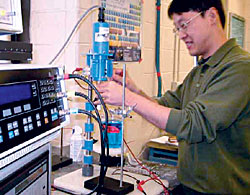 After satisfying the core requirement of Chemical process analysis (CHEN E4010), Transport phenomena, III (CHEN E4110x), and Statistical mechanics (CHAP E4120), chemical engineering graduate students are free to choose their remaining required courses as they desire, subject to their research adviser's approval. A Course Listing in Chemical Engineering is available.
Areas of Concentration
A number of areas of graduate concentration are suggested below, with associated recommended courses. Each concentration provides students with the opportunity to gain in-depth knowledge about a particular research field of central importance to the department.
Graduate students outside the department are very welcome to participate in these course concentrations, many of which are highly interdisciplinary. The department strongly encourages interdepartmental dialogue at all levels.
Science and Engineering of Polymers and Soft Materials
Soft materials include diverse organic media with supramolecular structure having scales in the range 1-100 nm. Their small-scale structure imparts unique, useful macroscopic properties. Examples include polymers, liquid crystals, colloids, and emulsions. Their "softness" refers to the fact that they typically flow or distort easily in response to moderate shear and other external forces. They exhibit a great many unique and useful macroscopic properties stemming from the variety of fascinating microscopic structures, from the simple orientational order of a nematic liquid crystal to the full periodic "crystalline" order of block copolymer mesophases. Soft materials provide ideal testing grounds for such fundamental concepts as the interplay between order and dynamics or topological defects. They are of primary importance to the paint, food, petroleum, and other industries as well as a variety of advanced materials and devices.
In addition, most biological materials are soft, so that understanding of soft materials is very relevant to improving our understanding of cellular function and therefore human pathologies. At Columbia Chemical Engineering, we focus on several unique aspects of soft matter, such as their special surface and interfacial properties. This concentration is similar in thrust to that of the "Biophysics and Soft Matter" concentration, except here there is greater emphasis on synthetic rather than biological soft matter, with particular emphasis on interfacial properties and materials with important related applications. Synthetic polymers are by far the most important material in this class.
Introduction to polymers (CHEN E4620)
Polymer surfaces and interfaces (CHEN E4640)
Physical chemistry of macromolecules (CHEN E6620y)
Polymers: synthesis of macromolecules (CHEN E6610)
Theoretical methods in polymer physics (CHEN E6910)
Introduction to surface and colloid chemistry (CHEN E4252)
Special topics in soft condensed matter (CHEN E6630)
Dynamics of complex media (CHEN E6100)
Physics of soft matter (CHEN E6920)
Biophysics and Soft Matter Physics
Soft matter denotes polymers, gels, self-assembled surfactant structures, colloidal suspensions, and many other complex fluids. These are strongly fluctuating, floppy, fluidlike materials that can nonetheless exhibit diverse phases with remarkable long-range order. In the last few decades, statistical physics has achieved a sound understanding of the scaling and universality characterizing large length scale properties of much synthetic soft condensed matter. More recently, ideas and techniques from soft condensed matter physics have been applied to biological soft matter such as DNA, RNA, proteins, cell membrane surfactant assemblies, actin and tubulin structures, and many others. The aim is to shed light on (1) fundamental cellular processes such as gene expression or the function of cellular motors and (2) physical mechanisms central to the exploding field of biotechnology involving systems such as DNA microarrays and methods such as genetic engineering. The practitioners in this highly interdisciplinary field include physicists, chemical engineers, biologists, biochemists, and chemists.
The "Biophysics and Soft Matter" concentration is closely related to the "Science and Engineering of Polymers and Soft Materials" concentration, but here greater emphasis is placed on biological materials and cellular biophysics. Both theory and experiment are catered to. Students will be introduced to statistical mechanics and its application to soft matter research and to cellular biophysics. In parallel, the student will learn about genomics and cellular biology to develop an understanding of what the central and fascinating biological issues are.
Statistical mechanics (CHAP E4120)
Physics of soft matter (CHEN E6920)
Dynamics of complex fluids (CHEN E6100y)
Special topics in soft condensed matter (CHEN E6630)
Biochemistry/molecular biology--eukaryotes, I (BIOC G6300)
Biochemistry/molecular biology--eukaryotes, II (BIOC G6301)
The genome and the cell, to be offered by Professor Leonard (CHEN, course number to be announced 4750) Cellular molecular biophysics (G4350)
Genomic Engineering
This course concentration prepares engineers and computer scientists for research in genomic engineering, defined as development and application of novel technologies for identifying and evaluating the significance of both particular and all nucleotide sequences in the genomes of organisms. Engineers and computer scientists aiming to do research in genomic engineering will gain an understanding of the major issues in contemporary genomics.
The motivating concept of the genomic engineering program is that engineers and computer scientists in this field need an understanding of the fundamental goals and problems of genomic science and gene-related intracellular processes, as well as physical, chemical, and instrumental principles available to extract sequence information from the genome, and the concepts used to organize, manipulate, and interrogate the genomic database. Understanding the principles of the sequence data acquisition and analysis is useful even though most students will subsequently choose to focus on either the physical and chemical processes of acquisition or the analytical processes of genomic science. The course Principles of genomic technology (CHEN E4700) provides students with a solid basis for understanding the principles and applications of genomic technologies.
Genomics sequencing laboratory (CHEN E4730) provides hands-on experience of high-throughput DNA sequencing as conducted in a bioscience research laboratory. The genome and the cell (CHEN, course number to be announcedE4750) conveys a broad but precise, organized, and quantitative overview of the cell and its genome: how the genome in partnership with extragenomic stimuli influences the behavior of the cell and how mechanisms within the cell enable genomic regulation. Computational genomics (COMS W4761) introduces students to basic and advanced computational techniques for analyzing genomic data, while Introduction of genomic information science and technology (ELEN E4060) provides the essential concepts of the information system paradigm of molecular biology and genetics.
Principles of genomic technology (CHEN E4700)
Genomic sequencing laboratory (CHEN E4730) 4760
The genome and the cell, to be offered by Professor Leonard (CHEN E4750), course number to be announced)
Computational genomics (COMS W4761)
Introduction to genomic information science and technology (ELEN E4060)
Interfacial Engineering and Electrochemistry
Electrochemical processes are key to many alternative energy systems (batteries and fuel cells), to electrical and magnetic-device manufacturing (interconnects and magnetic-storage media), and to advanced materials processing. Electrochemical processes are also involved in corrosion and in some waste-treatment systems. Key employers of engineers and scientists with knowledge of electrochemical/interfacial engineering include companies from the computer, automotive, and chemical industries. Knowledge of basic electrochemical principles, environmental sciences, and/or materials science can be useful to a career in this area. The following courses are recommended:
Elements of materials science (MSAE 3103)
Introduction to surface and colloid science (CHEN E4252)
Engineering applications of electrochemistry (CHEN E4201)
Industrial applications of electrochemistry (CHEN 4050)
Laboratory in materials science (MSAE 3104)
Undergraduate research project (CHEN 3900)
Bioinductive and Biomimetic Materials
This is a rapidly emerging area of research, and the department's course concentration is under development. At present, students interested in this area are recommended to attend Polymer surfaces and interfaces (CHEN E4640); Physical chemistry of macromolecules (CHEN E6620); Polymers: synthesis of macromolecules (CHEN E6610). Other courses in the "Science and Engineering of Polymers and Soft Materials" concentration are also relevant. When complete, the concentration will include courses directly addressing biomaterials and immunological response.