Our Research
Our research interests cover broad areas of organometallic chemistry and bioinorganic chemistry. The central theme is catalysis. Although we approach problems in a mechanistic way, and use a variety of physical methods, we also synthesize new compounds, ranging from models for metalloenzymes through organometallics to small organic compounds.
Much of our work lies at the interface between inorganic and organic chemistry. We have reported the asymmetric synthesis of amino acid amides and esters from zirconaaziridines. Our results with chiral carbonates (in some cases "dynamic asymmetric transformations") depend upon the rate at which the chiral center in the zirconaaziridine ring changes stereochemistry, so we are measuring the rate (and thus investigating the mechanism) of these inversions. We plan to extend our studies to related electrophiles (thiocarbonates, carbodiimides, epoxides), and hope to devise a general method for preparing and controlling the stereochemistry of 1,3-N,O and -N,N disubsubstituted carbon chains.
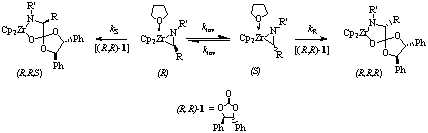
Currently we are:
1) measuring the rate at which Fe(II) is taken up by the apoprotein of ribonucleotide reductase at the beginning of the activation process. We are doing so by letting it compete with complexation reactions whose rate can be independently observed.
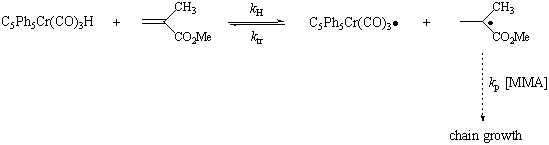
2) using metalloradicals and catalysts for chain transfer in radical polymerization reactions, and comparing the rate at which metalloradicals abstract H (which leads to chain transfer) with the rate at which they form weak metal-carbon bonds (which leads to reversible end-capping and "living" polymerization reactions).
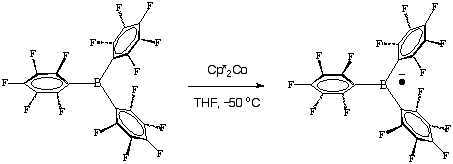
3) investigating the behavior of triaryl boranes toward one-electron reductants, in an effort to understand why fluorinating them makes them harder to reduce to anion radicals;
4) exploring how cation radicals can be formed from planar d0 organometallics;
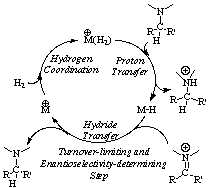
5) examining the stereochemistry of hydride transfer from chiral hydride complexes to various substrates, in the hope of making "ionic hydrogenation" reactions enantioselective. Such reactions, in which H+ and H- are transferred to the substrate more rapidly than they react with each other, may be done catalytically from H2, and should be selective for C=N and C=O double bonds.
6) learning what controls the protonation rates of various hydride and oxo ligands.
7) measuring the rate of allyl transfer between Zr and Al, in order to catalyze more efficiently chain growth in AlR3/C2H4.
