| |
Title |
| |
|
Chain-Structured Strain and Fracture Sensor for Bridge Structural Health Monitoring
|
| |
| |
Participants |
| |
|
- Huiming Yin
- Sung-Hwan Jang (Ph.D. student)
- Xin He (M.S. student)
- Mostafa E. Mobasher (Ph.D. student)
|
| |
Project Quad |
| |
|
|
| |
|
|
| |
| |
Summary/Objectives |
| |
|
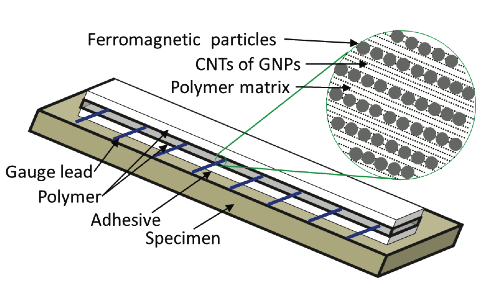
The primary objective of this project is to understand a motion of ferromagnetic particles (FMPs) in silicone prepolymer toward a design and a fabrication of a chain-structured strain and fracture sensor for outstanding sensitivity and applicability, which will be applied to bridge structural health monitoring (SHM). Existing bridge inspection and strain-based SHM are commonly expensive and time consuming due to a surface preparation and a sensor application. The proposed sensor made of FMPs and carbon nanotube(CNTs) or graphene nanoplatelets(GNPs) in polymer thin film provides a novel method for bridge inspection and SHM with the following unique features:
|
| |
|
- Ability to measure strain up to 50% makes the sensor an excellent candidate for measuring large deformation and sensing microcracks without destroying the sensor. This makes it suitable for pre- and post-cracking sensing.
- The proposed sensor can be easily glued onto various specimens and will deform together with target structures because of a compliant polymer material.
- The sensor can be also applied on a corner surface with a sharp angle or across welded joints where cracks often initiate due to stress concentrations.
- Chain-structured particles amplify an electrical conductivity in a chain direction and significantly improve a sensitivity of strain sensors.
- The sensor will not be affected by unwanted noise and can be used in extreme environments.
- A deformation of the sensor is reversible and a long service of the sensor is secured because of the hyperelastic nature of a polymeric elastomer.
|
| |
| |
Approach |
| |
|
This project mainly deal with followings:
|
| |
|
- Exploration of sensor design and sensing mechanism
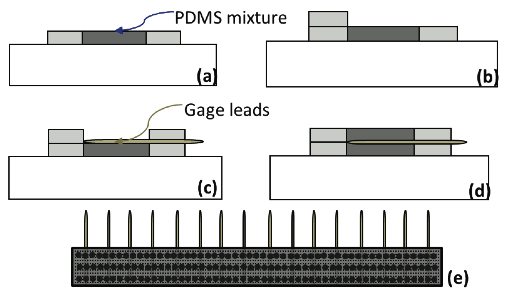
- Fabrication of chain-structured FMP/PDMS composites
- Magneto-mechanical coupling behavior of particles in a rheological fluid
- Simulation of the chain-structured formation of FMP
- Modeling and validation of multi-physical properties of the chain-structured composites
- Application for the sensor to bridge structural health monitoring
|
| |
| |
Results |
| |
|
- Fabrication of MWCNT/PDMS composite with chain-structured nickel particles was made
- An unit cell based model for an effective electrical conductivity of MWCNT/PDMS composite was established
- Two dimensional anisotropic model for an effective electrical conductivity of MWCNT/PDMS composite with chain-structured based on a representative volume element was obtained
|
| |
| |
