[ CORRECTIONS ]
"I think people aren’t nearly as cool as they pretend to be at naked parties, but whatever, I’m a pessimist."
-- Birk Oxholm, The Naked Truth
The Dark Days of Goya
Andrew Martin
Goya's Last Works
The Frick Collection
February 22 through May 14, 2006
In May of 1824, Francisco de Goya left his native Spain behind for the quieter environs of Bordeaux, France. His self-exile was politically and medically motivated. Spain had been under the reign of Ferdinand VII since 1814, when the monarchy was restored following the defeat of Napoleon. During this time, the Inquisition was renewed and Spain was returned to its pre-Napoleonic conservatism. This posed a threat to Goya as a liberal republican committed to Enlightenment ideals, which did not necessarily correspond to strict church and state doctrine. Additionally, Goya was suffering from a chronic, undiagnosed illness that he felt would be helped by the famed medicinal baths of Bordeaux. Thus, psychologically agitated, estranged from his home, and slowly going blind, Goya created a final and fascinating body of work while in France, the best of which is currently on display at The Frick Collection.
Goya's late period holds a biographical fascination for viewers similar to that of the late unfinished works of Michelangelo. Though these artists suffered from distinctly different torments, the two share an affinity for thrusting their moods and personalities into even the most traditional motifs, particularly in their later works. Michelangelo's twisting, broken pietas have a psychic kinship with the frenzied blurs of Goya's black paintings in that they appear to offer insight into the inner workings of restless great minds. While the late work of both figures loom large in the public consciousness, Goya has the distinction of having produced extraordinarily innovative work in his final, prolific years, while Michelangelo fell victim to an obsessive indecisiveness that marred his last pieces. Goya channeled his frustration and pessimism into a burst of incredible work, notable for loose and florid brush strokes, which anticipate impressionism and modernism. Viewers are drawn to Goya's work for its well-realized forms and color, but the story behind the work is as compelling for the average viewer, if not more so, than the art itself.
 It is no surprise that Goya's Last Works maintains a highly biographical approach, from the extensive and informative wall placards to the dark, elegiac lighting in the gallery space, suggestive of a wake. This morbid mood seems apt in light of the often haunted subject matter of the work at hand. The exhibition covers the years from 1824 to 1828, the final, difficult years of the artist's life. It consists of a series of oil portraits, a collection of drawings from his private albums, lithographs, and tiny paintings on ivory. From this group of roughly fifty works that are divided neatly into three small rooms, one gets the sense of a man with an extraordinarily prolific imagination working with diminished capacities but spectacular vitality. The presentation of the works is elegant and straightforward, separating the pieces for the most part by their respective media. While this organization provides a sense of coherence, it prevents the possibility of comparing Goya's approach to different media more directly.
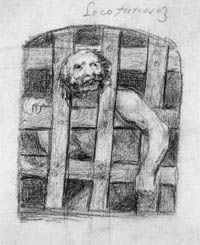
The most illuminating aspect of the show is unquestionably the drawings from Goya's private albums. These works were done in black crayon, and provide an extremely intimate look into the artist's methods of representation and the ways in which he experimented with his subject matter. The curator's essay on this wall of the exhibition describes these works as examples of Goya "talking to himself" through the artistic process; there is a sense of rumination in the drawn and redrawn lines and an internal logic in the symbols that suggests an impenetrable interior monologue. Themes of deformity, illness, and madness are repeated again and again, and figures from older works, such as the Caprichos series and the Black Paintings, are seamlessly integrated into new scenes. The drawings serve as minor and experimental explorations of the strange corners of human emotion to which Goya constantly returns. Loco Furioso (1824-1828) is a very primitive sketch of a man pushing his head through the bars of his asylum cell and screaming with a face that vividly recalls the primordial, inhuman rage in the face of Saturn devouring his children in the famous Black Painting. Meanwhile, the unsettling Holy Week in a Past Time (1824-1828) depicts an old Spanish Catholic tradition of self-flagellation with a combination of nostalgia and guilt. The tall caps and covered faces of the figures give them a ghostly and surreal quality; this is exacerbated by the dark, indistinct shadows that loom in the background, perhaps the encroaching shadows of the past. The rough execution of this work, and the rest of the Bordeaux sketches, renders the art immediate and almost voyeuristically personal. For example, in New Stagecoaches (1824-1828), a typical Goya imp carrying a man on his back is made significantly more fascinating due to the pentimento of a woman drinking from a bowl. One is forced to imagine what this underlying earlier drawing could have been, and it creates an indelible mystery within the piece. By letting his earlier sketch show, Goya draws the viewer into the artist's creative process, providing concrete proof of an abandoned work that might have been.
 While some of the subject matter displayed is overwhelmingly lurid (one drawing depicts a man stabbing a monk to death), Goya's humor is also on display in these final works, though this humor is mostly of the gallows variety. In the drawing Bad Husband (1824-1828), Goya offers pointed social criticism with dark wit, portraying a man literally riding on the back of his wife like she is a horse. In They Love Each Other Very Much (1824-1828), two demons embrace in a grotesque meeting of passion and evil. It is as though Goya has reunited his old Caprichos characters for a final farewell, bringing together the malignant forces of the underworld for reconciliation. The humor here comes from the tenderness of these demons for one another and the smirking melodrama evoked by Goya's title.
A resigned acceptance of fate, tempered with frustration, is evident in the pieces depicting old age and debilitation. These emotions are expressed most poignantly in Old Woman with Mirror, in which the bent female figure weeps upon seeing the reflection of herself as a tired and aged crone. In Beggars Who Get About On Their Own In Bordeaux (1824-1828), a crippled street figure is depicted with delicacy and tenderness as he gazes outward at the viewer indirectly. Goya himself was severely incapacitated when he drew this, and his compassion for his subject is evident in the nuance of the work, from the beggar's dark, hollow eyes to the mechanics of the elaborate contraption that the beggar has fashioned for himself. Importantly, the figure is not a pitiful one, but rather a symbol of resilience and ingenuity in the face of injury and circumstance.
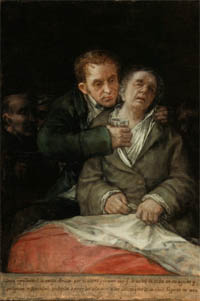
The drawn and painted portraits and other paintings that make up another significant element of the exhibition are fascinating documents of Goya's late period as well. These works are notable for their loose brush strokes and remarkably tactile quality which characterizes Goya's later paintings. Many of these works also provide insight into the psychology of the artist in his final years, a goal which is indicated explicitly in the presence of two self-portrait drawings in a room otherwise completely dedicated to paintings. The first was drawn between 1780 and 1792, prior to the artist's illness, and displays a confident, jaunty view of the artist. The second portrait was drawn between 1795 and 1797, following the significant sickness which left him partially deaf, and depicts him with an intense and angry expression on his face. Though these portraits are chronologically separate from the rest of the work in the exhibition, they serve to illustrate the exhibition's overriding thesis: Goya's work was affected thematically and aesthetically by the adverse circumstances of his later life. The painting that proves this notion most effectively is the famous Self-Portrait with Dr. Arrieta, which depicts the artist as an entirely weak and helpless creature, supported only by the strength of the vital and determined young doctor who takes care of him. In the background, one observes a gathering of haunting figures that appear to vacillate between concerned observers and the dark shades of death. The dark tone of the background becomes startlingly pitch black in the space directly around the doctor's head, indicating Goya's bleak condition and perspective at the time of the work. As indicated in the curator's notes, the structure of the piece strongly resembles the traditional pieta, giving the work a religious grandeur and strength that places Goya firmly in the lineage of great Renaissance artists.
 The only place in which the exhibition loses its way in terms of presentation is the miniature paintings on ivory, which are displayed in a glass case in the middle of the display space. The pieces are tiny, which makes it difficult to view them, and their placement together in a horizontal case seems to relegate them to unclassifiable afterthought. While the works are somewhat minor in relation to the other pieces in the exhibition, they are deserving of more attention than their arrangement seems to indicate, because they offer further insight into the working mind of the great artist. To create the images, Goya dropped water onto blackened ivory, then painted in the lightened spaces that were created. This use of improvisation indicates a mind that still yearned for new challenges, even as it was settling into decline. Despite the new technique, the images are familiar in content, drawing heavily from the artist's personal stock of motifs from earlier works. Like a musician with endless variations of a riff or series of chords, Goya places his menagerie of grotesqueries and charming females in new settings and combinations. Monk and Old Woman (1824-1825) introduces two figures from his Caprichos in all their leering glory, while Maja and Celestina (1824-1825) re-imagines his famous Maja paintings as a rumination on old age. While initially seemingly dismissible, these works are, on further consideration, a vital illumination of Goya's artistic process. Also representing Goya's later innovative works is a room upstairs and separate from the rest of the exhibition that features some of Goya's bullfighting lithographs. These are technically interesting and visually engaging, though they are, for the most part, thematically removed from the rest of the exhibition.
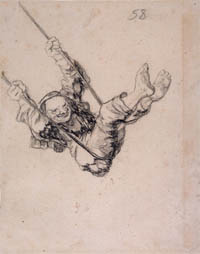
By focusing on such a small portion of the prolific artist's life, and giving a great deal of attention to his drawings, the Frick has created a show that will, at the very least, be a source of fascination and illumination of Goya's less known work, rather than a retread of well-worn knowledge and works. Goya remains an intriguing character for audiences today for his disarmingly contemporary-seeming depictions of odd aspects of the human perspective. As an exiled liberal with a strong streak of social criticism in his work, Goya also continues to stand as an engaging political artist, though his humanism and subtlety keep this from being his primary role. It appears that specific political movements were less important to him than the human consequences of their policies. This is what allowed him to simultaneously paint royal portraits and create devastating satires of the social conditions of his age—he was not bound any one ideology or doctrine. The definitive Goya image may not be The Third of May or any of his Caprichos, but rather a small drawing featured in this exhibition, a loose sketch of a small old man on a swing. He is pictured on the ascent—grotesque and ravaged by the affects of age, but also grinning sardonically at his audience as he climbs higher.