[ CORRECTIONS ]
"I think people aren’t nearly as cool as they pretend to be at naked parties, but whatever, I’m a pessimist."
-- Birk Oxholm, The Naked Truth
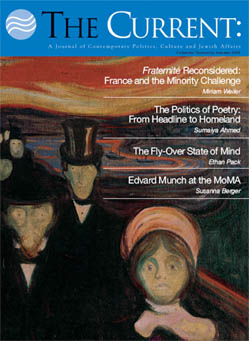
Fraternité Reconsidered
Miriam Weiler
They say Paris burned in November. Certainly not the Paris I know. For me, Paris ends with Sacre-Coeur in the north and Tour Montparnasse in the south. This is partly because I'm a touristy American, and partly because Parisians often warned me that wandering into the surrounding suburbs, les banlieues, is dangerous—especially for a Jew. In either case, I stayed well within the boundaries of the périphérique, a highway that encircles the twenty historic arrondisements of Paris. Most Parisians I met recognize the same boundary.
Take, for example, Benoit, a 23 year-old student who lives in the Marais, the fashionable old Jewish quarter known for its hip art galleries and shops. "The riots existed in articles, television reports, and everyday conversation," says Benoit. "It felt like everything was happening very far from me and my life, to such an extent that even talking to my friend who lives in the banlieues, said that he also felt very isolated from these events. I think that the riots only impacted Parisians in such a way as to feed the fear that they so often have of the banlieues and the people that live there."
Benoit's indifference is a characteristic result of France's ambivalence towards its increasingly diverse society. A recent poll published by Le Monde demonstrated that one in six Frenchmen believe there are too many immigrants in France.1 For many of the French who watched November's riots on the news, it was a spectacle as distant and arresting as it was for the rest of the world. Two jarring narratives compete in the French public space. One tells of a largely disenfranchised population, subjected to cultural inequality and institutionalized discrimination. The other is one of a hostile minority population that is unable or unwilling to conform to France's standard of assimilation. Both are far from the lofty ideals of Liberté, Egalité, and Fraternité. Both are highly disconcerting to all those who are struggling to reconcile their comfortable understanding of universal republicanism with a social reality of racial, ethnic, and religious tensions.
Aggravating the complexity of the situation and the discourse surrounding it is the generic identity attributed to the rioters: the voice of Western Europe's largest Muslim community. With the spread of fundamentalist Islam, it has become easy to conflate ethnicity with religion, and religion with its fringe factions, thereby demonizing entire communities of North African or Middle Eastern origin. The fundamentalist movement has manifested itself in the rise of anti-Semitic violence in France, culminating in the torture, abduction, and murder of Ilan Halimi in January 2006. However, foreign observers must be careful not to conflate Islamist anti-Semitism with the underclass discontent that spurred the riots.
November's riots, however, were not only about underclass discontent or the "woes of the ghetto" such as rampant unemployment, impoverished housing, and lousy schools—they also served as a wake-up call for French society to reconsider some of the basics tenets of its famous Republican Model.
The Republican Model
One of the organizing myths of the state, the Republican Model envisions a nation that is "one and indivisible," where the cohesive social bond that unites all individuals is their citizenship. The individual rights of a citizen are protected by the constitution, but the special rights of national, religious, and ethnic groups are not recognized. By limiting the expression of cultural particularities in public life, the Republican Model stratifies components of identity; social differences are expressed and related only along political lines. It is acceptable to be a left wing socialist or a right wing libertarian, but everyone is meant to feel "equally French." The danger in elevating only the rights of the individual is that minority cultural identities risk erosion. This is particularly true of religion. Last year France celebrated the centenary of the ratification of the laïcité law, which ensures what is translated variably as secularism, the separation of church and state, and even hostility towards religion.Famous for revolutions and counter-revolutions, the French have a healthy appetite for debate and protest. Even before the student-led demonstrations of 1968, which shocked the country with the sheer ferocity of the demonstrators, the traditional mode of expressing dissatisfaction was not through voting but through marching and striking. Yet despite the divisive events of French history that brought the people out on to the streets, the Republican Model unites all French elite in their notion of Frenchness. The French might vociferously debate all matters of the state, but on the Republican Model they all seem to agree.
This homogenous self-understanding is at once the product of confronting consistent waves of immigration and the veil that has allowed the French to maintain the appearance of a unified, egalitarian, and secular society. Unlike the United States, a comparable home for immigrants, the French suspect ethnic and religious groups of undermining the cohesiveness—the fraternité—of society. The French are disdainful of communitarianism, which they say defines the multiculturalism of the United States. In France, identification with a community is considered a withdrawal from French society and a rejection of the Republican ideal.
The absence of identity markers in the French public sphere is mandated by law, and the Constitution of la Cinquième Republique prohibits the inclusion of religious statistics in the national census. The government's difficulty at combating racist or religious-based discrimination, unquestionable elements in the November's riots, can never be mitigated if the deep structural problems in the Republican Model are not reevaluated. As Riva Kastoryno of the Centre National de la Recherche Scientifique points out, "France refers to the children and grandchildren of immigrants born on French national territory, citizen by birth, as immigrant because of their 'origin,' although they are statistically invisible." While the French constitution does not leave room for a multicultural society, everyday language suggests the persistence of an ethnic and/or religious identity separate from that of the majority.2
The laicité law is unsuccessful in separating church and state and even in preventing religious discrimination. Some complain of its double standard: Christmas trees are allowed in schools across the country, while other ostentatious signs of religion (a yarmulke or a veil) are not. More problematic for many religious people is the nature of the laicité law, which confines the practice of religion to the private sphere. Although this might not appear unsettling for the Roman Catholic citizen, for a religious person of a minority faith, laicité is reason enough to reject the French model. The Muslim community is unapologetic in refusing the French Model, unlike 19th-century Jews who embraced the opportunity to be "good citizens," while celebrating their religion in the private realm of home and synagogue. Dalil Boubakeur, president of France's newly sanctioned Muslim Council, seems to embody this model with his secularist view of the state, his clean-shaven look, and his quoting of Voltaire. To quote Le Monde, he is the ideal member of a minority, the "ideal Muslim."3 But make no mistake: the 19th-century acceptance of this model took no small toll on the generational observance of Jewish practice and ritual. Assimilation, not discrimination, is perceived by some to be the biggest threat to a minority religion or culture.
It is not specious then to claim that even in the absence of discrimination certain populations in France refuse to assimilate in accordance to their own set of beliefs. And who can blame them? If France refuses to recognize group rights of religious communities, why would their members wish to integrate? While historically the ghetto has been a coerced reality, nowadays one can point to the "cultural ghetto," electively constructed as a means of self-preservation. With the riots prompted by the volatile cartoons in the Danish newspaper Jyllands Posten still fresh in our minds, the culture clash between East and West has become a hot topic in public discourse. In France, however, the prevailing notion of French identity should bar such a division because the political rights granted to all citizens are meant to equalize and bond them. The November riots are a clear indication that what can be dismissed as culture clash by some and justified as the preservation of a minority identity by others is an urgent upheaval of identity politics in France. The refusal to recognize the self-definition of the communities of the banlieues, composed of North and West African immigrants both Muslim and not, just makes the supposedly religion-blind republican model even more onerous for the religious individual.
The riots of November 2005 were an invitation for France to reconsider herself as a multicultural society, in which definitions of the self do not lie exclusively along political lines but can find expression in race, ethnicity, and religion. Or at least to question whether "everyone signing on to Frenchness is an equal recipient of the country's glory," as John Vinocur of the International Herald Tribune puts it.4 France failed her citizens. The riots could have prompted re-evaluation, but in most cases they have led to the reaffirmation of laïcité and further suspicion of minority cultural and ethnic communities. By avoiding for so long the discussion of identity and multiculturalism, the French elite only perpetuated the problem.
New Forms of Escapism
Several generations of government have had to deal with a growing immigrant population, and if left and right political camps agree on one thing, it is the applicability and necessity of the Republican model. Left-leaning newspapers, such as Le Monde or Libération, blame the center-right government for mishandling the riots and indeed for exacerbating the situation with incendiary language. But the left has retreated to its class-struggle paradigm. Much attention is paid to the rampant unemployment of North and West African immigrants (and to their French born children) who arrived in France during the past three decades to fill low-wage blue collar jobs. Viewed by some as a conciliatory gesture towards the population of former French colonies, citizenship was offered to these immigrants along with the promise of social mobility. The riots, according to the intellectuals who live in the safe haven of the Left Bank, are reactive, predicated by disappointment, material disadvantage and social immobility. Still clinging to the nuanced schemes for the redistribution of wealth similar to those implemented by the Socialist-led government in the nineties, the left fails to see the larger picture.Those initiatives and ones led by the center-right have been largely ineffective, as described by Henri Astier of the BBC in a list of failed urban renewal policies: The 1981 "Policy for the City" was followed by the founding of pretentiously titled committees like the 1989 "High Council for Integration," the 1990 "Ministry for the City," and finally by a pragmatic-sounding plan in 1996 for tax-free zones in the suburbs. Hotel de Ville, the lavish city hall, cannot boast success in any of these endeavors.5 Even the "Plan for Social Cohesion" of 2004 neglects race, ethnicity and religion. Instead, it concentrates on employment, housing, and job market integration aimed at newly arrived immigrants. French citizens of non-French origin do not receive government attention. They are left to their discontent. As Thomas J. Sugrue explains in Dissent, France could and should learn from America that color blindness does not eliminate the everyday practice of discrimination or the institutionalization of racial and ethnic difference in housing and labor markets.6 By limiting the discourse to factors of economic discrimination and class struggle, the left ignores cultural marginalization and the despair it produces among minorities.
On the right, President Chirac's immediate cry for the return of public order was followed by an abrupt mobilization of the police and implementation of curfews. Prime Minister Dominique de Villepin is notorious for his anti-immigration laws and stubbornly insisted on the redemptive potential of the Republican Model as if the forced acculturation of the so-called Foulard Law, the ban on headscarves, would encourage integration. The security policies barely led to any new social polices. A few weeks after the riots, the government announced several economic reforms, including tax breaks for businesses located in poor suburbs, more money to local schools, a costly new apprenticeship plan for teenagers, and renewed support for nongovernmental organizations involved in keeping the peace. Critics of these reforms claim that they are no different to the defunct urban renewal programs that the government has been issuing for years. Others point to the lack of funds and even to governmental duplicity in promising money to hard-hit areas by taking it away from suburbs that are barely more stable. The only voice which seems to take into consideration the multicultural aspect of the riots is that of Interior Minister Nicolas Sarkozy (himself the son of a Hungarian immigrant), who refers to North African immigrants as "Muslims."7 After abandoning his initial response of calling the rioters "scum," Sarkozy's combination of economic liberalism, a strong police force, and the involvement of both secular and religious community leaders aided the government in maintaining calm. Even with this newfound appreciation for the role of religion, Sarkozy faces an uphill fight to sway a nation spellbound by the Republican ideal.
Looking to the future, France has a series of unpalatable choices and no easy solutions. The French may choose to stick their heads in the sand by relying too heavily on economic incentives to fix a deep cultural problem. Already, economic solutions prove to be a double edged sword: the law that was supposed to help invigorate inert hiring practices, an especially important measure for the banlieues where youth unemployment is at 40%8 has met frantic dissent because it gives employers more flexibility in their hiring and firing practices. France was recently crippled by demonstrations and strikes that have shut down universities, transportation and social services across the country for weeks. The heart of these demonstrations is the Latin Quarter, home to the Sorbonne and the cultural elite, but the rejection of this law by the students ultimately affects their far flung neighbors in the banlieues.
This brings us to the reality that most of November's rioters are staying at home. The youth of the suburbs are too disillusioned to march.9 They know that the reality of the workplace predicates discrimination whether or not the adjusted CPE passes. The students reject a free-market economy and globalization and still believe that their government owes them job security and pensions. The minorities from suburbs demand recognition and legitimization before they can get nostalgic for a welfare state they never really had.
Even if France were not torn by demonstrations, a further danger in hearing only the elite dispute their various myopic plans is that it opens the field to the likes of Jean-Marie Le Pen, the far right candidate who is much more sensitive to what popular, provinciale France generally feels: the Muslim communities are not really French. This popular sentiment is transmitted to the marginalized communities themselves, who in turn retreat into feelings of alienation.
The reality of a large Arab Muslim minority is not going away. One apparent choice would be to begin the process of recalibrating France's self-understanding away from the Republican Model towards a multicultural society. There are those who oppose such a recalibration because to them France would no longer be France. Multiculturalism would come at too high a cost to an ideal which has survived more than two centuries. It is a solution only if each multicultural element embraces the Western ideal of tolerance, which an alienated community could very well reject. Dalil Boubakeur, the government's favored spokesperson for the Muslim community, is in a minority position when he promotes one culture in France, namely French culture. Katrin Bennhold, in the International Herald Tribune, writes: "many French Muslims, most of whom are descendants of working-class immigrants, feel resentment toward a man they say is not one of them. They say that Boubakeur, who has never lived in an immigrant suburb and rarely visits one, does not understand their plight and that he has bought into a Republican vision of integration that has left them in limbo between formal equality and de facto discrimination."10
If indeed the problem is attributable to a trenchant rejection of the French model by large segments of the minority population, then no matter how much force and money is thrown at the banlieues, the deep roots of the conflict will not be eradicated. It is very seductive to think that after much rumination and many sleepless nights, one can come up with a rational strategy to solve the problems made urgent by the November riots. But the complicated problem of communities, individuals, and miscommunication cannot be solved by theories. One way or another, the fires that were seemingly put out in November will continue to smolder.
1http://www.iht.com/articles/2005/12/26/news/france/php. ( "In French Suburbs Rage is Only Asleep," IHT Katrin Bennhold)
2 http://riotsfrance.ssrc.org/Kastoryano/
3 http://www.iht.com/articles/2006/03/16/news/islam.php. (Katrin Bennhold "Muslim, French--and proud to be both", IHT March 16 2006)
4 John Vinocur, No Real Answer to Riots in Political Wrangling, December 27th, The New York Times
5http://news.bbc.co.uk/1/hi/world/europe/4415018.stm. (France City Policy in Tatters, Henri Astier November 7, 2005)
6 Thomas J. Sugrue,"Burn, Bébé, Burn," Dissent Magazine (Winter 2006).
7 http://news.bbc.co.uk/2/hi/europe/3673102.stm
8 «Banlieues, chômage et communautés» Daniel Cohen, Le Monde January 11, 2006
9 "Why few young immigrants are protesting in Paris" Peter Ford, Christian Science Monitor, April 6, 2006
10http://www.iht.com/articles/2006/03/16/news/islam/php. (Katrin Bennhold "Muslim, French--and proud to be both", IHT March 16 2006)
MIRIAM WEILER is a senior at Barnard College and the Jewish Theological Seminary. She is majoring in Art History with a concentration in the Visual Arts and Talmud, and is currently studying at the Jewish Studies Institue at the Hebrew University, Israel.