1988 Olympic Gymnastic Stadium
Seoul, Korea
1988
Space Group of Korea, Architect
David Geiger, Engineer
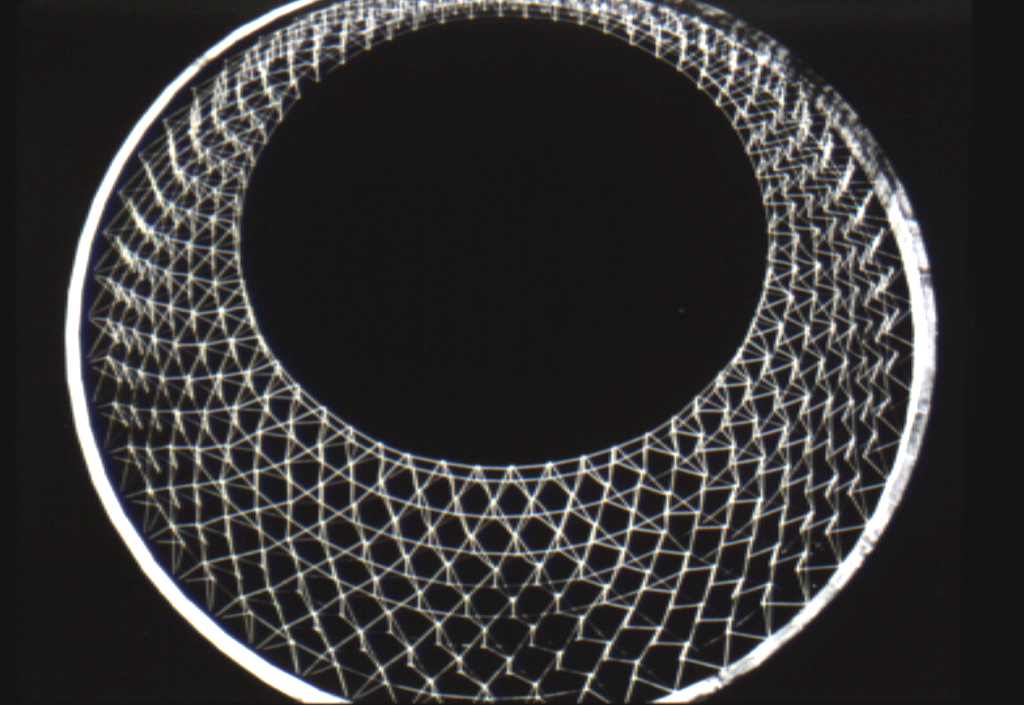
 The 1988 Gymnastics and Fencing Arenas were the first structures
to realize R. Buckminster Fuller's "tensegrity" systems
at building scale. The evolution of this new structural type began
in 1949, when Kenneth Snelson, working as a student of Fuller's,
developed a series of sculptures comprised of continuous wires
separated by discontinuous struts. Fuller realized that if this
concept was applied to structures, that "the compression
struts [would] become small islands in a sea of tension,"
which in turn would drastically reduce the amount of material
required to build them. Fuller, who had worked for years to emphemeralize
buildings, transformed Snelson's sculptural idea into a "tensile
integrity" or "tensegrity" structural system for
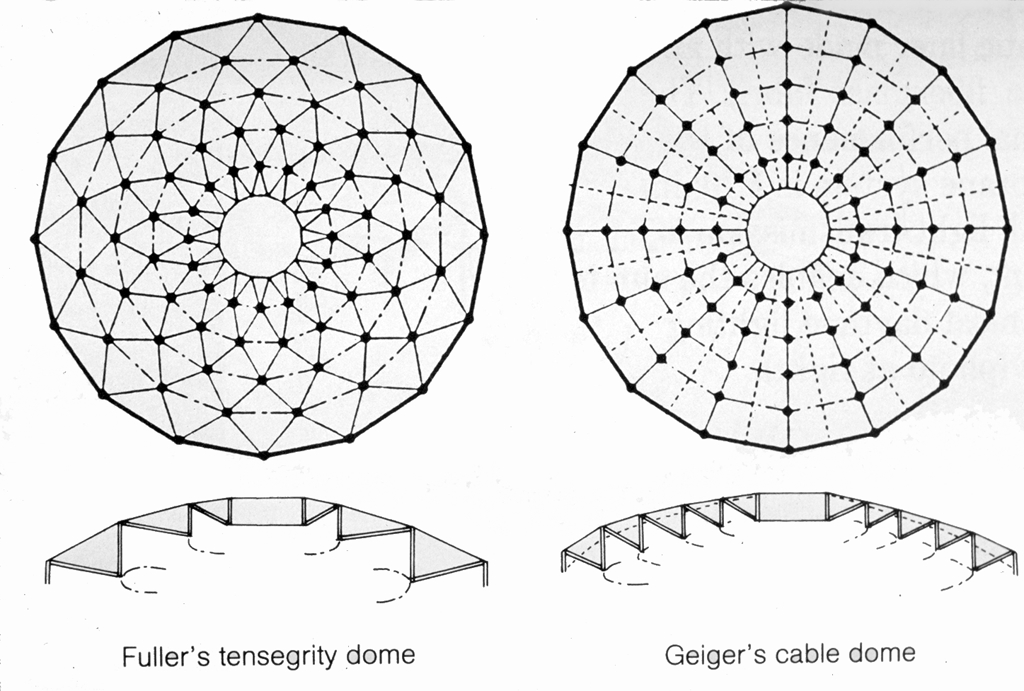
domes and other longspan roofs, which he patented in 1962 (figure
1).
The 1988 Gymnastics and Fencing Arenas were the first structures
to realize R. Buckminster Fuller's "tensegrity" systems
at building scale. The evolution of this new structural type began
in 1949, when Kenneth Snelson, working as a student of Fuller's,
developed a series of sculptures comprised of continuous wires
separated by discontinuous struts. Fuller realized that if this
concept was applied to structures, that "the compression
struts [would] become small islands in a sea of tension,"
which in turn would drastically reduce the amount of material
required to build them. Fuller, who had worked for years to emphemeralize
buildings, transformed Snelson's sculptural idea into a "tensile
integrity" or "tensegrity" structural system for
domes and other longspan roofs, which he patented in 1962 (figure
1).
 The complexity of Fuller's tensegrity domes precluded
their full-scale realization until the 1980's, when another brilliant
engineer simplified them enough to make them buildable. David
Geiger had been refining his pneumatic cable-stiffened dome designs
since his first spectacular success at the U.S. Pavilion at Expo
70 in Osaka. Unfortunately, these roofs had not always performed
well in northern American cities -- the Pontiac Silverdome roof
in Detroit was partially destroyed in a windstorm during construction,
and the roof of the Hubert H. Humphrey Metrodome in Minneapolis
partially deflated after a heavy snowstorm. Geiger had been aware
of Fuller's tensegrity structures for some time and "thought
it would be a significant breakthrough" to build one. By
simplifying Fuller's cable net and making the dome profile much
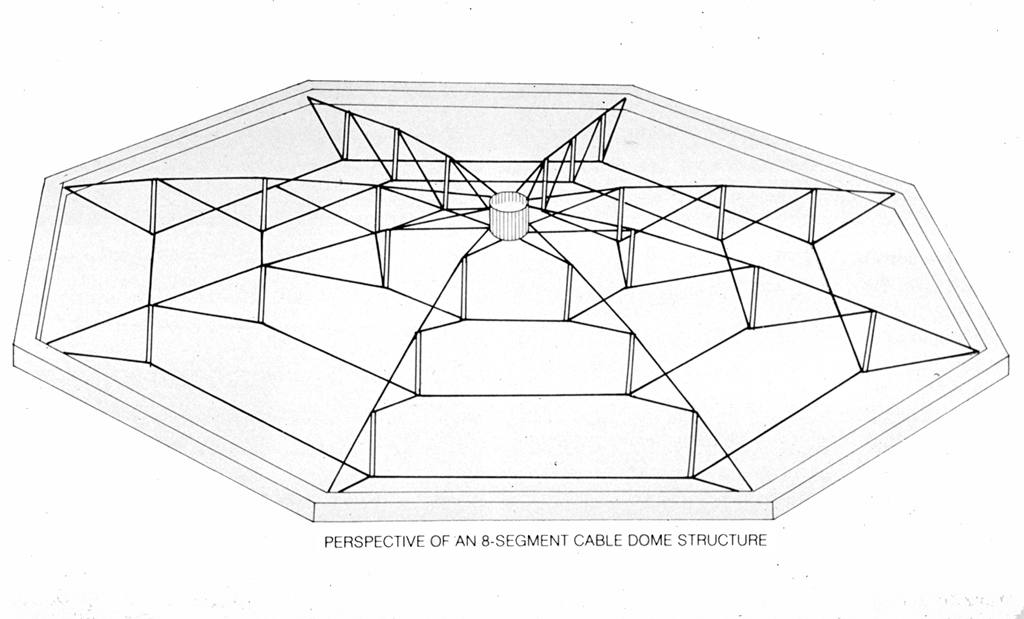
lower and more aerodynamic, (figure 2) Geiger was able to design
self supporting stadium covers weighing only slightly more that
his pneumatic roofs (figure3).
The complexity of Fuller's tensegrity domes precluded
their full-scale realization until the 1980's, when another brilliant
engineer simplified them enough to make them buildable. David
Geiger had been refining his pneumatic cable-stiffened dome designs
since his first spectacular success at the U.S. Pavilion at Expo
70 in Osaka. Unfortunately, these roofs had not always performed
well in northern American cities -- the Pontiac Silverdome roof
in Detroit was partially destroyed in a windstorm during construction,
and the roof of the Hubert H. Humphrey Metrodome in Minneapolis
partially deflated after a heavy snowstorm. Geiger had been aware
of Fuller's tensegrity structures for some time and "thought
it would be a significant breakthrough" to build one. By
simplifying Fuller's cable net and making the dome profile much
lower and more aerodynamic, (figure 2) Geiger was able to design
self supporting stadium covers weighing only slightly more that
his pneumatic roofs (figure3).
 As built, Geiger's seminal Seoul Olympic domes weighed just 3
pounds per square foot, compared to the U.S. Pavilion's 1.5 pounds
per square foot and the 1965 Houston Astrodome's 30 pounds per
square foot. Like the steel and plastic Astrodome and the reinforced
concrete Seattle Kingdome roofs, Geiger's tensegrity structures
supported themselves without elevated internal air pressure (and
the fans required to maintain it), ensuring that his roofs would
be unaffected by mechanical failures, and that they could support
a lot of snow without melting it. As at the U.S. Pavilion, Geiger's
structure was cost effective as well as structurally inventive.
The 295 foot and 393 foot diameter Olympic domes each cost $20
per square foot, which was more than that of Geiger's cable domes,
but still much less than traditional reinforced concrete or steel
domes (figure 4).
As built, Geiger's seminal Seoul Olympic domes weighed just 3
pounds per square foot, compared to the U.S. Pavilion's 1.5 pounds
per square foot and the 1965 Houston Astrodome's 30 pounds per
square foot. Like the steel and plastic Astrodome and the reinforced
concrete Seattle Kingdome roofs, Geiger's tensegrity structures
supported themselves without elevated internal air pressure (and
the fans required to maintain it), ensuring that his roofs would
be unaffected by mechanical failures, and that they could support
a lot of snow without melting it. As at the U.S. Pavilion, Geiger's
structure was cost effective as well as structurally inventive.
The 295 foot and 393 foot diameter Olympic domes each cost $20
per square foot, which was more than that of Geiger's cable domes,
but still much less than traditional reinforced concrete or steel
domes (figure 4).
Geiger shared with his client, the Seoul Olympic Committee, the
notion that his new structural form would serve as much more than
just a roof over sports arenas. The Olympic Committee hoped that
the arenas would be "[among the] many firsts that we will
show the world through the Olympics," and that they would
help "advance the country just as the Japanese did in [the]
1964 [Olympics]." Geiger quickly reported that the diameter
of his domes could be expanded indefinitely with little additional
weight or expense per square foot of roof. Buckminster Fuller
would certainly have appreciated this expansive optimism. In the
opening paragraph of his tensegrity patent he claims that the
system has "special application to structures of vast proportions
such as free span domes capable of…housing an entire city"
Sources
 Back
to Seoul Main Menu
Back
to Seoul Main Menu
 The 1988 Gymnastics and Fencing Arenas were the first structures
to realize R. Buckminster Fuller's "tensegrity" systems
at building scale. The evolution of this new structural type began
in 1949, when Kenneth Snelson, working as a student of Fuller's,
developed a series of sculptures comprised of continuous wires
separated by discontinuous struts. Fuller realized that if this
concept was applied to structures, that "the compression
struts [would] become small islands in a sea of tension,"
which in turn would drastically reduce the amount of material
required to build them. Fuller, who had worked for years to emphemeralize
buildings, transformed Snelson's sculptural idea into a "tensile
integrity" or "tensegrity" structural system for
domes and other longspan roofs, which he patented in 1962 (figure
1).
The 1988 Gymnastics and Fencing Arenas were the first structures
to realize R. Buckminster Fuller's "tensegrity" systems
at building scale. The evolution of this new structural type began
in 1949, when Kenneth Snelson, working as a student of Fuller's,
developed a series of sculptures comprised of continuous wires
separated by discontinuous struts. Fuller realized that if this
concept was applied to structures, that "the compression
struts [would] become small islands in a sea of tension,"
which in turn would drastically reduce the amount of material
required to build them. Fuller, who had worked for years to emphemeralize
buildings, transformed Snelson's sculptural idea into a "tensile
integrity" or "tensegrity" structural system for
domes and other longspan roofs, which he patented in 1962 (figure
1).