

Morgan, Thomas Hunt, The mechanism of Mendelian heredity
(New York : Henry Holt and Company, 1915.)
|
||

 Click here and hold to drag menu around
|





|
|
|
|

|
Page 59 | 
|
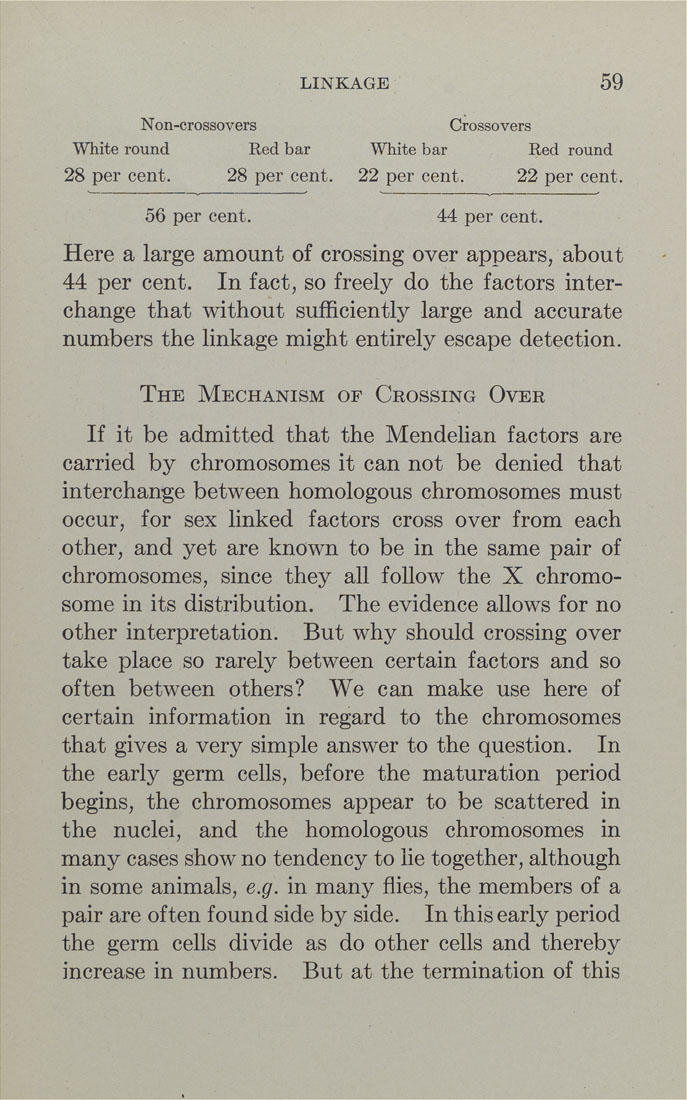
LINKAGE Non-crossovers Crossovers White round Red bar White bar Red round 28 per cent. 28 per cent. 22 per cent. 22 per cent. 56 per cent. 44 per cent. Here a large amount of crossing over appears, about 44 per cent. In fact, so freely do the factors inter- change that without sufficiently large and accurate numbers the linkage might entirely escape detection. The Mechanism of Crossing Over If it be admitted that the Mendelian factors are carried by chromosomes it can not be denied that interchange between homologous chromosomes must occur, for sex linked factors cross over from each other, and yet are known to be in the same pair of chromosomes, since they all follow the X chromo- some in its distribution. The evidence allows for no other interpretation. But why should crossing over take place so rarely between certain factors and so often between others? We can make use here of certain information in regard to the chromosomes that gives a very simple answer to the question. In the early germ cells, before the maturation period begins, the chromosomes appear to be scattered in the nuclei, and the homologous chromosomes in many cases show no tendency to lie together, although in some animals, e.g. in many flies, the members of a pair are often found side by side. In this early period the germ cells divide as do other cells and thereby increase in numbers. But at the termination of this |
|
|
Page 59 |
|