

American dictionary of printing and bookmaking
(New York : H. Lockwood, 1894.)
|
||

 Click here and hold to drag menu around
|





|
|
|
|

|
Page 167 | 
|
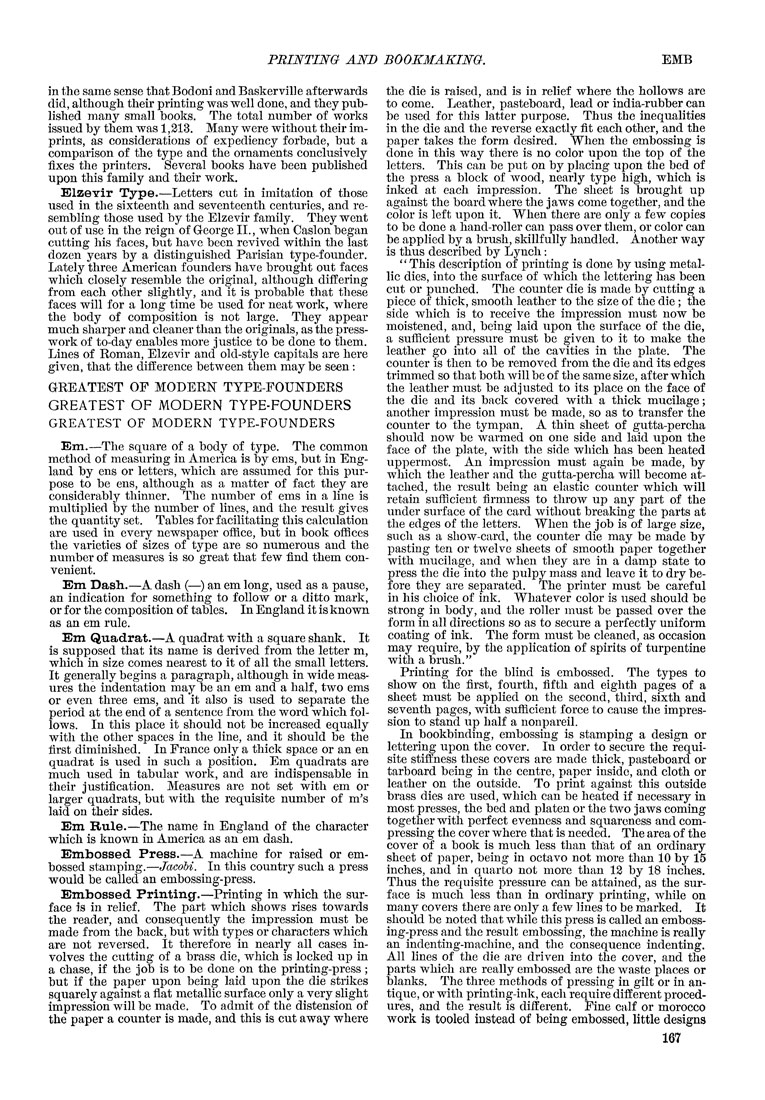
PRINTING AND BOOKMAKING. EMB in the same sense that Bodoni and Baskerville afterwards did, although their printing was well done, and they pub¬ lished many small books. The total number of works issued by them was 1,213. Many were without their im¬ prints, as considerations of expediency forbade, but a comparison of the type and the ornaments conclusively fixes the printers. Several books have been published upon this family and their work. Elzevir Type.—Letters cut in imitation of those used in the sixteenth and seventeenth centuries, and re¬ sembling those used by the Elzevir family. They went out of use in the reign of George II., when Caslon began cutting his faces, but have been revived within the last dozen years by a distinguished Parisian type-founder. Lately three American founders have brought out faces which closely resemble the original, although differing from each other slightly, and it is probable that these faces will for a long time be used for neat work, where the body of composition is not large. They appear much sharper and cleaner than the originals, as the press- work of to-day enables more justice to be done to them. Lines of Roman, Elzevir and old-style capitals are here given, that the difference between them may be seen: GREATEST OF MODERN TYPE-FOUNDERS GREATEST OF MODERN TYPE-FOUNDERS GREATEST OF MODERN TYPE-FOUNDERS Em.—The square of a body of type. The common method of measuring in America is by ems, but in Eng¬ land by ens or letters, which are assumed for this pur¬ pose to be ens, although as a matter of fact they are considerably thinner. The number of ems in a line is multiplied by the number of lines, and the result gives the quantity set. Tables for facilitating this calculation are used in every newspaper office, but in book offices the varieties of sizes of type are so numerous and the number of measures is so great that few find them con¬ venient. Em Dash.—A dash (—) an em long, used as a pause, an indication for something to follow or a ditto mark, or for the composition of tables. In England it is known as an em rule. Em Quadrat.—A quadrat with a square shank. It is supposed that its name is derived from the letter m, which in size comes nearest to it of all the small letters. It generally begins a paragraph, although in wide meas¬ ures the indentation may be an em and a half, two ems or even three ems, and it also is used to separate the period at the end of a sentence from the word which fol¬ lows. In this place it should not be increased equally with the other spaces in the line, and it should be the first diminished. In France only a thick space or an en quadrat is used in such a position. Em quadrats are much used in tabular work, and are indispensable in their justification. Measures are not set with em or larger quadrats, but with the requisite number of m's laid on their sides. Em Rule.—The name in England of the character which is known in America as an em dash. Embossed Press.—A machine for raised or em¬ bossed stamping.—Jacohi. In this country such a press would be called an embossing-press. Embossed Printing.—Printing in which the sur¬ face is in relief. The part which shows rises towards the reader, and consequently the impression must be made from the back, but with types or characters which are not reversed. It therefore in nearly all cases in¬ volves the cutting of a brass die, which is locked up in a chase, if the job is to be done on the printing-press ; but if the paper upon being laid upon the die strikes squarely against a flat metallic surface only a very slight impression will be made. To admit of the distension of the paper a counter is made, and this is cut away where the die is raised, and is in relief where the hollows are to come. Leather, pasteboard, lead or india-rubber can be used for this latter purpose. Thus the inequalities in the die and the reverse exactly fit each other, and the paper takes the form desired. When the embossing is done in this way there is no color upon the top of the letters. This can be put on by placing upon the bed of the press a block of wood, nearly type high, which is inked at each impression. The sheet is brought up against the board where the jaws come together, and the color is left upon it. When there are only a few copies to be done a hand-roller can pass over them, or color can be applied by a brush, skillfully handled. Another way is thus described by Lynch: ''This description of printing is done by using metal¬ lic dies, into the surface of which the lettering has been cut or punched. The counter die is made by cutting a piece of thick, smooth leather to the size of the die; the side which is to receive the impression must now be moistened, and, being laid upon the surface of the die, a sufficient pressure must be given to it to make the leather go into all of the cavities in thc plate. The counter is then to be removed from the die and its edges trimmed so that both will be of the same size, after which the leather must be adjusted to its place on the face of the die and its back covered with a thick mucilage; another impression must be made, so as to transfer the counter to the tympan. A thin sheet of gutta-percha should now be warmed on one side and laid upon the face of the plate, with the side which has been heated uppermost. An impression must again be made, by which the leather and the gutta-percha will become at¬ tached, the result being an elastic counter which will retain sufficient firmness to throw up any part of the under surface of the card without breaking the parts at the edges of the letters. When the job is of large size, such as a show-card, the counter die may be made by pasting ten or twelve sheets of smooth paper together with mucilage, and when they are in a damp state to press the die into the pulpy mass and leave it to dry be¬ fore they are separated. The printer must be careful in his choice of ink. Whatever color is used should be strong in body, and the roller must be passed over the form in all directions so as to secure a perfectly uniform coating of ink. The form must be cleaned, as occasion may require, by the application of spirits of turpentine with a brush." Printing for the blind is embossed. The types to show on the first, fourth, fifth and eighth pages of a sheet must be applied on the second, third, sixth and seventh pages, with sufficient force to cause the impres¬ sion to stand up half a nonpareil. In bookbinding, embossing is stamping a design or lettering upon the cover. In order to secure the requi¬ site stiffness these covers are made thick, pasteboard or tarboard being in the centre, paper inside, and cloth or leather on the outside. To print against this outside brass dies are used, which can be heated if necessary in most presses, the bed and platen or the two jaws coming together with perfect evenness and squareness and com¬ pressing the cover where that is needed. The area of the cover of a book is much less than that of an ordinary sheet of paper, being in octavo not more than 10 by 15 inches, and in quarto not more than 12 by 18 inches. Thus the requisite pressure can be attained, as the sur¬ face is much less than in ordinary printing, while on many covers there are only a few lines to be marked. It should be noted that while this press is called an emboss¬ ing-press and the result embossing, the machine is really an indenting-machine, and the consequence indenting. All lines of the die are driven into the cover, and the parts which are really embossed are the waste places or blanks. The three methods of pressing in gilt or in an¬ tique, or with printing-ink, each require different proced¬ ures, and the result is different. Fine calf or morocco work is tooled instead of being embossed, little designs 167 |
|
|
Page 167 |
|