

American dictionary of printing and bookmaking
(New York : H. Lockwood, 1894.)
|
||

 Click here and hold to drag menu around
|





|
|
|
|

|
Page 186 | 
|
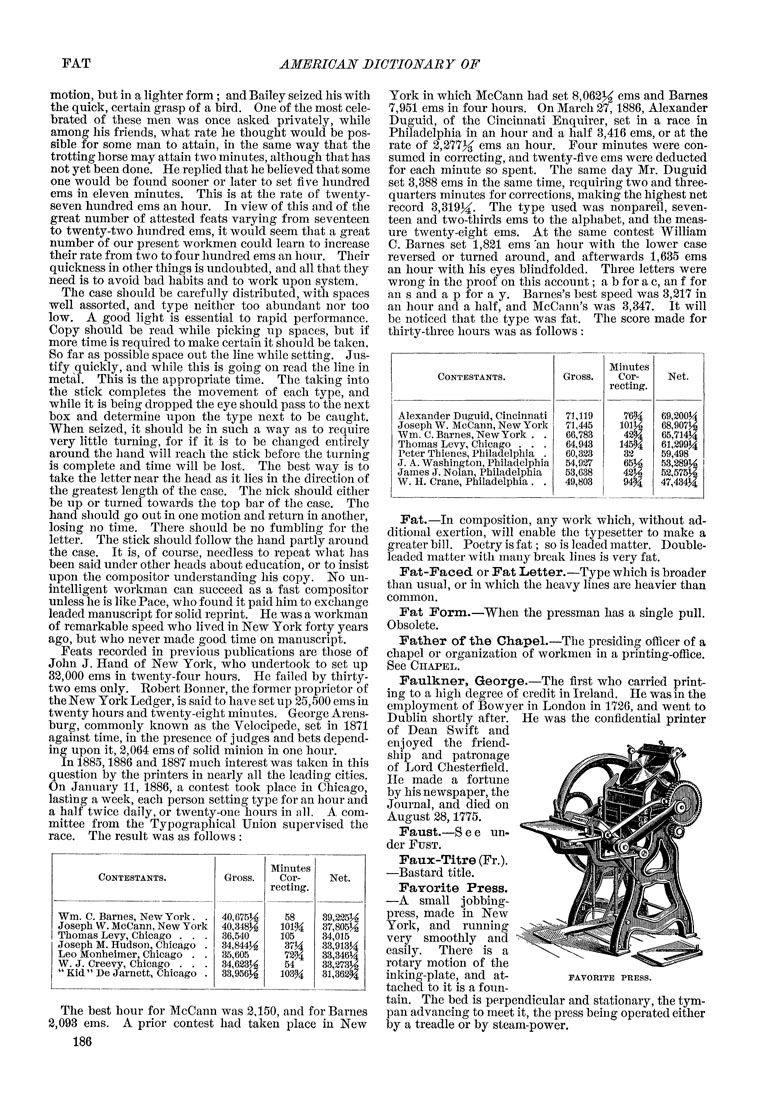
FAT AMERICAN DICTIONARY OF motion, but in a lighter form; and Bailey seized his with the quick, certain grasp of a bird. One of the most cele¬ brated of these men was once asked privately, while among his friends, what rate he thought would be pos¬ sible for some man to attain, in the same way that the trotting horse may attain two minutes, although that has not yet been done. He replied that he believed that some one would be found sooner or later to set five hundred ems in eleven minutes. This is at the rate of twenty- seven hundred ems an hour. In view of this and of the great number of attested feats varying from seventeen to twenty-two hundred ems, it would seem that a great number of our present workmen could learn to increase their rate from two to four hundred ems an hour. Their quickness in other things is undoubted, and all that they need is to avoid bad habits and to work upon system. The case should be carefully distributed, with spaces well assorted, and type neither too abundant nor too low. A good light is essential to rapid performance. Copy should be read while picking up spaces, but if more time is required to make certain it should be taken. So far as possible space out the line while setting. Jus¬ tify quickly, and while this is going on read the line in metal. This is the appropriate time. The taking into the stick completes the movement of each type, and while it is being dropped the eye should pass to the next box and determine upon the type next to be caught. When seized, it should be in such a way as to require very little turning, for if it is to be changed entirely around the hand will reach the stick before the turning is complete and time will be lost. The best way is to take the letter near the head as it lies in the direction of the greatest length of the case. The nick should either be up or turned towards the top bar of the case. The hand should go out in one motion and return in another, losing no time. There should be no fumbling for the letter. The stick should follow the hand partly around the case. It is, of course, needless to repeat what has been said under other heads about education, or to insist upon the compositor understanding his copy. No un¬ intelligent workman can succeed as a fast compositor unless he is like Pace, who found it paid him to exchange leaded manuscript for solid reprint. He was a workman of remarkable speed who lived in New York forty years ago, but who never made good time on manuscript. Feats recorded in previous publications are those of John J. Hand of New York, who undertook to set up 32,000 ems in twenty-four hours. He failed by thirty- two ems only. Robert Bonner, the former proprietor of the New York Ledger, is said to have set up 25,500 ems in twenty hours and twenty-eight minutes. George Arens- burg, commonly known as the Velocipede, set in 1871 against time, in the presence of judges and bets depend¬ ing upon it, 2,064 ems of solid minion in one hour. In 1885,1886 and 1887 much interest was taken in this question by the printers in nearly all the leading cities. On January 11, 1886, a contest took place in Chicago, lasting a week, each person setting type for an hour and a half twice daily, or twenty-one hours in all. A com¬ mittee from the Typographical Union supervised the race. The result was as follows : Minutes Contestants. Gross. Cor¬ recting. Net. Wm. C. Barnes, New York. . 40,6751^ 40,3481^ 58 39,2251^ Joseph W. McCann, New York 10134 37,805^ Thomas Levy, Chicago . . . 36,540 105 34,015 Joseph M. Hudson, Chicago . 34,844^ 37M 33,913^ 33,346H Leo Monheimer, Chicago . . 35,605 72M W. J. Creevy, Chicago . . . 34,6231^ 54 33,273U " Kid " De Jarnett, Chicago . 33,956^ 103M 31,362M York in which McCann had set 8,062^ ems and Barnes 7,951 ems in four hours. On March 27, 1886, Alexander Duguid, of the Cincinnati Enquirer, set in a race in Philadelphia in an hour and a half 8,416 ems, or at the rate of 2,2773^ ems an hour. Four minutes were con¬ sumed in correcting, and twenty-five ems were deducted for each minute so spent. The same day Mr. Duguid set 3,388 ems in the same time, requiring two and three- quarters minutes for corrections, making the highest net record 8,319}^. The type used was nonpareil, seven¬ teen and two-thirds ems to the alphabet, and the meas¬ ure twenty-eight ems. At the same contest William C. Barnes set 1,821 ems 'an hour with the lower case reversed or turned around, and afterwards 1,635 ems an hour with his eyes blindfolded. Three letters were wrong in the proof on this account; a b for a c, an f for an s and a p for a y. Barnes's best speed was 3,217 in an hour and a half, and McCann's was 8,347. It will be noticed that the type was fat. The score made for thirty-three hours was as follows : Minutes Contestants. Gross. Cor¬ recting. Net. Alexander Duguid, Cincinnati 71,119 76M 69,200M Joseph W. McCann, New York 71,445 145p| 68,907J^ Wm. C.Barnes, New York . . 66,783 65,714^ Thomas Levy, Chicago . . . 64,943 61,29914 Peter Thienes, Philadelphia . 60,323 32 59,498 J. A. Washington, Philadelphia 54,927 651^ 53,2891^ James J. Nolan, Philadelphia 53,638 42M 52,575)4 W. H. Crane, Philadelphia . . 49,803 94% 47,43414 Fat.—In composition, any work which, without ad¬ ditional exertion, will enable the typesetter to make a greater bill. Poetry is fat; so is leaded matter. Double- leaded matter with many break lines is very fat. Fat-Faced or Fat Letter.—Type which is broader than usual, or in which the heavy lines are heavier than common. Fat Form.- Obsolete. -When the pressman has a single pull. The best hour for McCann was 2,150, and for Barnes 2,093 ems. A prior contest had taken place in New 186 Father of the Chapel.—The presiding officer of a chapel or organization of workmen in a printing-office. See Chapel. Faulkner, George.—The first who carried print¬ ing to a high degree of credit in Ireland. He was in the employment of Bowyer in London in 1726, and went to Dublin shortly after. He was the confidential printer of Dean Swift and enjoyed the friend¬ ship and patronage of Lord Chesterfield. He made a fortune by his newspaper, the Journal, and died on August 28,1775. Faust.—See un¬ der Fust. Faux-Titre (Fr.). —Bastard title. Favorite Press. —A small jobbing- press, made in New York, and running very smoothly and easily. There is a rotary motion of the inking-plate, and at- favorite press. tached to it is a foun¬ tain. The bed is perpendicular and stationary, the tym¬ pan advancing to meet it, the press being operated either by a treadle or by steam-power. |
|
|
Page 186 |
|