

American dictionary of printing and bookmaking
(New York : H. Lockwood, 1894.)
|
||

 Click here and hold to drag menu around
|





|
|
|
|

|
Page 520 | 
|
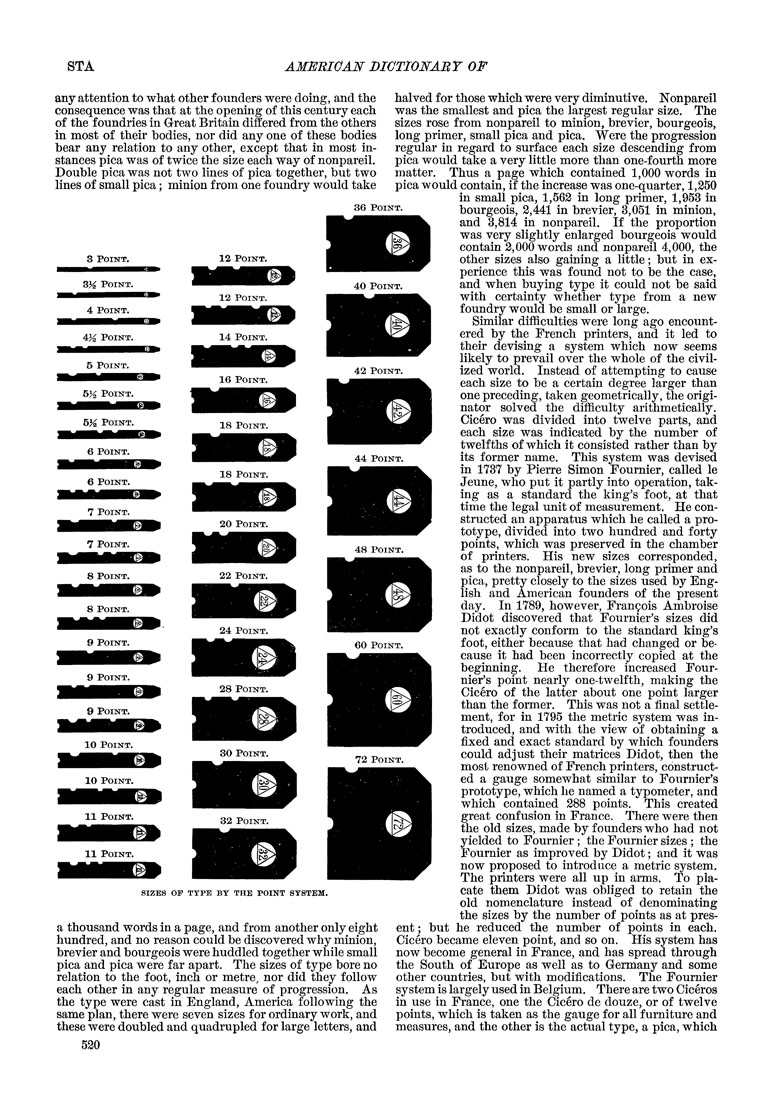
STA AMERICAN DICTIONARY OF any attention to what other founders were doing, and the consequence was that at the opening of this century each of the foundries in Great Britain differed from the others in most of their bodies, nor did any one of these bodies bear any relation to any other, except that in most in¬ stances pica was of twice the size each way of nonpareil. Double pica was not two lines of pica together, but two lines of small pica; minion from one foundry would take 3 Point. 12 Point. 3J^ Point. 4>^ Point. 5>^ Point. 5>^ Point. 6 Point. 6 Point. 7 Point, 42 Point. 18 Point. 18 Point, 7 Point. 8 Point. 24 Point. 28 Point. 60 Point. 10 Point. 11 Point. 30 Point. 72 Point. SIZES of type by the point system. a thousand words in a page, and from another only eight hundred, and no reason could be discovered why minion, brevier and bourgeois were huddled together while small pica and pica were far apart. The sizes of type bore no relation to the foot, inch or metre, nor did they follow each other in any regular measure of progression. As the type were cast in England, America following the same plan, there were seven sizes for ordinary work, and these were doubled and quadrupled for large letters, and 520 halved for those which were very diminutive. Nonpareil was the smallest and pica the largest regular size. The sizes rose from nonpareil to minion, brevier, bourgeois, long primer, small pica and pica. Were the progression regular in regard to surface each size descending from pica would take a very little more than one-fourth more matter. Thus a page which contained 1,000 words in pica would contain, if the increase was one-quarter, 1,250 in small pica, 1,562 in long primer, 1,953 in bourgeois, 2,441 in brevier, 3,051 in minion, and 3,814 in nonpareil. If the proportion was very slightly enlarged bourgeois would contain 2,000 words and nonpareil 4,000, the other sizes also gaining a little; but in ex¬ perience this was found not to be the case, and when buying type it could not be said with certainty whether type from a new foundry would be small or large. Similar difficulties were long ago encount¬ ered by the French printers, and it led to their devising a system which now seems likely to prevail over the whole of the civil¬ ized world. Instead of attempting to cause each size to be a certain degree larger than one preceding, taken geometrically, the origi¬ nator solved the difficulty arithmetically. Cicero was divided into twelve parts, and each size was indicated by the number of twelfths of which it consisted rather than by its former name. This system was devised in 1737 by Pierre Simon Fournier, called le Jeune, who put it partly into operation, tak¬ ing as a standard the king's foot, at that time the legal unit of measurement. He con¬ structed an apparatus which he called a pro¬ totype, divided into two hundred and forty points, which was preserved in the chamber of printers. His new sizes corresponded, as to the nonpareil, brevier, long primer and pica, prettv closely to the sizes used by Eng¬ lish and American founders of the present day. In 1789, however, Frangois Ambroise Didot discovered that Fournier's sizes did not exactly conform to the standard king's foot, either because that had changed or be¬ cause it had been incorrectly copied at the beginning. He therefore increased Four- nier's point nearlj'^ one-twelfth, making the Cicero of the latter about one point larger than the former. This was not a final settle¬ ment, for in 1795 the metric system was in¬ troduced, and with the view of obtaining a fixed and exact standard by which founders could adjust their matrices Didot, then the most renowned of French printers, construct¬ ed a gauge somewhat similar to Fournier's prototype, which he named a typometer, and which contained 288 points. This created great confusion in France, There were then the old sizes, made by founders who had not yielded to Fournier ; the Fournier sizes ; the Fournier as improved by Didot; and it was now proposed to introduce a metric system. The printers were all up in arms. To pla¬ cate them Didot was obliged to retain the old nomenclature instead of denominating the sizes by the number of points as at pres¬ ent ; but he reduced the number of points in each. Cicero became eleven point, and so on. His system has now become general in France, and has spread through the South of Europe as well as to Germany and some other countries, but with modifications. The Fournier system is largely used in Belgium. There are two Ciceros in use in France, one the Cicero de douze, or of twelve points, which is taken as the gauge for all furniture and measures, and the other is the actual type, a pica, which |
|
|
Page 520 |
|