

Ganong, William Francis, A monograph of the place-nomenclature of the province of New Brunswick
([Ottawa : Toronto : London : J. Durie & Son ; Copp-Clark Co. ; B. Quaritch], 1896.)
|
||

 Click here and hold to drag menu around
|





|
|
|
|

|
Page 243 | 
|
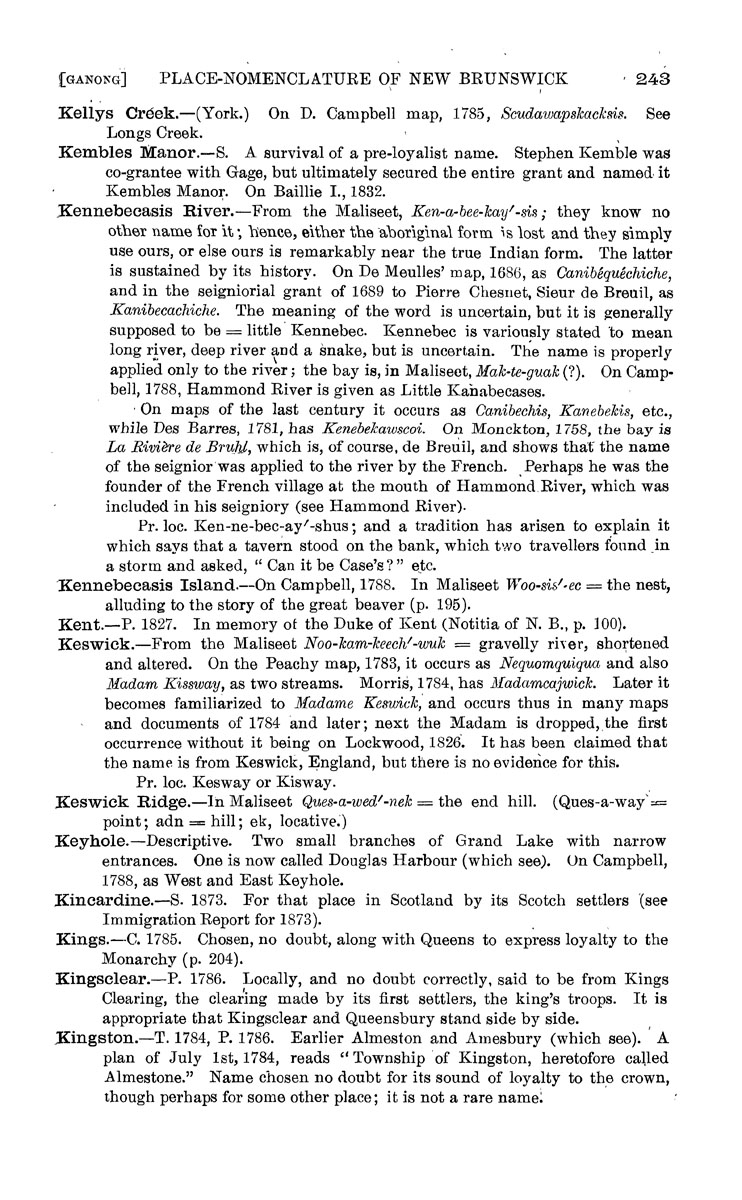
[GANONG] PLACE-NOMENCLATURE OF NEW BRUNSWICK ' 243 Kellys Cr^ek.—(York.) On D. Campbell map, 1785, Scudaivapskacksis. See Longs Creek. Kembles Manor.—S. A survival of a pre-loyalist name. Stephen Kemble was co-grantee with Gage, but ultimately secured the entire grant and named it Kembles Manor. On Baillie L, 1832. Kennebecasis River.—From the Maliseet, Ken-a-bee-kay^-sis; they know no other name lor it; hence, either tlie aboriginal form is lost and they simply use ours, or else ours is remarkably near the true Indian form. The latter is sustained by its history. On De Meulles' map, 1686, as Canibequechiche, and in the seigniorial grant of 1689 to Pierre Chesnet, Sieur de Breuil, as Kanibecachiche. The meaning of the word is uncertain, but it is generally supposed to be = little Kennebec. Kennebec is variously stated to mean long river, deep river and a snake, but is uncertain. The name is properly applied only to the river; the bay is, in Maliseet, Mak-te-guak (?). On Camp¬ bell, 1788, Hammond River is given as Little Kanabecases. ■ On maps of the last century it occurs as Canibechis, Kanebekis, etc., while Des Barres, 1781, has Kenebekawscoi. On Monckton, 1758, the bay ia La Rivihre de BruJil, which is, of course, de Breuil, and shows that the name of the seignior was applied to the river by the French. Perhaps he was the founder of the French village at the mouth of Hammond River, which was included in his seigniory (see Hammond River). Pr. loc. Ken-ne-bec-ay^-shus; and a tradition has arisen to explain it which says that a tavern stood on the bank, which tv/o travellers found in a storm and asked, " Can it be Case's?" etc. Kennebecasis Island.—On Campbell, 1788. In Maliseet Woo-sis^-ec = the nest, alluding to the story of the great beaver (p. 195). Kent.—P. 1827. In memory of the Duke of Kent (Notitia of N. B., p. 100). Keswick.—From the Maliseet Noo-kam-keech^-wuk = gravelly ri\er, shortened and altered. On the Peachy map, 1783, it occurs as Nequomquiqua and also Madam Kissway, as two streams. Morris, 1784, has Madamcajwlck, Later it becomes familiarized to Madame Keswick, and occurs thus in many maps and documents of 1784 and later; next the Madam is dropped, the first occurrence without it being on Lockwood, 1826. It has been claimed that the name is from Keswick, England, but there is no evidence for this. Pr. loc. Kesway or Kisway. Keswick Ridge.—In Maliseet Ques-a-wed^-nek ==: the end hill. (Ques-a-way= point; adn == hill; ek, locative.) Keyhole.—Descriptive. Two small branches of Grand Lake with narrow entrances. One is now called Douglas Harbour (which see). On Campbell, 1788, as West and East Keyhole. Kincardine.—S. 1873. For that place in Scotland by its Scotch settlers (see Immigration Report for 1873). Kings.—C. 1785. Chosen, no doubt, along with Queens to express loyalty to the Monarchy (p. 204). Kingsclear.—P. 1786. Locally, and no doubt correctly, said to be from Kings Clearing, the clearing made by its first settlers, the king's troops. It is appropriate that Kingsclear and Queensbury stand side by side. Kingston.—T. 1784, P. 1786. Earlier Almeston and Amesbury (which see). A plan of July 1st, 1784, reads " Township of Kingston, heretofore called Almestone." Name chosen no doubt for its sound of loyalty to the crown, though perhaps for some other place; it is not a rare namei |
|
|
Page 243 |
|