

Wundt, Wilhelm Max, Lectures on human and animal psychology
(London : New York : Swan Sonnenschein & Co. ; Macmillan & Co., 1894.)
|
||

 Click here and hold to drag menu around
|





|
|
|
|

|
Page [1] | 
|
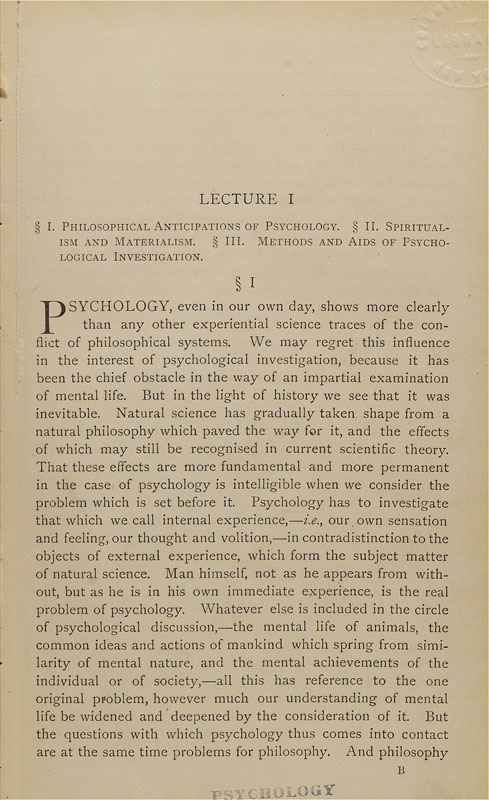
LECTURE I § I. Philosophical ANTicip.iTiONS of Psychology. § H. Spiritual¬ ism AND Materialism. § IIL Methods and Aids of Psycho¬ logical Investigation. § I PSYCHOLOGY, even in our own day, shows more clearly than any other experiential science traces of the con¬ flict of philosophical systems. We may regret this influence in the interest of psychological investigation, because it has been the chief obstacle in the way of an impartial examination of mental life. But in the light of history we see that it was inevitable. Natural science has gradually taken shape from a natural philosophy which paved the way for it, and the effects of which may still be recognised in current scientific theory. That these effects are more fundamental and more permanent in the case of psychology is intelligible when we consider the problem which is set before it. Psychology has to investigate that which we call internal experience,—i.e., our.own sensation and feeling, our thought and volition,—in contradistinction to the objects of external experience, which form the subject matter of natural science. Man himself, not as he appears from with¬ out, but as he is in his own immediate experience, is the real problem of psychology. Whatever else is included in the circle of psychological discussion,—the mental life of animals, the common ideas and actions of mankind which spring from simi¬ larity of mental nature, and the mental achievements of the individual or of society,—all this has reference to the one original problem, however much our understanding of mental life be widened and deepened by the consideration of it. But the questions with which psychology thus comes into contact are at the same time problems for philosophy. And philosophy B F'SIJGHOLOGr |
|
|
Page [1] |
|