

Wundt, Wilhelm Max, Lectures on human and animal psychology
(London : New York : Swan Sonnenschein & Co. ; Macmillan & Co., 1894.)
|
||

 Click here and hold to drag menu around
|





|
|
|
|

|
Page 308 | 
|
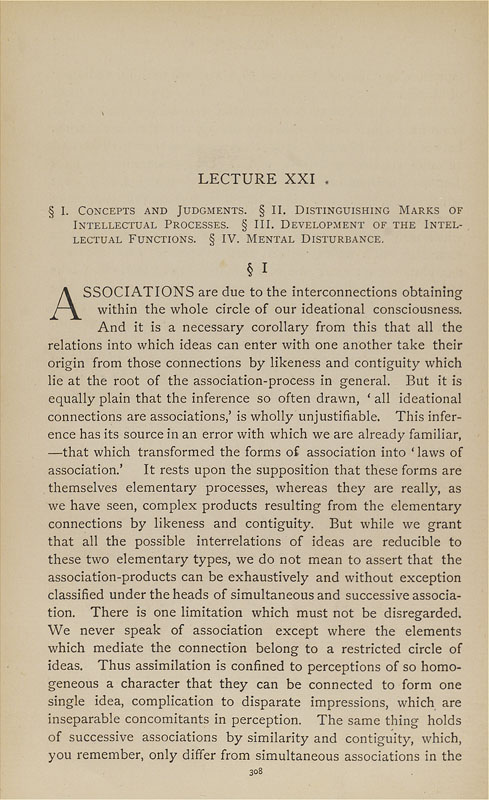
LECTURE XXI , § I. Concepts and Judgments. § II. Distinguishing Marks of Intellectual Processes. § III. Development of the Intel- . LECTUAL Functions. § IV. Mental Disturbance, § I ASSOCIATIONS are due to the interconnections obtaining within the whole circle of our ideational consciousness. And it is a necessary corollary from this that all the relations into which ideas can enter with one another take their origin from those connections by likeness and contiguity which lie at the root of the association-process in general. But it is equally plain that the inference so often drawn, ' all ideational connections are associations,' is wholly unjustifiable. This infer¬ ence has its source in an error with which we are already familiar, —that which transformed the forms of association into ' laws of association.' It rests upon the supposition that these forms are themselves elementary processes, whereas they are really, as we have seen, complex products resulting from the elementary connections by likeness and contiguity. But while we grant that all the possible interrelations of ideas are reducible to these two elementary types, we do not mean to assert that the association-products can be exhaustively and without exception classified under the heads of simultaneous and successive associa¬ tion. There is one limitation which must not be disregarded. We never speak of association except where the elements which mediate the connection belong to a restricted circle of ideas. Thus assimilation is confined to perceptions of so homo¬ geneous a character that they can be connected to form one single idea, complication to disparate impressions, which are inseparable concomitants in perception. The same thing holds of successive associations by similarity and contiguity, which, you remember, only differ from simultaneous associations in the |
|
|
Page 308 |
|