

Wundt, Wilhelm Max, Lectures on human and animal psychology
(London : New York : Swan Sonnenschein & Co. ; Macmillan & Co., 1894.)
|
||

 Click here and hold to drag menu around
|





|
|
|
|

|
Page 367 | 
|
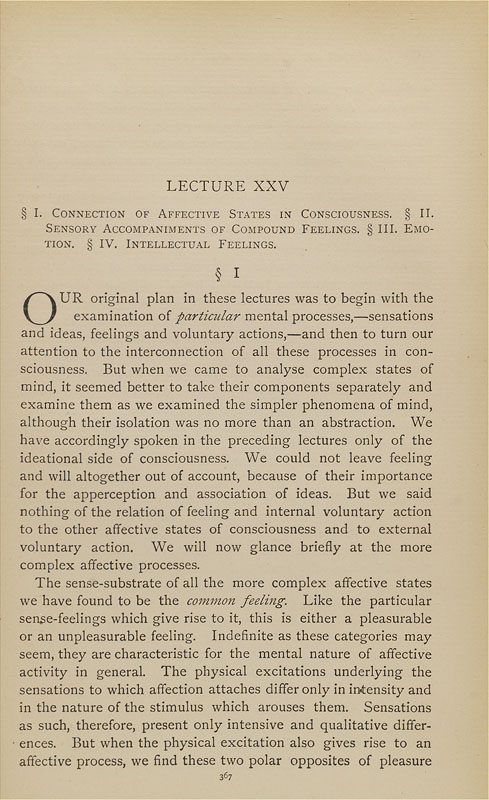
LECTURE XXV § I. Connection of Affective States in Consciousness, § II, Sensory Accompaniments of Compound Feelings. § III. Emo¬ tion. § IV. Intellectual Feelings. § I OUR original plan in these lectures was to begin with the examination of particular mental processes,—sensations and ideas, feelings and voluntary actions,—and then to turn our attention to the interconnection of all these processes in con¬ sciousness. But when we came to analyse complex states of mind, it seemed better to take their components separately and examine them as we examined the simpler phenomena of mind, although their isolation was no more than an abstraction. We have accordingly spoken in the preceding lectures only of the ideational side of consciousness. We could not leave feeling and will altogether out of account, because of their importance for the apperception and association of ideas. But we said nothing of the relation of feeling and internal voluntary action to the other affective states of consciousness and to external voluntary action. We will now glance briefly at the more complex affective processes. The sense-substrate of all the more complex affective states we have found to be the common feeling. Like the particular sense-feelings which give rise to it, this is either a pleasurable or an unpleasurable feeling. Indefinite as these categories may seem, they are characteristic for the mental nature of affective activity in general. The physical excitations underlying the sensations to which affection attaches differ only in in-tensity and in the nature of the stimulus which arouses them. Sensations as such, therefore, present only intensive and qualitative differ¬ ences. But when the physical excitation also gives rise to an affective process, we find these two polar opposites of pleasure 367 |
|
|
Page 367 |
|