

Wundt, Wilhelm Max, Lectures on human and animal psychology
(London : New York : Swan Sonnenschein & Co. ; Macmillan & Co., 1894.)
|
||

 Click here and hold to drag menu around
|





|
|
|
|

|
Page 381 | 
|
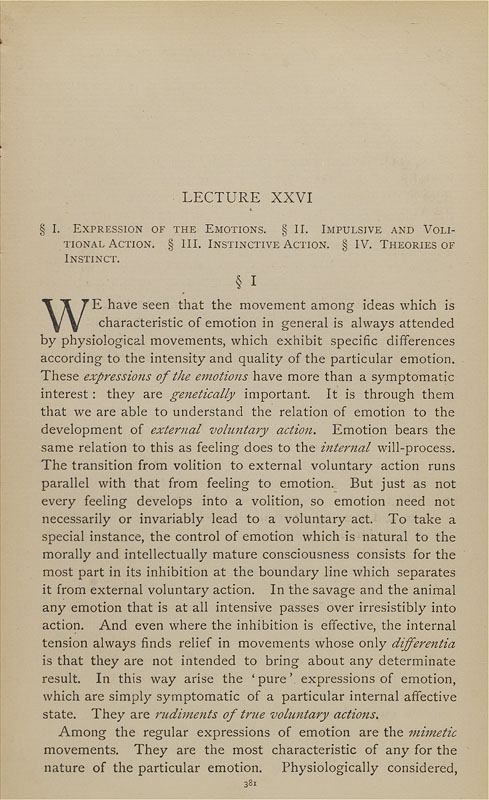
LECTURE XXVI § I. Expression of the Emotions. § II. Impulsive and Voli¬ tional Action. § III. Instinctive Action. § IV. Theories of Instinct. § I WE have seen that the movement among ideas which is characteristic of emotion in general is always attended by physiological movements, which exhibit specific differences according to the intensity and quality of the particular emotion. These expressions of the emotions have more than a symptomatic interest: they are genetically important. It is through them that we are able to understand the relation of emotion to the development of external voluntary action. Emotion bears the same relation to this as feeling does to the internal will-process. The transition from volition to external voluntary action runs parallel with that from feeling to emotion. But just as not every feeling develops into a volition, so emotion need not necessarily or invariably lead to a voluntary act. To take a special instance, the control of emotion which is natural to the morally and intellectually mature consciousness consists for the most part in its inhibition at the boundary line which separates it from external voluntary action. In the savage and the animal any emotion that is at all intensive passes over irresistibly into action. And even where the inhibition is effective, the internal tension always finds relief in movements whose only differentia is that they are not intended to bring about any determinate result. In this way arise the 'pure', expressions of emotion, which are simply symptomatic of a particular internal affective state. They are rudiments of true voluntary actions. Among the regular expressions of emotion are the mimetic movements. They are the most characteristic of any for the nature of the particular emotion. Physiologically considered. |
|
|
Page 381 |
|