

Wundt, Wilhelm Max, Lectures on human and animal psychology
(London : New York : Swan Sonnenschein & Co. ; Macmillan & Co., 1894.)
|
||

 Click here and hold to drag menu around
|





|
|
|
|

|
Page 437 | 
|
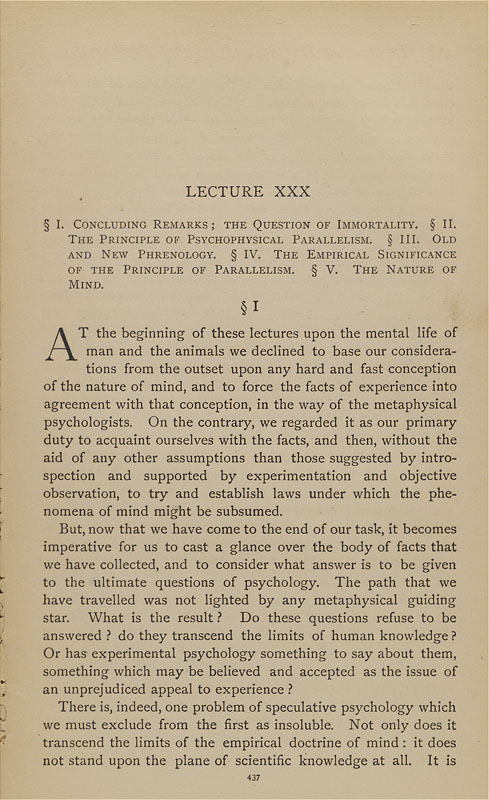
LECTURE XXX . Concluding Remarks ; the Question of Immortality. § II. The Principle of Psychophysical Parallelism. § III. Old AND New Phrenology. § IV. The Empirical Significance OF the Principle of Parallelism. § V. The Nature of Mind. AT the beginning of these lectures upon the mental life of man and the animals we declined to base our considera¬ tions from the outset upon any hard and fast conception of the nature of mind, and to force the facts of experience into agreement with that conception, in the way of the metaphysical psychologists. On the contrary, we regarded it as our primary duty to acquaint ourselves with the facts, and then, without the aid of any other assumptions than those suggested by intro¬ spection and supported by experimentation and objective observation, to try and establish laws under which the phe¬ nomena of mind might be subsumed. But, now that we have come to the end of our task, it becomes imperative for us to cast a glance over the body of facts that we have collected, and to consider what answer is to be given to the ultimate questions of psychology. The path that we have travelled was not lighted by any metaphysical guiding star. What is the result ? Do these questions refuse to be answered ? do they transcend the limits of human knowledge ? Or has experimental psychology something to say about them, something which may be believed and accepted as the issue of an unprejudiced appeal to experience ? There is, indeed, one problem of speculative psychology which we must exclude from the first as insoluble. Not only does it transcend the limits of the empirical doctrine of mind : it does not stand upon the plane of scientific knowledge at all. It is |
|
|
Page 437 |
|