

McAtamney, Hugh, Cradle days of New York (1609-1825)
(New York : Drew & Lewis, 1909.)
|
||

 Click here and hold to drag menu around
|





|
|
|
|

|
Page 15 | 
|
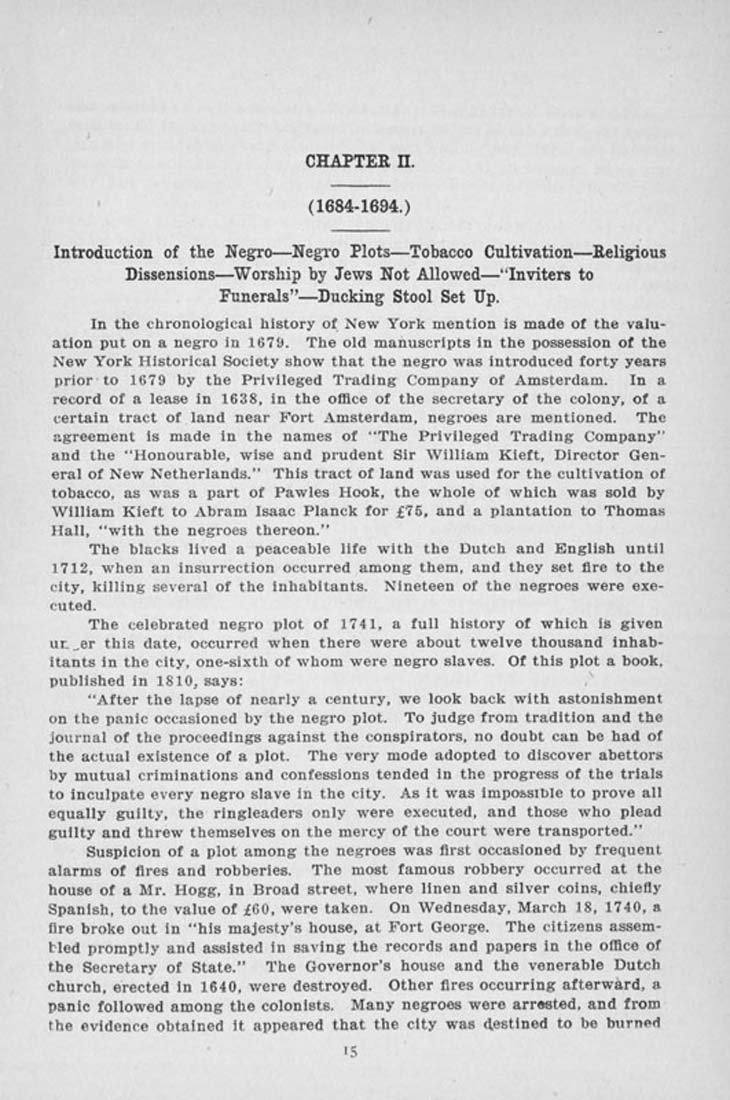
CHAPTEKIL (1684-16M.) Introduction of the Negro—Negro Plots—Tobaceo dtltivetion—Beligioui Biuensions—Worship by Jews Not Allowed—"Invitert to Frnteralft^-^Daoking Stool Set Up. In the chronological history of New York mention is made of the valu^ ation put on a negro in 1^79. The old manuscripts In the poesesston of the New York Historical Society show that the negro was introduced forty years prior to 167fl by the Privileged Trading Company of Amsterdam. In a record of a lease In 1638, in the office of the secretary of tbe colony, of a L^rtaln tract of land near Fort Amsterdam, negroes are mentioned. The agreement is made Ln the names of "The Privileged Trading Company" and the "Honourable^ wise and prudent Sir William Kieft, Director Oen- eral of New Netherlands." This tract of land was tued for the cultivation of tobacco, as was a part of Pawtes Hook, tbe whole of which was sold by William Kieft to Abram Isaac Planck for £76, and a plantation to Thomas Hall, "with the negroes thereon/' Tbe blacks lived a peaceable life with the Dutch and English until i7l£, when an insurrection occurred among them, and they set fire to tbe city, killing several of the inhabitants. Nineteen of the negroes were exe¬ cuted. Tbe celebrated negro plot of 174U a full history of which Is given un^er this date* occurred when there were about twelve thousand Inhab* Itants in the city, one-sixth of whom were negro slaves. Of this plot s book* published in 1810, says: "After the lapse of nearly a century, we look back with oBtouishment on the panic occasioned by tbe negro plot. To Judge from tradition and the Journal of the proceedings against tbe conspirators* no doubt can be bad of the actual existence of a plot. The very mode adopted to discover abettors by mutual criminations and confessions tended In the progress of the trials to inculpate every negro stave In the city. As It was impobsibie to prove all equally guilty, the ringleaders only were executed, and those who plead guilty and threw themselves on the mercy of the court were tramiported/* Suspicion of a plot among the negroes was first occasioned by frequent alarms of Area and robt>eries. Tbe most famous robbery occurred at the house of a Ur. Hogg, in Broad street, where linen and silver coins, chlefiy Spanish, to the value of i60, were taken. On Wednesday, March 18, 1740, a fire broke out In "his majesty's house, at Fort George. The citizens assem¬ bled promptly and assisted in saving the records and papers la the office of the Secretary of State/' The Governor's house and the venerable Dutch church, erected in 1(40, were destroyed. Other fires occurring afterwhrd, a panic followed among the colonists. Many negroes were arrested, and from ihe evidence obtained it appeared that the city was destined to be burned "5 |
|
|
Page 15 |
|