

McAtamney, Hugh, Cradle days of New York (1609-1825)
(New York : Drew & Lewis, 1909.)
|
||

 Click here and hold to drag menu around
|





|
|
|
|

|
Page 93 | 
|
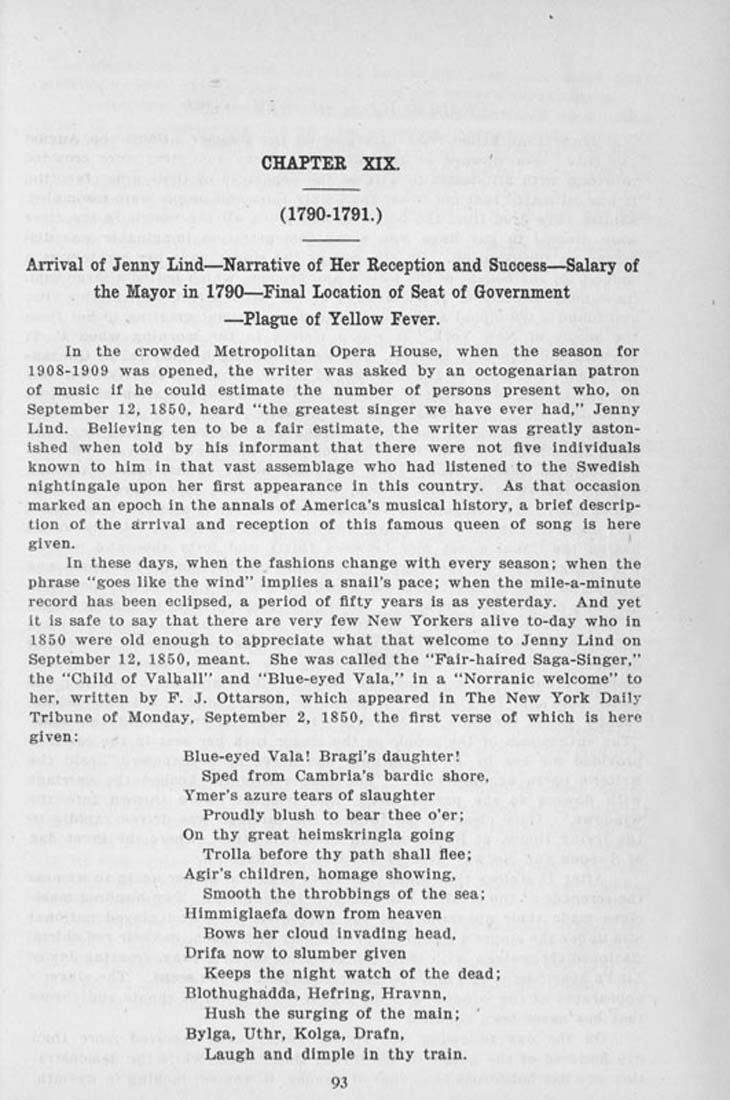
CHAPTER XTX. (1790-1791.) Anival of Jenny land—NarratiTe of Her Reception and Sneoeu—Salary of the Hayor in 1790—Pinal I.ooation of Seat of Oovemment ^PJagne of Yellow Fever. In the crowded Metropolitan Opera House, when the season for 1908^1909 was opened, tbe writer was asked by an octogenarian patron of music If he could estimate the number of persons present who, on September 12, 1S60, heard "the neatest singer we have ever had," Jenny Und. Believing ten to be a fair estimate* the writer was greatly aston¬ ished when told by hia Informant tbat there were not Ave individuals known to him In that vaat assemblage who had liatened to the Swedish nightingale upon her flrst appearance in this country. As that occasion marked an epoch In the annals of America's musical history, a brief descrip¬ tion of tbe Arrival and reception of this famous queen of song Is hers given. la theae days, when the fashions change with every season; when the phrase "goes like tbe wind" Implies a snail's pace: when the mlle^^mlnute record has been eclipsed, a period of flfty yeara Is as yeaterday. And yet It ia safe to say that there are very tew New Yorkers alive tonlay who In ISSO were eld enough to appreciate what that welcome to Jenny LInd on September 12, 1S50, meant. She was called the "Fair-haired Saga-Singer," the "Child of Valbatr' and "Blue-eyed Vafa,'^ In a "Norranic welcome" to her, written by F. J, Ottarson, which appeared in The New York Dally Tribune of Monday, September 2, 1S50, the flrst verse of which Is here given: Blue-eyed Valal Bragi's datighter! Sped from Cambria's bardic shore, Ymer*s azure tears of slaughter Proudly blush to bear thee o'er; On thy great heimakrlngla going Trolla before thy path aball flee; Agir'a children, homage showing. Smooth the throbblnga of the sea; Himmiglaefa down from heaven Bows her cloud invading head, Drifa now to slumber given Keeps the night watch of the dead; Blothughadda, Hefrlng. Hravnn, Huah the aurglng of the main; Bylga. Uthr. Kolga. Drafn. Laugh and dimple In thy train. 93 |
|
|
Page 93 |
|