

Brown, Henry Collins, Fifth Avenue old and new 1824-1924
(New York : Fifth Avenue Association, c1924.)
|
||

 Click here and hold to drag menu around
|





|
|
|
|

|
Page 13 | 
|
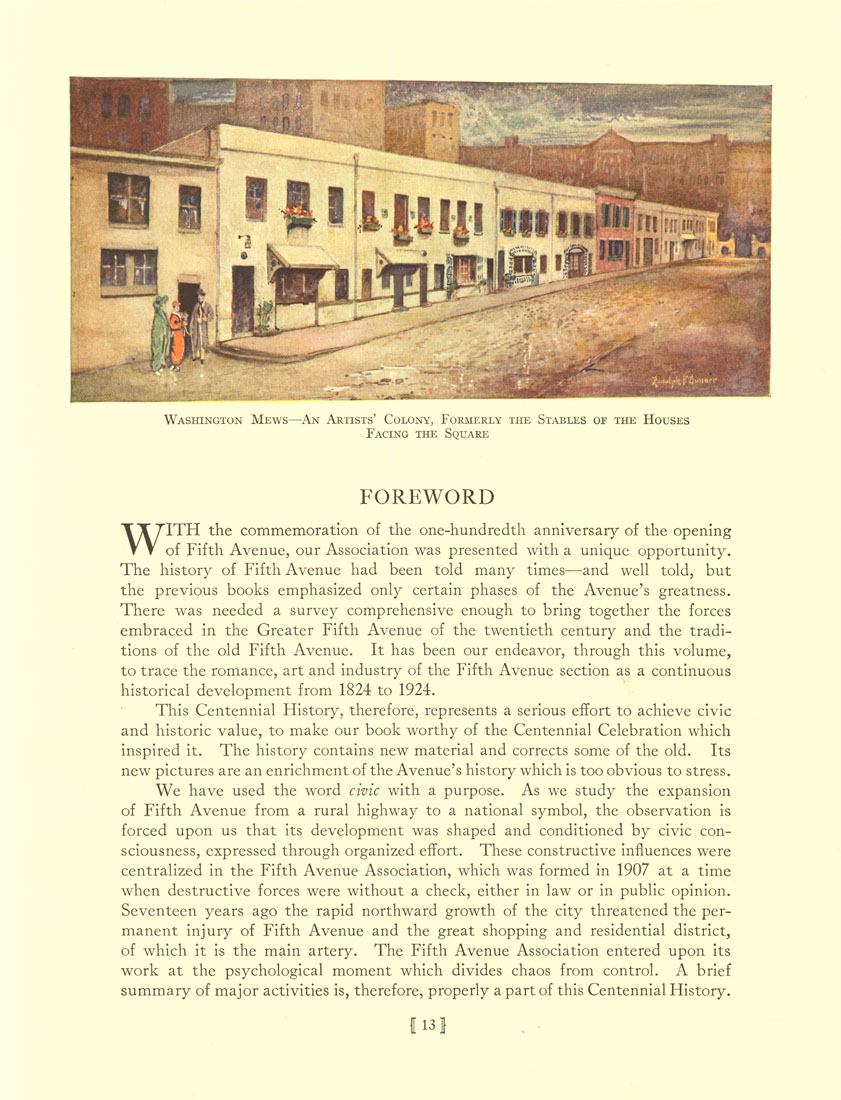
Washington Mews—An Artists' Colony, Formerly the Stables of the Houses Facing the Square FOREWORD WITH the commemoration of the one-hundredth anniversary of the opening of Fifth Avenue, our Association was presented with a unique opportunity. The history of Fifth Avenue had been told many times—and well told, but the previous books emphasized only certain phases of the Avenue's greatness. There was needed a survey comprehensive enough to bring together the forces embraced in the Greater Fifth Avenue of the twentieth century and the tradi¬ tions of the old Fifth Avenue. It has been our endeavor, through this volume, to trace the romance, art and industry of the Fifth Avenue section as a continuous historical development from 1824 to 1924. This Centennial History, therefore, represents a serious effort to achieve civic and historic value, to make our book worthy of the Centennial Celebration which inspired it. The history contains new material and corrects some of the old. Its new pictures are an enrichment of the Avenue's history which is too obvious to stress. We have used the word civic with a purpose. As we study the expansion of Fifth Avenue from a rural highway to a national symbol, the observation is forced upon us that its development was shaped and conditioned by civic con¬ sciousness, expressed through organized eifort. These constructive influences were centralized in the Fifth Avenue Association, which was formed in 1907 at a time when destructive forces were without a check, either in law or in public opinion. Seventeen years ago the rapid northward growth of the city threatened the per¬ manent injury of Fifth Avenue and the great shopping and residential district, of which it is the main artery. The Fifth Avenue Association entered upon Its work at the psychological moment which divides chaos from control. A brief summary of major activities is, therefore, properly a part of this Centennial History. |[13]1 |
|
|
Page 13 |
|