

Brown, Henry Collins, Fifth Avenue old and new 1824-1924
(New York : Fifth Avenue Association, c1924.)
|
||

 Click here and hold to drag menu around
|





|
|
|
|

|
Page 17 | 
|
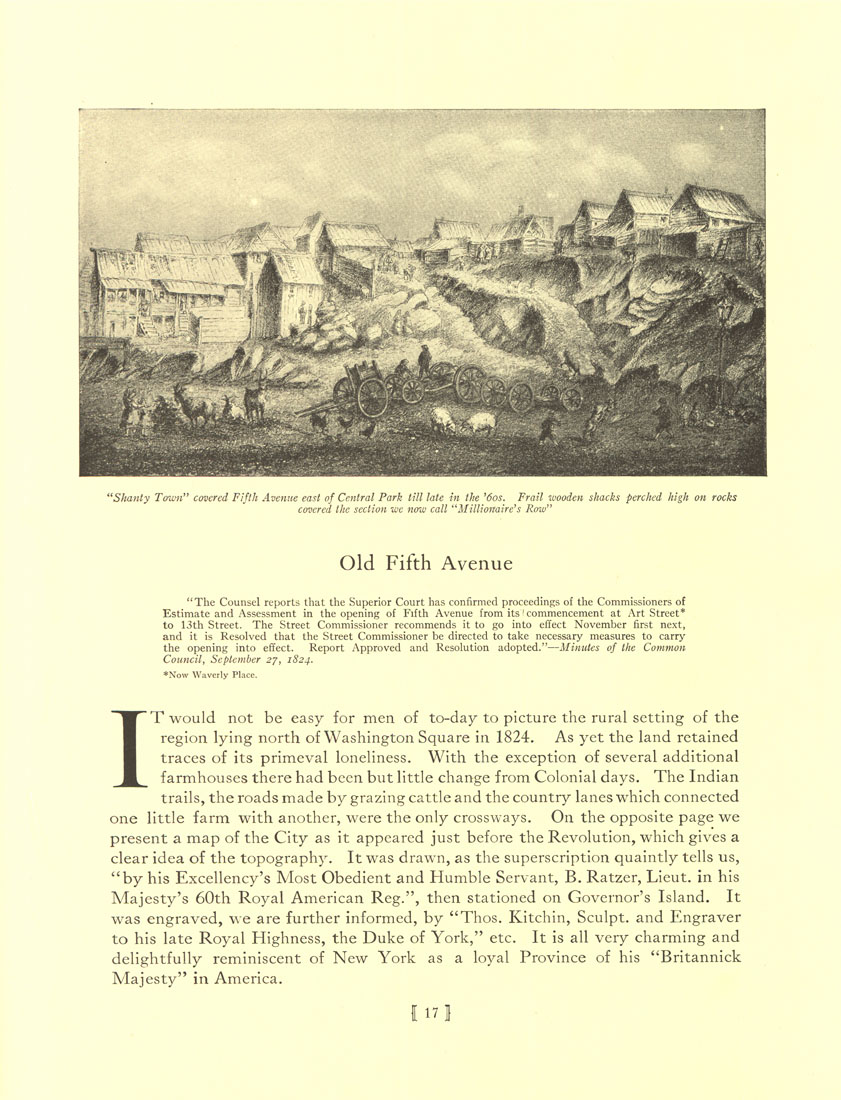
iwfT :?/'*>:'i**^f':2ff, &*■% iM^MW'€ Y' 'MVi.:.^ h <:.\ "Shanty Town^^ covered Fifth Avenue east of Central Park till late in the ^6os. Frail wooden shacks perched high on rocks covered the section we now call '^Millionairess Roiv'^ Old Fifth Avenue ''The Counsel reports that the Superior Court has confirmed proceedings of the Commissioners of Estimate and Assessment in the opening of Fifth Avenue from its ? commencement at Art Street* to 13th Street. The Street Commissioner recommends it to go into effect November first next, and it is Resolved that the Street Commissioner be directed to take necessary measures to carry the opening into effect. Report Approved and Resolution adopted."—Minutes of the Common Council, Septe?7iber 27, 1824. *Now Waverly Place. IT would not be easy for men of to-day to picture the rural setting of the region lying north of Washington Square in 1824. As yet the land retained traces of its primeval loneliness. With the exception of several additional farmhouses there had been but little change from Colonial days. The Indian trails, the roads made by grazing cattle and the country lanes w^hlch connected one little farm with another, were the only crossways. On the opposite page we present a map of the City as it appeared just before the Revolution, which gives a clear idea of the topography. It was drawn, as the superscription quaintly tells us, ''by his Excellency's Most Obedient and Humble Servant, B. Ratzer, Lieut, in his Majesty's 60th Royal American Reg.", then stationed on Governor's Island. It was engraved, we are further informed, by "Thos. KItchin, Sculpt, and Engraver to his late Royal Highness, the Duke of York," etc. It is all very charming and delightfully reminiscent of New York as a loyal Province of his "Britannick Majesty" in America. I 17 1 |
|
|
Page 17 |
|