

Wilson, James Grant, The memorial history of the City of New-York (v. 1)
([New York] : New York History Co., 1892-93.)
|
||

 Click here and hold to drag menu around
|





|
|
|
|

|
Page 33 | 
|
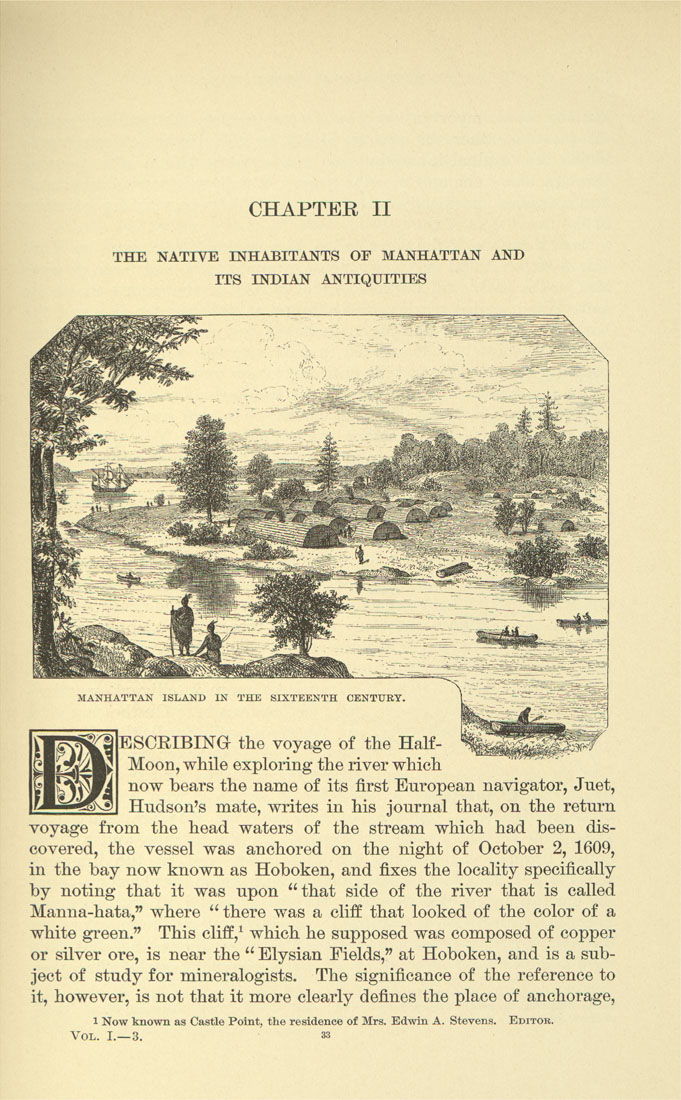
CHAPTER II THE NATIVE INHABITANTS OF MANHATTAN AND ITS INDIAN ANTIQUITIES MANHATTAN ISLAND IN THE SIXTEENTH CENTURY. ESCRIBING the voyage of the Half- Moon, while exploring the river which now bears the name of its first European navigator, Juet, Hudson's mate, writes in his journal that, on the return voyage from the head waters of the stream which had been dis¬ covered, the vessel was anchored on the night of October 2, 1609, in the bay now known as Hoboken, and fixes the locality specifically by noting that it was upon "that side of the river that is called Manna-hata," where " there was a cliff that looked of the color of a white green.'' This cliff,^ which he supposed was composed of copper or silver ore, is near the " Elysian Fields," at Hoboken, and is a sub¬ ject of study for mineralogists. The significance of the reference to it, however, is not that it more clearly defines the place of anchorage. 1 Now known as Castle Point, the residence of Mrs. Edwin A. Stevens. Vol. I.—3. 33 Editor. |
|
|
Page 33 |
|