

Ganong, William Francis, An organization of the scientific investigation of the Indian place-nomenclature of the Maritime Provinces of Canada (second paper)
(Ottawa : Printed for the Royal Society of Canada, 1912.)
|
||

 Click here and hold to drag menu around
|





|
|
|
|

|
Page [179] | 
|
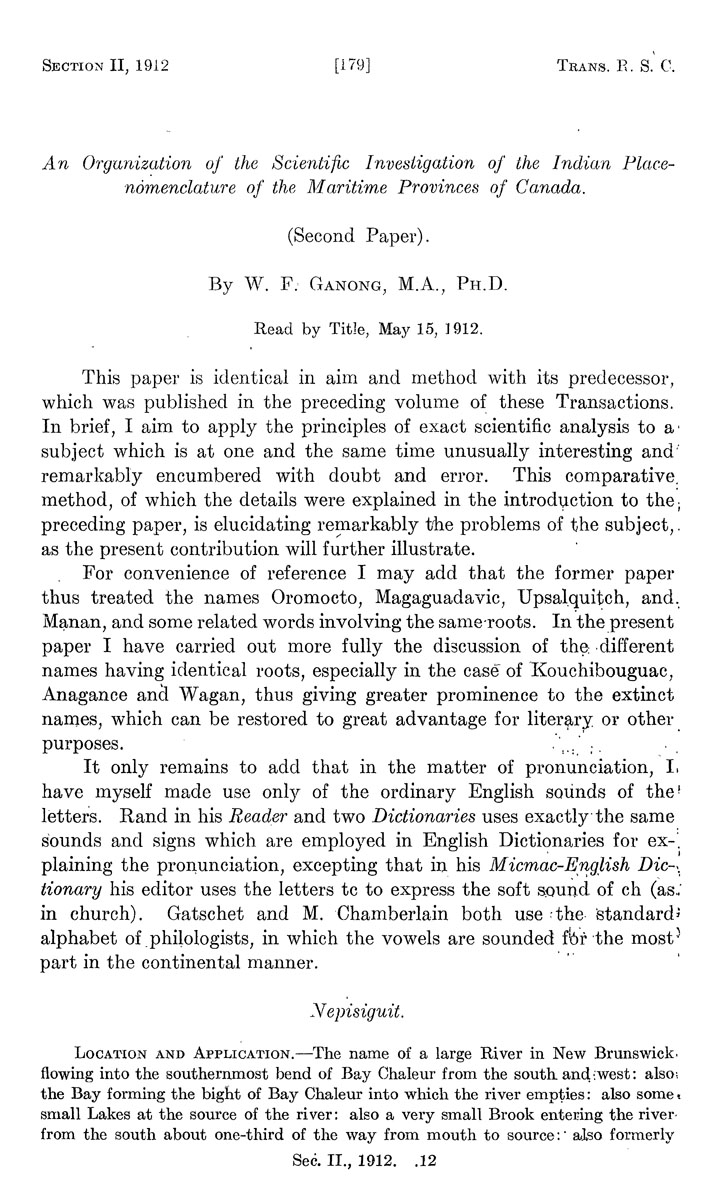
Section II, 1912 [179] Trans. K. S. C. An Organization of the Scientific Investigation of the Indian Flace- nomenclatw^e of the Maritime Provinces of Canada. (Second Paper). By W. F. Ganong, M.A., Ph.D. Read by Title, May 15, 1912. This paper is identical in aim and method with its predecessor, which was published in the preceding volume of these Transactions. In brief, I aim to apply the principles of exact scientific analysis to a' subject which is at one and the same time unusually interesting and remarkably encumbered with doubt and error. This comparative, method, of which the details were explained in the introduction to the; preceding paper, is elucidating remarkably tiie problems of the subject,. as the present contribution will further illustrate. For convenience of reference I may add that the former paper thus treated the names Oromocto, Magaguadavic, Upsalquitch, and. Manan, and some related words involving the same-roots. In the present paper I have carried out more fully the discussion of the: different names having identical roots, especially in the case of Kouchibouguac, Anagance ancl Wagan, thus giving greater prominence to the extinct naraes, which can be restored to great advantage for literary or other purposes. :: .. It only remains to add that in the matter of pronunciation, I. have myself made use only of the ordinary English sounds of the- letters. Rand in his Reader and two Dictionaries uses exactly the same sounds and signs which are employed in English Dictionaries for ex-', plaining the pronunciation, excepting that in his Micmac-English Dic-^ tionary his editor uses the letters tc to express the soft s<)Uiid of ch (as..' in church). Gatschet and M. Chamberlain both use the standard*' alphabet of philologists, in which the vowels are sounded fbr the most^ part in the continental manner. Nepisignit. Location and Application.—The name of a large River in New Brunsv/ick. flowing into the southernmost bend of Bay Chaleur from the south and-west: also; the Bay forming the bight of Bay Chaleur into which the river empties: also some« small Lakes at the source of the river: also a very small Brook entering the river- from the south about one-third of the way from mouth to source:* a>lso formerly Sec. II., 1912. .12 |
|
|
Page [179] |
|