

Ganong, William Francis, An organization of the scientific investigation of the Indian place-nomenclature of the Maritime Provinces of Canada
(Ottawa : Printed for the Royal Society of Canada, 1914.)
|
||

 Click here and hold to drag menu around
|





|
|
|
|

|
Page [259] | 
|
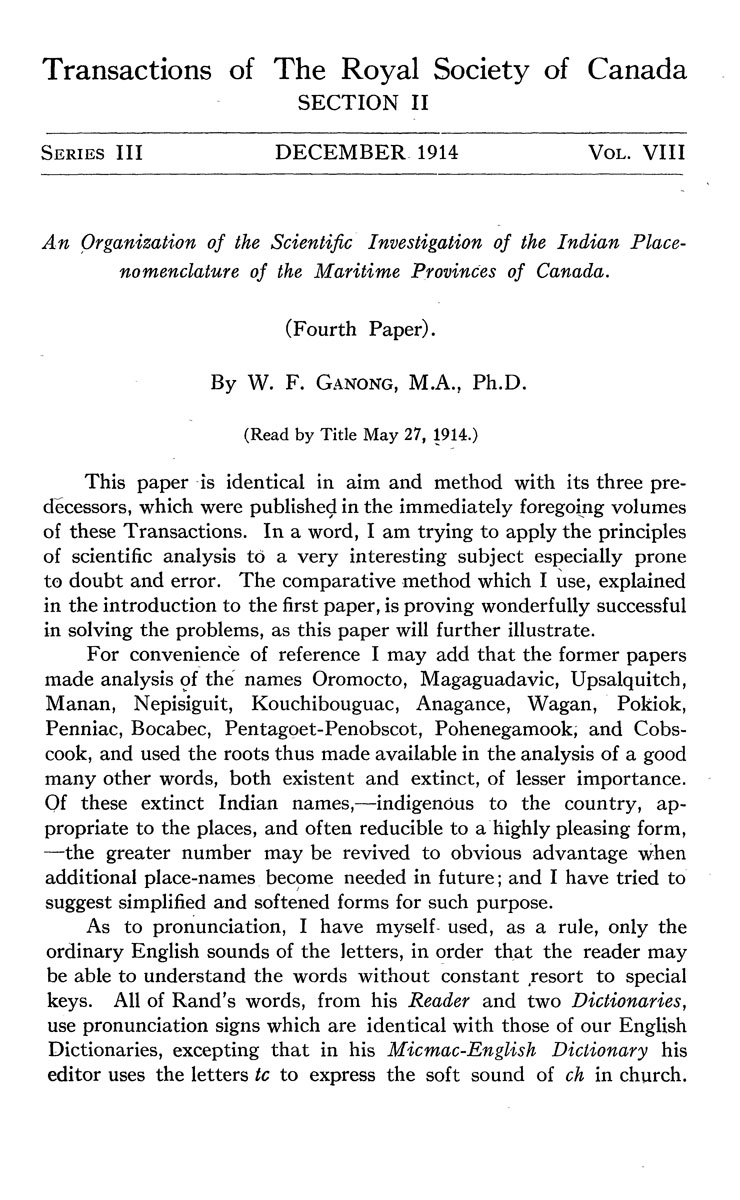
Transactions of The Royal Society of Canada SECTION II Series III DECEMBER 1914 Vol. VIII An Organization of the Scientific Investigation of the Indian Place- nomenclature of the Maritime Provinces of Canada, (Fourth Paper). By W. F. Ganong, M.A., Ph.D. (Read by Title May 27, 1914.) This paper is identical in aim and method with its three pre¬ decessors, which were published in the immediately foregoing volumes of these Transactions. In a word, I am trying to apply the principles of scientific analysis to a very interesting subject especially prone to doubt and error. The comparative method which I use, explained in the introduction to the first paper, is proving wonderfully successful in solving the problems, as this paper will further illustrate. For convenience of reference I may add that the former papers made analysis of the names Oromocto, Magaguadavic, Upsalquitch, Manan, Nepisiguit, Kouchibouguac, Anagance, Wagan, Pokiok, Penniac, Bocabec, Pentagoet-Penobscot, Pohenegamook, and Cobs- cook, and used the roots thus made available in the analysis of a good many other words, both existent and extinct, of lesser importance. Of these extinct Indian names,—indigenous to the country, ap¬ propriate to the places, and often reducible to a highly pleasing form, —the greater number may be revived to obvious advantage when additional place-names become needed in future; and I have tried to suggest simplified and softened forms for such purpose. As to pronunciation, I have myself used, as a rule, only the ordinary English sounds of the letters, in order that the reader may be able to understand the words without constant resort to special keys. All of Rand's words, from his Reader and two Dictionaries, use pronunciation signs which are identical with those of our English Dictionaries, excepting that in his Micmac-English Dictionary his editor uses the letters to to express the soft sound of ch in church. |
|
|
Page [259] |
|