

Assyrian and Babylonian literature
(New York : D. Appleton and Company, 1901.)
|
||

 Click here and hold to drag menu around
|





|
|
|
|

|
Page 445 | 
|
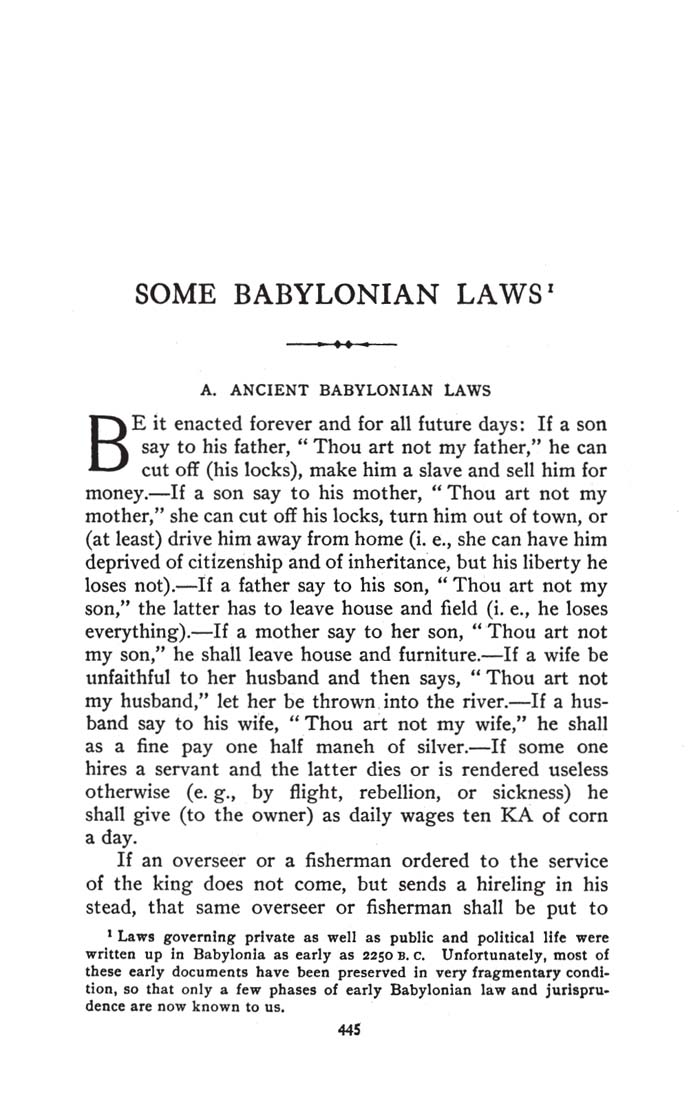
SOME BABYLONIAN LAWS' >♦ — A. ANCIENT BABYLONIAN LAWS BE it enacted forever and for afl future days: If a son say to his father, " Thou art not my father," he can cut off (his locks), make him a slave and sell him for money.—If a son say to his mother, " Thou art not my mother," she can cut off his locks, turn him out of town, or (at least) drive him away from home (I. e., she can have him deprived of citizenship and of Inheritance, but his liberty he loses not).—If a father say to his son, " Thou art not my son," the latter has to leave house and field (I. e., he loses everything).—If a mother say to her son, " Thou art not my son," he shall leave house and furniture.—If a wife be unfaithful to her husband and then says, " Thou art not my husband," let her be thrown into the river.—If a hus¬ band say to his wife, " Thou art not my wife," he shall as a fine pay one half maneh of silver.-—If some one hires a servant and the latter dies or is rendered useless otherwise (e. g., by flight, rebellion, or sickness) he shall give (to the owner) as daily wages ten KA of corn a day. If an overseer or a fisherman ordered to the service of the king does not come, but sends a hireling in his stead, that same overseer or fisherman shall be put to • Laws governing private as well as public and political Hfe were written up in Babylonia as early as Z250 B. c. Unfortunately, most of these early documents have been preserved in very fragmentary condi¬ tion, so that only a few phases of early Babylonian law and jurispru¬ dence are now known to us. 445 |
|
|
Page 445 |
|