

Ohnefalsch-Richter, Max Hermann, Kypros the Bible and Homer
(London : Asher & Co., 1893.)
|
||

 Click here and hold to drag menu around
|





|
|
|
|

|
Page [29] | 
|
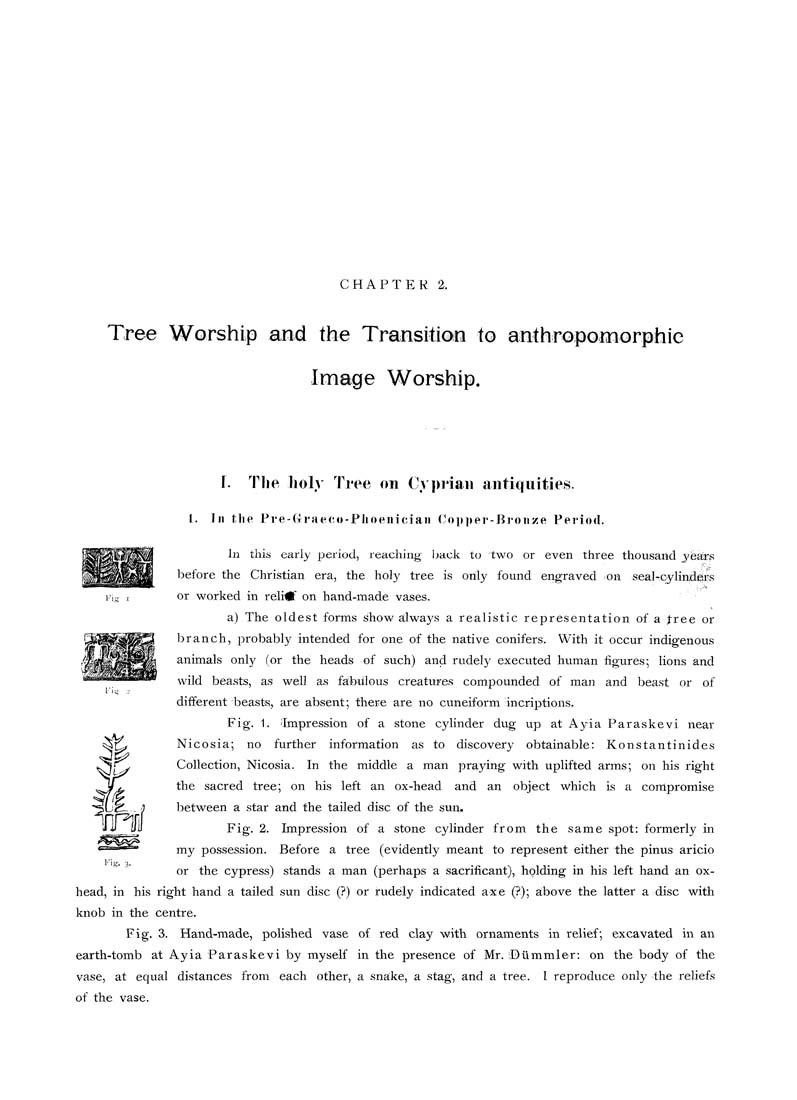
CHAPTER 2. Tree Worship and the Transition to anthropomorphic Image Worship. I'ig I I. Tlie lioly Tree on Cy|>iiaii antiquities. L Jn the Pre-Graeco-Phoenician Copper-Bronze Period. In this early period, reaching back to two or even three thousand yemcs before the Christian era, the holy tree is orily found engraved on seal^cylind^rs or worked in relief on hand-made vases. a) The oldest forms show alwa3^s a realistic representation of a tree or branch, probably intended for one of the native conifers. With it occur indigenous animals only (or the heads of such) and rudely executed human figures; lions and wild beasts, as well as fabiilous creatures compounded of man and beast or of different beasts, are absent; there are no cuneiform incriptions. Fig. 1. 'Impression of a stone cylinder dug up at Ayia Paraskevi near Nicosia; no further information as to discovery obtainable: Konstantinides Collection, Nicosia. In the middle a man praying with uplifted arms; on his right the sacred tree; on his left an ox-head and an object which is a compromise between a star and the tailed disc of the sun. Fig. 2. Impression of a stone cylinder from the same spot: formerly in my possession. Before a tree (evidently meant to represent either the pinus aricio or the cypress) stands a man (perhaps a sacrificant), holding in his left hand an ox- head, in his right hand a tailed sun disc (?) or rudely indicated axe (?); above the latter a disc with knob in the centre. Fig. 3. Hand-made, polished vase of red clay with ornaments in relief; excavated in an earth-tomb at Ayia Paraskevi by myself in the presence of Mr. .Dummler: on the body of the vase, at equal distances from each other, a sna:ke, a stag, and a tree. I reproduce only the reliefs of the vase. |
|
|
Page [29] |
|