

Ohnefalsch-Richter, Max Hermann, Kypros the Bible and Homer
(London : Asher & Co., 1893.)
|
||

 Click here and hold to drag menu around
|





|
|
|
|

|
[No Page Number] | 
|
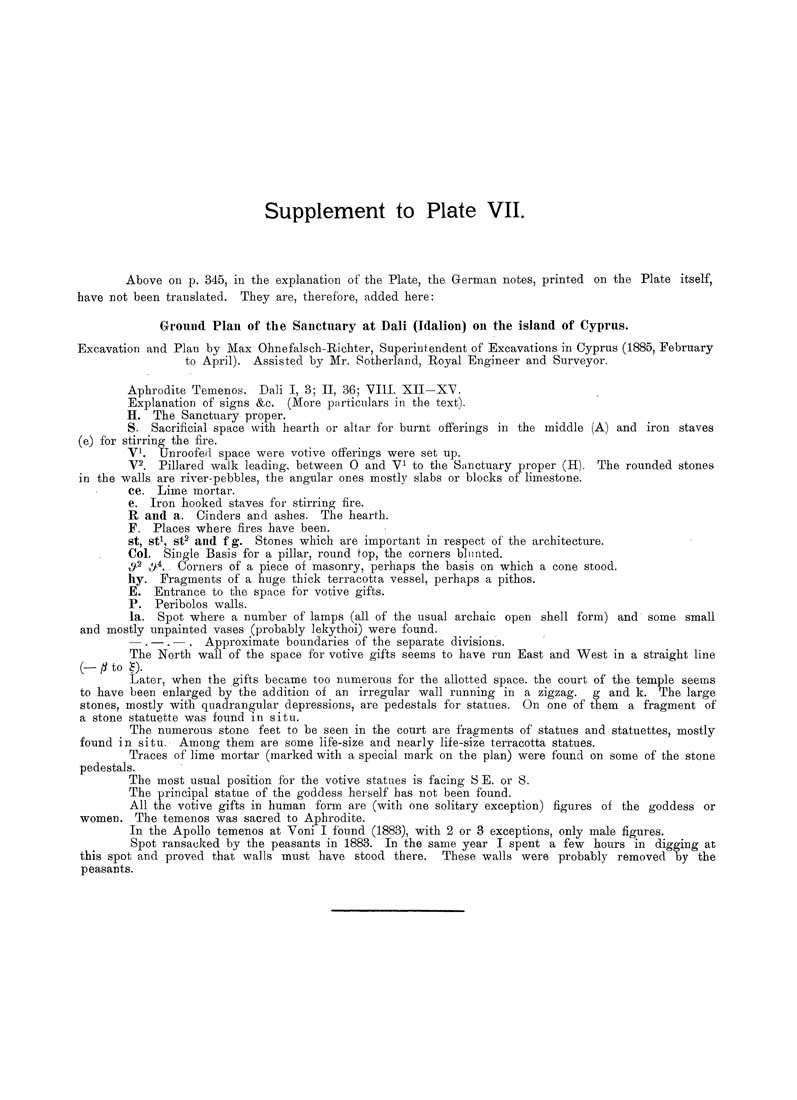
Supplement to Plate VII, Above on p. 345, in the explanation of the Plate, the German notes, printed on the Plate itself, have not been translated. They are, therefore, added here: Ground Plan of the Sanctuary at Dali (Idalion) on the island of Cyprus. ^lan by Max Ohnefalsch-Pichter, Superintendent of Excavations in Cyprt] to April). Assisted by Mr. Sotherland, Eoyal Engineer and Surveyor. Excavation and Plan by Max Ohnefalseh-Richter, Superinte^ndent^f Excavations^in Cyprus (1885, February rlai Aphrodite Temenos. Dali I, 3; II, 36; VIIL XII-XV, Explanation of signs &c. (More particulars in the text), H. The Sanctuary proper. S. Sacrificial space with hearth or altar for burnt offerings in the middle (A) and iron staves (e) for stirring the fire. V^. Unroofed space were votive oiferings were set up. V^. Pillared walk leading, between 0 and V^ to the Sanctuary proper (H), The rounded stones in the walls are river-pebbles, the angular ones mostly slabs or blocks of^ limestone. ce. Lime mortar. e. Iron hooked staves for stirring fire. R and a. Cinders and ashes. The hearth. F, Places where fires have been. st, st^, st^ and f g. Stones which are important in respect of the architecture. CoL Single Basis for a pillar, round top, the corners blunted. ■d^ i}^. Corners of a piece of masonry, perhaps the basis on which a cone stood. hy. Fragments of a huge thick terracotta vessel, perhaps a pithos. E. Entrance to the space for votive gifts. P. Peribolos walls. la. Spot where a number of lamps (all of the usual archaic open shell form) and some small and mostly unpainted vases (probably lekythoi) were found. — . — . — . Approximate boundaries of the separate divisions. The North wall of the space for votive gifts seems to have run East and West in a straight line (— ^ to ?). Later, when the gifts became too numerous for the allotted space, the court of the temple seems to have been enlarged by the addition of an irregular wall running in a zigzag, g and k. The large stones, mostly with quadrangular depressions, are pedestals for statues. On one of them a fragment of a stone statuette was found in situ. The numerous stone feet to be seen in the court are fragments of statues and statuettes, mostly found in situ. Among them are some life-size and nearly life-size terracotta statues. Traces of lime mortar (marked with a special mark on the plan) w^ere found on some of the stone pedestals. The most usual position for the votive statues is facing S E, or S. The principal statue of the goddess herself has not been found. All the votive gifts in human form are (with one solitary exception) figures of the goddess or women. The temenos was sacred to Aphrodite. In the Apollo temenos at Voni I found (1883), with 2 or 8 exceptions, only male figures. Spot ransacked by the peasants in 1888. In the same year I spent a few hours in digging at this spot and proved that walls must have stood there. These walls were probably removed by the peasants. |
|
|
[No Page Number] |
|