

Thucydides. Thucydides translated into English (v. 1)
(Oxford : Clarendon Press, 1881.)
|
||

 Click here and hold to drag menu around
|





|
|
|
|

|
Page [169] | 
|
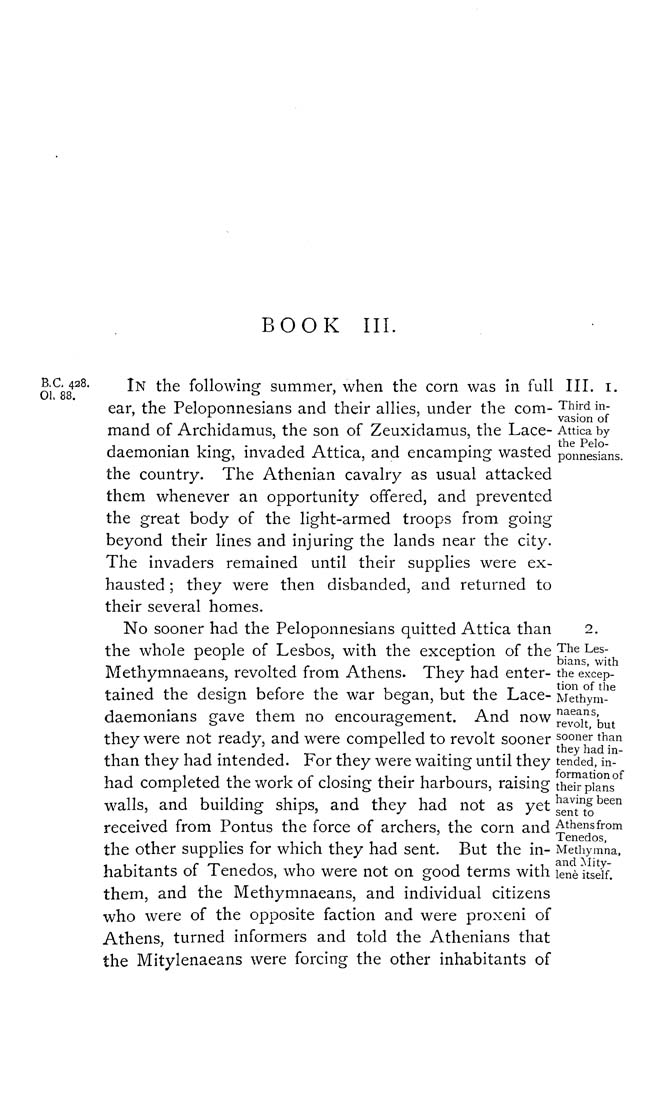
BOOK III. B.C. 428. In tiie following summer, when the corn was in full III. i. Uli 88. ear, the Peloponnesians and their allies, under the com- Third in- ^ . vasion of mand of Archidamus, the son of Zeuxidamus, the Lace- Attica by daemonlan king, invaded Attica, and encamping wasted ponnesians. the country. The Athenian cavalry as usual attacked them whenever an opportunity offered, and prevented the great body of the light-armed troops from going beyond their lines and injuring the lands near the city. The Invaders remained until their supplies were ex¬ hausted ; they were then disbanded, and returned to their several homes. No sooner had the Peloponnesians quitted Attica than 2. the whole people of Lesbos, with the exception of the ^he Les- bians, with Methymnaeans, revolted from Athens. They had enter- the excep- tained the design before the war began, but the Lace- Methym-^ daemonians gave them no encouragement. And now r^voi^^b^t they were not ready, and were compelled to revolt sooner sooner than -^ . "^ ^ they had in- than they had Intended. For they were waiting until they tended, in- had completed the work of closing their harbours, raising their pians° walls, and building ships, and they had not as yet ^^JJ^^I ^^^^ received from Pontus the force of archers, the corn and Athens from 1- r 1 1 Tenedos, the other supplies for which they had sent. But the in- Methymna, habitants of Tenedos, who were not on good terms with lene itself. them, and the Methymnaeans, and individual citizens who were of the opposite faction and were proxeni of Athens, turned Informers and told the Athenians that the MItylenaeans were forcing the other inhabitants of |
|
|
Page [169] |
|