
The Magill Lecture:
Stephen Jay Gould on the Symbiotic Relationship Between Art and Science.
by John Wong

|
The Magill Lecture:Stephen Jay Gould on the Symbiotic Relationship Between Art and Science.
by John Wong
|
|
Is there a strong relationship between the arts and the
sciences?
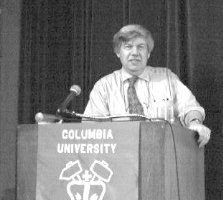
This was the question posed by Stephen Jay Gould, the 1996 speaker for the
annual Magill Lecture on March 27, 1996. Gould is an evolutionary
biologist, paleontologist, and professor at Harvard University.
Gould began the lecture by talking about categorization, or the human tendency to order the world. For example, take his field of paleontology. Why is this field placed in the realm of physical sciences and not history? In terms of science, paleontology is the science of the forms of life existing in former geological periods, as represented by fossils. Such an endeavor requires mostly the use of classification. It is the act of allocating nature to its proper place. However, some scientists look down upon the field as merely a tidying operation. Some feel that paleontologists are merely "stamp collectors". However, Dr. Gould defends against this statement saying that there is an active theory at work behind the field, and that paleontologists are not just passive recorders. Gould explained that science, as well as art, benefits from the personalities that represent their respective fields. Darwin, with his radical way of explaining evolution, impacted the way the world now views evolution, just as Michelangelo redefined the art of his time. In essence, science is not just an exercise of objective judgement. Rather, it has its own human dimensions. It is incorrect to assume that personalities are of no interest in science. Gould also gave a few stories to illustrate the relationship between art and science. His claim is that "art needs science, and science needs art". In the first example, he showed a book written many years ago on shells. The fascinating aspect of the book is that these shells were placed in strategic positions as to maximize their aesthetic effect. The scientist who put together the book took the role of the artist to bring out the full effect of the science. The second story told by Dr. Gould was about the poet and writer Edgar Allan Poe's little-known authoring of "The Chonconlogist's First Book," which was a book about clams and shelled animals. Literary scholars could not figure out why Poe, who was not known to have an interest in biology, wrote such a book. It turned out that a science background was needed to decipher this question. In the introduction of the book, Poe wrote that shelled animals were traditionally classified in books by the shells. He said that his book was the first to classify them by both the shells and the animals that live within those shells. The reason a biologist chose Poe to write the book was that Poe was known to be fluent in French. Information about the shelled animals was not available in English; therefore, a translator was needed to write the book. Poe copied much of the information from French sources, as international copyright laws were not heavily enforced during Poe's time. Biologists made a living in those times by giving lectures and selling such books, as university positions were relatively scarce. | |
 
|
|
|
The third story told by Gould was about how an artistic
background once
aided scientists in solving a particular puzzle. One artist in the early
20th century, obsessed with the idea that all coloring in animals can be
attributed to concealment, once produced many hundreds of examples how
this occurs. For example, a zebra in wild-grass seems to be entirely
camouflaged. A peacock can be strategically situated in front of trees and
shrubs so that even his vibrant feathers are concealed. However, these
backgrounds were not the natural habitats of the respective animals. The
artist's contention was obviously mistaken. Nevertheless, he also made an
astute observation on one particular point that proved to be insightfully
correct: In ducks, there exists a gradual change from lighter colors to
darker colors. This technique, called "countershading" in the artistic
realm, has the effect of making a three-dimensional object look two
dimensional. This effect serves to protect the animal from its predators.
While scientists has speculated on the value of the duck's shaded
feathers, they had never been able to fully solve the puzzle of how the
phenomena helped in concealment. It took an artist's trained eye to
point out this fact.
The fourth story was about how knowledge of science is needed to make depictions of prehistoric life true. Dr. Gould showed some slides of prehistoric scenes. First, there were the dinosaurs. When another species, such as fish, appeared, the dinosaurs were gone. In other words, there exists archeological evidence that certain species coexisted in a certain period, but these species were not shown together in the pictorial depiction of a certain time period. Therefore, knowledge in science is helpful in creating historically correct art. Dr. Gould ended his lecture declaring that people who master both art and science should not be seen as a rarity; such people are merely intellectually curious people who make full and complete use of their minds. Also, people should not be beguiled by false, erstwhile misleading categorizations Dr. Gould is well-known both in academic and popular science circles. In addition to excellent teaching skills, he has the talent of explaining science to the general public in clear prose. He has written for a column for Natural History magazine for 20 years. He is also the author of Dinosaur in a Haystack, a New York Times best-seller. He received his Ph.D. from Columbia in 1967. | |

|
Harvard University |
 |
 |
 |
 |
| Moment Home Page |
Current Article Index |
Search |
Back Issues |