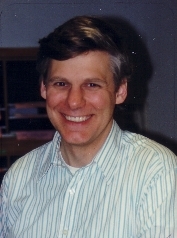
Biography
EDUCATION:
B.S. 1985, M.I.T.
Ph.D. 1992, M.I.T.
RESEARCH:
My research is focused on the study of nuclear matter at extreme temperatures and/or densities. One of the goals of this research is experimental manifestation of the QCD phase transition from ordinary hadronic matter to a form of matter in which quarks and gluons become locally deconfined. Our group currently uses fixed-target collisions of heavy nuclei to produce systems at high baryon density (up to 10 times normal nuclear density), which we then study through the measurement of single-particle production cross sections and two-particle correlation functions. These measurements provide information on the kinetic and flavor partitioning of energy during the collision and on the size of the system at breakup. The experiments are performed at Brookhaven National Laboratory using the Alternating Gradient Synchrotron, which provides beams of Au ions at a momentum of 11 A GeV/c.
One of my specific interests is the study of strange-particle production in these collisions. Early data from our experiment demonstrated that the yield of particles carrying a strange quark is significantly enhanced in heavy-ion collisions. A detailed understanding of the mechanism responsible for this increase has eluded our grasp. Therefore, I have led the development of a proposal for a new experiment to perform a detailed study of the strangeness-enhancement mechanism in proton-nucleus collisions using a 4p detector. This experiment will also make use of the high strange-particle yield in these collisions to search for the H dibaryon, a six-quark particle that is thought to be stable against strong decay.
For the future, I am working on the Phenix experiment, which is one of two major experiments to be carried out at the Relativistic Heavy-Ion Collider Facility currently under construction at Brookhaven. This facility is devoted to the study of heavy-ion collisions at a center-of-mass energy of 200xA GeV. It is thought that such collisions will produce conditions similar to those that existed in the early universe before the universe cooled through the QCD phase-transition. Our group is developing data-acquisition electronics to be used to read out various detectors in the experiment.
SELECTED PUBLICATIONS:
"Leading Particle Distributions in 200 Gev/c p+A Interactions" (K. Abe, et al.) PLB 200, 266 (1988).
"Kaon and Pion Production in Central Si+Au Collisions at 14.6 A GeV" (T. Abbott, et al.) PRL 64, 847 (1990).
"Bose-Einstein Correlations of Kaons in Si+Au Collisions at 14.6 A GeV" (T. Abbott et al.) PRL 70, 1057 (1993).
"A Proposal for a Facility to Study Proton-Nucleus and Nucleus-Nucleus Collisions Using a Large-Acceptance Detector with Particle Identification Capabilities" (B. A. Cole, et al.) BNL Proposal P910, October 1994.
"Coalescence Production of H0's in p-A Collisions" (B. A. Cole et al.) submitted to Phys. Lett. B.
Back to Top 

|