 Speaker:
Lidija Zivkovic, Columbia University
Speaker:
Lidija Zivkovic, Columbia University
Speaker:
Lidija Zivkovic, Columbia University
Title: "Closing in on the Higgs Boson"
The Standard Model describes the unification of electromagnetic and
weak interactions. It was thoroughly tested over past thirty years,
and represents one of the major successes of modern physics. This
theory predicted the existence and the masses of the weak bosons. The
last remaining piece of the puzzle is the Higgs boson whose existence
is crucial for our understanding of the origin of particle masses.
 Speaker: Martina Hurwitz, University of Chicago
Title: "Observation of WW+WZ production in a semileptonic decay at CDF"
Abstract:
I will present the recent observation and cross section measurement of WW+WZ production in the lepton plus jets final state at CDF. This measurement is an important milestone in the search for the Standard Model Higgs boson at the Tevatron due to the similar event topology and analysis techniques. I will describe the details of the analysis, including the use of matrix element calculations to separate the signal from the large backgrounds.
 Speaker: Miguel Vidal, CIEMAT
Title: "Search for Third Generation Squarks in the Missing Transverse Energy plus jet Sample at CDF"
Abstract:
I will present the searches for gluino-mediated sbottom, and stop direct production decaying into charm and neutralino using CDF II data. These signatures translate into final states with large missing transverse energy and jets, where at least one of the jets is required to be tagged as originated from a heavy flavor quark. I will describe the analysis techniques and optimization tools, focusing on data driven methods to estimate heavy flavor multijet bacgrounds and charm tagging, both especially developed for these analyses.
**Special start time at 1:30 PM in 831 Pupin Hall**
 Speaker: Mandy Rominsky, University of Oklahoma
Title: "Measuring the Dijet Mass Cross Section at D0"
Abstract:
The dijet mass cross section is measured in ppbar collisions at a center of mass energy of 1.96 TeV using 0.7 fb-1 of data collected at the D0 detector at the Tevatron. The measurement is performed in six rapidity regions up to |y| < 2.4 for the two jets with the largest transverse momentum. The results are compared to MSTW2008 NLO predictions and found to be in good agreement.
**Special start time at 12:30 PM in 705 Pupin Hall**
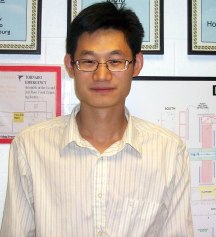 Speaker: Xuebing Bu, USTC, Hefei, China
Title: "Search for H->gammagamma at D0"
Abstract:
We present a search for a light Higgs boson in the di-photon final state using 4.2 fb-1 of the D0 Run II data, collected at the Fermilab Tevatron collider from April 2002 to December 2008. Good agreement between the data and the Standard Model (SM) background prediction is observed. Since there is no evidence for new physics, we set 95% C.L. limits on the production cross section times the branching ratio relative to the SM-like Higgs prediction for different assumed Higgs masses. We also extend the results to the particular fermiophobic Higgs model, where we have reached the world's best sensitivity, and provide the access to the Mhf>125 GeV regions, which is inaccessible at LEP.
**Seminar will start at 1:00 PM in 1124 Pupin Hall**