Professor Charles Hailey
Currently we are building the telescopes for the High Energy Focusing Telescope (HEFT) experiment. HEFT will be the world’s largest hard X-ray telescope, operating in the 20-120 keV energy band and flown from a balloon. HEFT will map the hard X-ray emission from supernova remnants to investigate issues of stellar nucleosynthesis (through the mapping of radioactive Titanium) and study the origin and acceleration of cosmic-rays (through mapping the continuum hard X-rays produced in the same shocks that produce the cosmic-rays). HEFT employs a novel approach to the construction of low cost, high performance hard X-ray telescopes that was developed in our group. The first flight of HEFT will take place within a year with many flights to follow which will observe other objects of interest such as Active Galactic Nuclei. HEFT will also make the first high resolution hard X-ray maps of the galactic center, the site of many black holes and neutron stars. HEFT is being done in collaboration with several other institutions including CalTech detectors), Danish Space Research Institute (mirror coatings) and Lawrence Livermore National Lab (pointing system and gondola). We are also investigating the feasibility of employing the telescope fabrication techniques we have developed for HEFT to the next generation of X-ray satellites called Constellation-X (in collaboration with CalTech, Livermore, DSRI and Goddard Space Flight Center).


Asst. Professor Amber Miller
A Columbia research effort in experimental CMB started in 2002 headed by Professor Miller. Miller studies anisotropies in the CMB, constraining cosmological parameters such as the geometry and composition of the Universe. She is also involved in the Interferometric Sunyaev-Zel'dovich Effect Imaging Experiment at the OVRO and BIMA radio observatories. The Sunyaev-Zel'dovich effect (SZE) causes a change in the apparent brightness of the CMB towards a cluster of galaxies or any other reservoir of hot plasma. Measurements of the effect provide distinctly different information about cluster properties than X-ray imaging data, while combining X-ray and Sunyaev-Zel'dovich effect data leads to new insights into cluster physics. The effect is redshift-independent, and so provides a unique probe of the structure of the Universe on the largest scales. The group will be designing instruments for non-targeted SZE surveys which will be capable of measuring all clusters independent of redshift out to a specified mass limit, providing a powerful probe of the high redshift Universe.
 Amber Miller leads the Columbia University Experimental Cosmology
group, dedicated to studying relic signatures from the Big Bang with
the goal of understanding the origin and evolution of the universe.
Specifically, the team studies the Cosmic Microwave Background (CMB)
and the Sunyaev-Zel'dovich Effect (SZE) using sensitive centimeter and
millimeter-wave instruments designed specifically for this work. The
Columbia team designs, builds, deploys, and analyzes data from novel
telescopes employing cutting edge technology, much of which is piloted
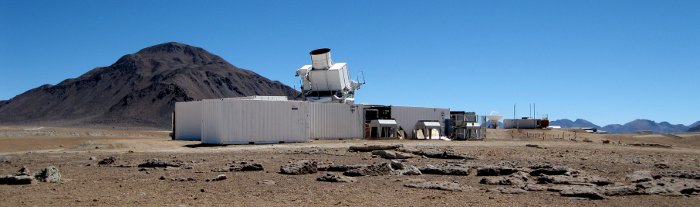
and tested by the group. The QUIET and EBEX experiments - currently
under development in close collaboration with teams at other
universities - are designed to probe detailed physics in the universe
when it was much less than one second old. The first QUIET camera,
built at Columbia, is currently observing the CMB from 17,000 ft. in
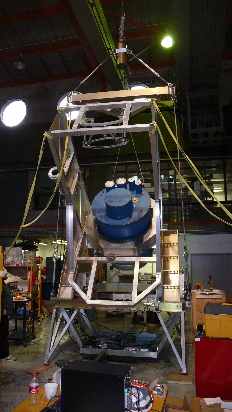
the Atacama desert in Chile. The EBEX experiment is currently being
integrated at Columbia's Nevis laboratories for it's first flight from
a high-altitude balloon in the spring of 2009.
Amber Miller leads the Columbia University Experimental Cosmology
group, dedicated to studying relic signatures from the Big Bang with
the goal of understanding the origin and evolution of the universe.
Specifically, the team studies the Cosmic Microwave Background (CMB)
and the Sunyaev-Zel'dovich Effect (SZE) using sensitive centimeter and
millimeter-wave instruments designed specifically for this work. The
Columbia team designs, builds, deploys, and analyzes data from novel
telescopes employing cutting edge technology, much of which is piloted
and tested by the group. The QUIET and EBEX experiments - currently
under development in close collaboration with teams at other
universities - are designed to probe detailed physics in the universe
when it was much less than one second old. The first QUIET camera,
built at Columbia, is currently observing the CMB from 17,000 ft. in
the Atacama desert in Chile. The EBEX experiment is currently being
integrated at Columbia's Nevis laboratories for it's first flight from
a high-altitude balloon in the spring of 2009.
Prof. Miller has also long held an interest in issues on the interface between science and policy. She worked at Princeton University on issues related to satellite verification of nuclear non-proliferation agreements, organized a round table meeting at Columbia with the Union of Concerned Scientists, and has participated in several conferences on science and politics. Prof. Miller developed and piloted a seminar at Columbia entitled "Science, Politics, and Critical Thinking", and taught a lecture course entitled "Weapons of Mass Destruction". She was a Columbia University Committee on Global Thought Fellow, and is currently a Term Member on the Council on Foreign Relations.
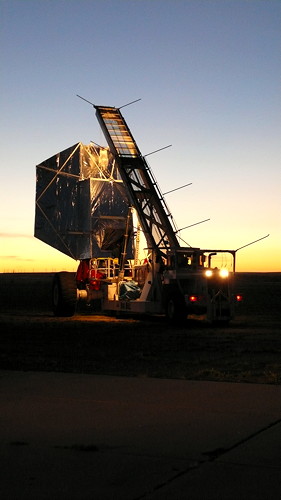
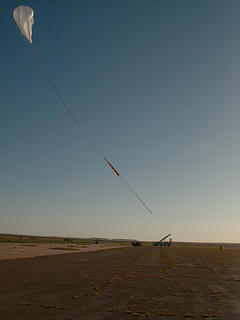
The E and B Experiment (EBEX) is a NASA-funded balloon-borne telescope designed to measure the polarization of the cosmic microwave background (CMB). The experiment will use 1432 transition edge sensor (TES) bolometric detectors read out with a frequency multiplexed SQUID readout. EBEX will observe in three frequency bands centered at 150, 250, and 410 GHz, with 768, 384, and 280 detectors in each band, respectively. This broad frequency coverage will provide valuable information about foreground emission from thermal dust. The polarimetry and signal modulation are achieved using an achromatic half wave plate (AHWP) rotating on a superconducting magnetic bearing and a fixed wire grid polarizer. The 420 square degree observing area and 8' resolution provide sensitivity to an angular power spectrum from 0.2 deg to 5 deg. This will allow EBEX to observe the primordial B-mode signal predicted by inflation on scales of about 0.5 deg and the anticipated lensing B-mode signal at smaller angular scales. Simulations show that EBEX will detect the primordial B-mode signal if the tensor to scalar ratio, r, is 0.1, or it will reduce the current upper limit to ~0.05. The test flight took place in June, 2009, from Ft. Sumner, NM, and the science flight will occur over Antarctica.
 Professor Reshmi Mukherjee (Barnard)
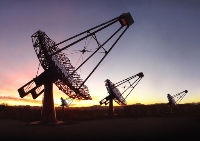
The Solar Tower Atmosphereic Cherenkov Effect Experiment (STACEE) is an experiment dedicated to the study of high energy light (gamma rays) produced in astrophysicical sources. We study gamma rays to learn how Nature's powerful accelerators work and to learn about possible new physics outside of our current theories. Astrophysical sources of gamma rays include powerful objects such as neutron stars, supernovae, and supermassive black holes. STACEE uses a large field of solar mirrors (heliostats) at the National Solar Thermal Test Facility near Albuquerque, NM. These mirrors were built for solar energy research conducted during the daytime. STACEE uses the mirrors at night for astronomy. The mirrors collect quick flashes of blue Cherenkov light that result from gamma-ray interactions in the atmosphere. The Cherenkov light is then detected and recorded by the STACEE equipment.
The National Solar Thermal Test Facility (NSTTF) is a national user facility for solar energy research. Its primary mission is to carry out research in the area of concentrated solar energy, but we are able to use this one-of-a-kind facility for astronomical research. The NSTTF is funded by the U.S. Department of Energy, and managed by Sandia National Laboratories.
 Professor Elena Aprile
 from the Northern Hemisphere. Following the first engineering flight, of short duration, in 1997, LXeGRIT was successfully operated as gamma-ray telescope on two longer duration flights in 1999 and 2000. A total of about 36 hours of data have been accumulated with the LXeTPC at an average altitude of 39 km. The background rate measured in flight is consistent with that expected from the dominant flux of atmospheric gamma-rays, confirming the radiation hardness of Xe as detector material. The gamma-ray data from the strongest source in the sky, the Crab Nebula/Pulsar, in the 1 steredian field-of-view of LXeGRIT for more than 10 hours, are being analyzed to verify the response as Compton imager and polarimeter. LXeGRIT is a collaboration between Columbia, the University of New Hampshire, Waseda University in Japan and Padova University in Italy. The LXeGRIT balloon flight program and the continuuing R&D on xenon imaging detectors for future missions in highenergy astrophysics is supported by NASA.

As recent experiments such as the hugely successful WMAP satellite have demonstrated, the Cosmic Microwave Background (CMB) provides a clean laboratory for studying the physics of the early Universe. Arguably the most exciting future CMB results will come from measurements of the CMB polarization signal. CMB polarization is generated by the same density perturbations that give rise to temperature anisotropies (E-mode polarization) and, in the inflationary universe scenario, by distortions in the spacetime metric caused by inflationary gravity waves (producing a separable, B-mode polarization signature). Measurements of E-mode polarization will allow us to break degeneracies in the determination of cosmological parameters present with temperature anisotropy measurements alone, and improve cosmological constraints. Measurements or limits placed on B-mode polarization will allow us to probe the very earliest moments of the history of the universe, verifying or refuting the inflationary paradigm.
The Sunyaev-Zel'dovich
effect (SZE) causes a change in the apparent brightness of the CMB
towards a cluster of galaxies or any other reservoir of hot plasma.
Measurements of the effect provide distinctly different information
about cluster properties than X-ray imaging data, while combining X-ray
and Sunyaev-Zel'dovich effect data leads to new insights into cluster
physics. The effect is redshift-independent, and so provides a unique
probe of the structure of the Universe on the largest scales.
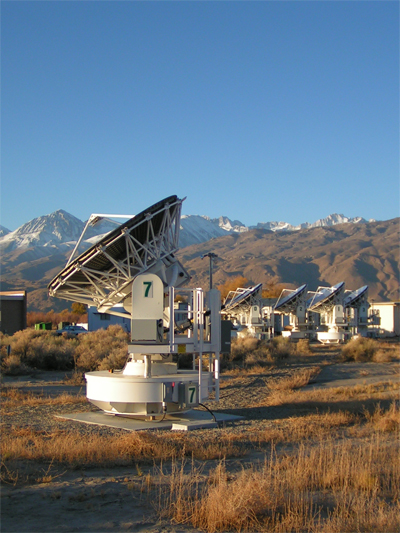 The Sunyaev-Zeldovich Array (SZA) is an interferometer
comprised of eight 3.5 m telescopes operating with two frequency bands,
one centered at 30 GHz and onecentered at 90 GHz with a correlator
bandwidth of 8 GHz. The combination of small telescopes optimized for
SZE observations and large correlator bandwidth make this system roughly
100 times more sensitive than the previous SZE system on the OVRO
(10.4m dishes) and BIMA (6.1m dishes) telescopes. The SZA has been used as a stand-alone instrument in two modes. In the first mode, using
primarily 30 GHz receivers, a blank-field cluster survey was conducted.
The second mode takesadvantage of the higher resolution possible for a given telescope
configuration using both the 30 GHz and the 90 GHz receivers. In this mode detailed follow-up observations are made of specific clusters. The SZA is currently integrated withthe OVRO and BIMA arrays to form a single heterogeneous array known as
CARMA, capable of imaging clusters to an angular resolution of 5".
The Sunyaev-Zeldovich Array (SZA) is an interferometer
comprised of eight 3.5 m telescopes operating with two frequency bands,
one centered at 30 GHz and onecentered at 90 GHz with a correlator
bandwidth of 8 GHz. The combination of small telescopes optimized for
SZE observations and large correlator bandwidth make this system roughly
100 times more sensitive than the previous SZE system on the OVRO
(10.4m dishes) and BIMA (6.1m dishes) telescopes. The SZA has been used as a stand-alone instrument in two modes. In the first mode, using
primarily 30 GHz receivers, a blank-field cluster survey was conducted.
The second mode takesadvantage of the higher resolution possible for a given telescope
configuration using both the 30 GHz and the 90 GHz receivers. In this mode detailed follow-up observations are made of specific clusters. The SZA is currently integrated withthe OVRO and BIMA arrays to form a single heterogeneous array known as
CARMA, capable of imaging clusters to an angular resolution of 5".