
ATLAS
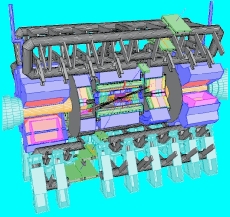 Dr. Kamal Benslama, Asst. Professor Gustaaf Brooijmans, Dr. Jeremy Dodd, Dr. Mikhail Leltchouk, Dr. Andrew Haas, Professor Emlyn Hughes, Professor John Parsons, Professor Mike Tuts, Professor William Willis
The ATLAS experiment is being designed and built for operation at the Large Hadron Collider (LHC) at CERN in Geneva, Switzerland. The LHC is a proton-proton collider which will be the world's highest energy collider and will be the premier experimental HEP facility for many years.
The foremost question of HEP is the source of so-called "electroweak symmetry breaking" (EWSB), related to the issue of the origin of mass. The SM postulates the existence of the Higgs boson to solve this issue. However, many other scenarios (eg. supersymmetry, technicolor, extra dimensions) have been proposed. The LHC and ATLAS are designed to probe an energy scale which should make possible investigation of the source of EWSB. For example, ATLAS should be able to either discover the SM Higgs boson or to definitively rule out its existence. If no SM Higgs is found, we expect to find instead indications of the true source of EWSB.
ATLAS is in the design and construction phase. On-going ATLAS activities at Nevis include development of state-of-the-art electronics for readout of the ATLAS calorimeter, studies of the physics potential of ATLAS, and development of software for the simulation of the calorimeter performance.
Back to Top 

D0
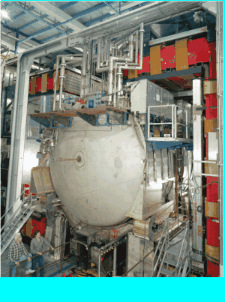 Asst. Professor Gustaaf Brooijmans, Dr. Andrew Haas, Dr. Sabine Lammers, Dr. Michael Mulhearn, Professor John Parsons, Professor Mike Tuts
The Tevatron proton-antiproton collider at Fermilab, near Chicago, is currently the energy frontier for particle colliders. The DØ experiment is currently runnign with an upgraded detector for which the Columbia group made major contributions. We are making important contributions to the study of many of the most interesting questions in physics today. Included in a long list of topics are studies of the top quark (which was discovered by the D0 and CDF experiments), attempts to understand the source of the huge preponderance of matter over antimatter in the universe (by studies of CP violation in b-quarks), probes of the electro-weak and strong forces and searches for the unexpected. Additionally, there is the challenge of operating and understanding a complicated, new detector with more than one million channels of information coming from a variety of technologies.
The Columbia DØ group is involved a wide range of activities on the experiment. We have built cutting-edge electronics for the calorimeter and the level-2 muon trigger and will be analyzing the first data from these devices in the spring and summer. We are also involved in designing and building a precision tracking trigger using information from the DØ silicon tracker. Our physics activities include studies of b-quarks, top-quarks and searches for physics beyond the standard theory.
Back to Top
Double Chooz
 Professor Michael Shaevitz, Dr. Leslie Camilleri, Dr. Camillo Mariani,
Dr. Zelimir Djurcic
Professor Michael Shaevitz, Dr. Leslie Camilleri, Dr. Camillo Mariani,
Dr. Zelimir Djurcic
Neutrino physics
is currently one of the most active areas of research in modern particle
physics. One of the main reasons for such heightened activity is the continued
mystery regarding some of the basic properties of this elusive particle.
Experiments using solar and atmospheric neutrinos have shown that neutrinos do
have mass and that the different flavors can mix.The big questions now arehow big are the neutrino masses and does
neutrino mixing exhibit CP violation.CP
violation by neutrinos could hold the key to explaining the observed baryon to
antibaryon asymmetry in the universe.Beyond
these neutrino questions, our knowledge about neutrinos directly affects models
of the evolution of galaxies and the visible universe.
The Double Chooz experimental goal is to search for a non-vanishing value of
the last unmeasured neutrino oscillation mixing angle θ13, which
governs the transition from electron to muon neutrinos at the distance and
energy scale of the observed atmospheric oscillation signal. This is the last
step to accomplish prior moving towards a new era of precision oscillation measurements
in the lepton sector associated with long-baseline experiments to new labs such
as the Deep Underground Science and Engineering Lab at Homestake, South Dakota.
The most stringent constraint on the θ13 mixing
angle comes from the CHOOZ reactor neutrino experiment with sin2(2θ13)<0.2
which used a single detector at 1.05 km from the reactor. Double Chooz will
explore the range of sin2(2θ13) from 0.2 down to
0.03-0.02, within three years of data taking. The improvement over the CHOOZ
result requires an increase in the statistical data sample, a reduction of the
systematic error below one percent, and a careful control of the backgrounds.
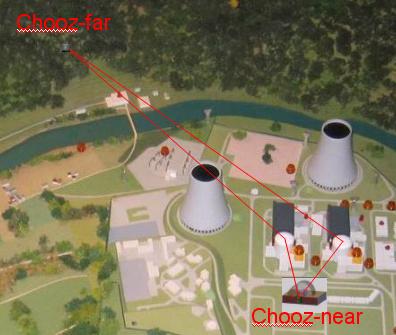
Therefore, Double Chooz will use two identical detectors, one at 300 m and
another at 1.05 km distance from the Chooz nuclear cores.In addition, the near detector will be used
to investigate the potential of neutrinos for monitoring civil nuclear power
plants with respect to nuclear proliferation programs.
The Double Chooz collaboration is composed of institutions from
France, Germany, Italy,
Japan, Russia and USA. Columbia is
collaborating with the University of Chicago, Barnard
College, and MIT to build
an outer veto system to reduce and constrain the cosmic ray muon induced
backgrounds.The plan for Double Chooz is
to start operation in 2009 with one detector and to have both detectors
operating by the end of 2010. With such a scenario Double Chooz will reach a
sin2(2θ13) sensitivity of 0.06 after 1 year of operation
with 1 detector, and 0.03-0.02 after 3 years of operation with both detectors. (See Double Chooz link at http://doublechooz.in2p3.fr/)
Back to Top
e-Bubble
 Dr. Jeremy Dodd, Dr. Mikhail Leltchouk, Professor William Willis
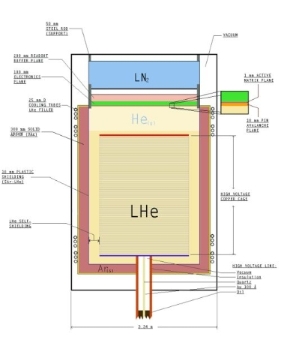
For many years neutrino physics and collider detectors have been a major part of the Nevis program. During the last year we have established a new program to move forward on research on new detectors, so that we will be prepared for the next round of experimental needs in these areas. We are focusing on ideas for detectors which utilize the advantages of a cryogenic environment, and in particular on detectors using liquid helium as the detection medium.
More than thirty years ago it was learned that the stable state of an electron in liquid helium is a bubble of about 2 nm diameter, with nothing but the electron inside. Electron bubbles ('eBubbles') can also exist in liquid neon and liquid hydrogen. These eBubbles have properties that appear to be well-suited to detecting particle interactions where the relevant energies are small, where good position and energy resolution are required, and where a large detection volume is needed. We anticipate that this technology may open up new possibilities for next-generation neutrino detectors, and may also have applications in detecting 'dark matter' particles and in future collider detectors.
Back to Top
MicroBooNE
 Professor Michael
Shaevitz, Prof. William Willis, Dr. Leslie Camilleri, Dr. Camillo Mariani
Professor Michael
Shaevitz, Prof. William Willis, Dr. Leslie Camilleri, Dr. Camillo Mariani
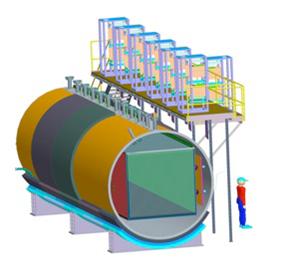
MicroBooNE is an approved experiment at Fermilab to build a large (100 ton)
liquid Argon Time Projection Chamber (LArTPC) to be exposed to the Booster
neutrino beam and the NuMI beam at Fermilab. The experiment will address the
low energy excess observed by the MiniBooNE experiment and measure low energy neutrino
cross sections.In addition, MicroBooNE
will serve as the necessary next step in a phased program towards massive
Liquid Argon TPC detectors for long-baseline neutrino and proton-decay
experiments.
One of the key questions raised by MiniBooNE is whether the low energy
excess is associated with events with final state electrons or gammas.MiniBooNE cannot tell the difference between
electrons and gammas since they both give similar Cherenkov rings.MicroBooNE can clearly identify electrons
from gammas due to the difference in ionization loss in the liquid argon.If MicroBooNE shows that the excess events
have final state electrons, then the source could be neutrino oscillations
through an intermediate “sterile” neutrino that can travel in “extra
dimensions”.If the excess is from final
state gamma events, the source has been postulated to be associated with a new
anomaly mediated process where neutrinos can directly produce single gamma
rays.In either case, the results from
MicroBooNE will be important for planning and analyzing future larger scale
neutrino experiments.(See MicroBooNE link
at http://www-microboone.fnal.gov/)
Back to Top
Mini-BooNE
 Professor Michael Shaevitz,
Dr. Zelimir Djurcic, Dr. Camillo Mariani
Professor Michael Shaevitz,
Dr. Zelimir Djurcic, Dr. Camillo Mariani
The BooNE neutrino experiment at
Fermilab was designed to address the question of whether neutrino have flavor
transitions for distances much less than the already observed atmospheric or
solar signals. The BooNE experiment uses a muon-neutrino beam to determine
whether muon neutrinos oscillate to
electron neutrinos. An experiment at Los Alamos National Laborotories (LSND)
indicated that such oscillation may indeed occur, but the results were not
conclusive. This type of oscillation could occur only if there were more than
the standard three neutrinos and would have a major impact on particle physics.
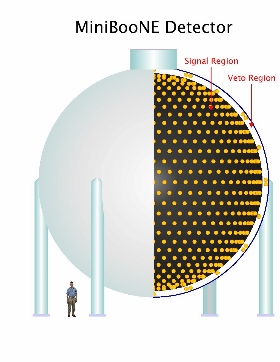
For the experiment, the low energy Fermilab neutrino beam was aimed at the
BooNE detector -- a 40-foot-diameter tank filled with mineral oil. The neutrinos
interacting with the oil would either release a muon or an electron, depending
on the incoming neutrino flavor. The observation of an excess of electron
production in the detector would indicate neutrino oscillations since the beam
is almost entirely composed of muon neutrinos. In addition to neutrino
oscillations, BooNE is also sensitive to other phenomena, such as supernova
explosions and the decay of exotic particles.
The first results from MiniBooNE from the search for muon neutrinos changing
into electron neutrinos were shown and published at the beginning of the summer
2007.For the search, MiniBooNE took a
“blind box” approach, meaning that as the data were being collected, the data
in the region of interest, the region where one would expect to see the same
signature of oscillations as LSND, was hidden.This data was not “unblinded” until three weeks before our official
announcement.After opening the “box”,
we found no telltale oscillation signature in the expected energy region above
475 MeV, contradicting the LSND findings from 1995.The MiniBooNE’s results, therefore, rule out
a fourth sterile neutrino, thereby verifying the current Standard Model with
its three low-mass neutrino species.On
the other hand after looking at the our data, a new anomaly presented itself. There were
more electron neutrino events detected at low neutrino energies than expected
which could not be explained by normal interactions and the source of this
excess remains a mystery. Further analysis is planned using the MiniBooNE
antineutrino sample and a new experiment, MicroBooNE, has been approved at
Fermilab to explore this low energy anomaly.The source of this new anomaly is not only important for our
understanding of neutrinos but also could have a major impact on future neutrino
oscillation studies.
MiniBooNE will continue running in antineutrino mode through 2009 and plans
to bring out a number of results on neutrino/antineutrino oscillations both
appearance and disappearance along with precision measurements of the cross
sections for various neutrino interaction processes.In addition another experiment, SciBooNE, was
accomplished during the 2007-2008 period where a second fine-grained detector
was placed much closer to the booster neutrino beam source.SciBooNE will not only allow precision cross
section measurements but also can be used as a near detector in conjunction
with MiniBooNE to explore muon neutrino disappearance oscillations with better
sensitivity.(See MiniBooNE/SciBooNE
links at http://www-boone.fnal.gov/
and http://www-sciboone.fnal.gov/)
Back to Top




