|
|
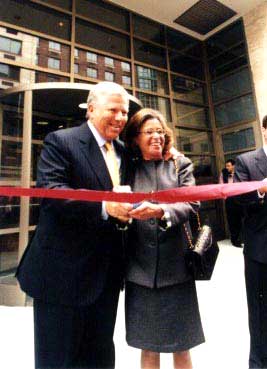
Robert Kraft, the University Trustee and patron of the building, left, joins with his wife, Myra, at the ribbon-cutting Sunday, April 2, for the new Robert K. Kraft Family Center for Jewish Student Life
|
The Robert K. Kraft Family Center for Jewish Student Life was dedicated at Columbia University on Sunday, April 2, as several hundred students, alumni, donors and guests gathered for a joyful outdoor ceremony that filled West 115th Street off Broadway with tributes, music and song.
Following remarks by Columbia President George Rupp; Barnard College President Judith Shapiro; Professor Robert Pollack and Earle Kazis, President and Chairman, respectively, of the Jewish Campus Life Fund, and Shira Brafman, BC '01, President of the Jewish Student Union, Rabbi Charles Sheer, Jewish Chaplain at Columbia for 31 years, led the group in a traditional Jewish dance and song. As a band played and the audience clapped hands to the music, two mezuzot were affixed to a door of the building by Rabbi Jennie Rosenn, Associate Chaplain, Ruth E. Horowitz, BC '83, Treasurer of the Jewish Campus Life Fund, and Robert Lichtman, Associate Vice President of Hillel.
Robert Kraft, CC '63, a University Trustee since 1991 and patron of the building, then joined his wife and other members of his family to cut a ribbon draped across the entrance that signalled the formal opening of the building -- the first permanent home on campus for Columbia's Jewish community. A reception and tours of the building followed.
Kraft recalled his own participation in spiritual and cultural events sponsored by the Jewish Office as a Columbia undergraduate in the early 1960's. When his son enrolled at Columbia 30 years later and found the Jewish Office occupied the same small space in the basement of Earl Hall, the elder Kraft decided to help to provide more expansive accomodations for Columbia's vibrant and diverse Jewish student community, which by then was participating in an expansive range of social, cultural and religious activities. Kraft's $3 million gift led the fundraising for the building by the Jewish Campus Life Fund, the alumni group that sponsors Jewish student activities on campus.
Thanking Kraft on behalf of the University and acknowledging a milestone in the life of the Jewish community at Columbia, President Rupp said: "We are making up for lost time and now are moving to a front-runner."
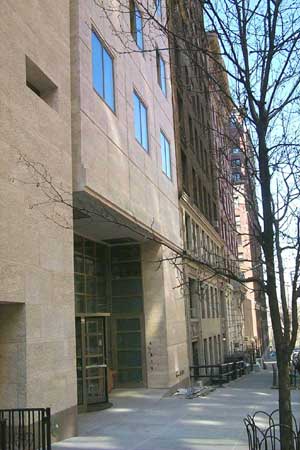
The new six-story $11.5 million building fulfills the long-held goal of creating a permanent home for the more than 3,000 students served by Columbia's Jewish Office. With the opening of the Kraft Center, the Jewish Office will move from its three-room suite in the basement of Earl Hall to a building, which includes a grand hall and sanctuary seating 375, four classrooms, several student lounges and kitchens, a library, an auditorium seating 175, staff and student offices, Beit Midrash Judaica Learning Center and an outdoor terrace.
Designed by Gruzen Samton Architects of New York, the Kraft Center is nestled between two brick apartment buildings and clad in "Jerusalem stone," a limestone quarried in the Negev that is used extensively in Jerusalem. The variety chosen for the Kraft Center, Ramon gray, is the densest type of Jerusalem stone and was chosen to stand up to the New York freeze-and-thaw cycles and the winds off the Hudson River, according to Jordan Gruzen, partner in the architectural firm that has completed more than two dozen synagogues or Jewish cultural and community facilities in the metropolitan New York area. The Jerusalem stone wall appears throughout the building, including on the main floor of the Center. "The wall is symbolic of the fabric of Jewish life," said Mr. Gruzen. "It connects all components of the facility, weaving together the various social, religious, cultural and intellectual functions."
Mr. Kraft said: "Columbia has long needed this building as a symbol of support for this vibrant community and its strong tradition of spirituality on the Columbia campus. I am honored to have been part of the commitment to make the center a reality for today's students and for future generations. "
Through the leadership of President Rupp the University embraced the Kraft initiative and donated the land for the building, formerly a parking lot. Contributions to the building campaign were made by alumni, parents, foundations and friends, and an endowment has been established to sustain the building's operations and programs.
The Kraft Center is sponsored by the Jewish Campus Life Fund, established by alumni in 1929 to sustain Jewish life on campus. The development committee for the Kraft Center campaign was co-chaired by Arthur Ochs Sulzberger, a 1951 graduate of Columbia College and chairman emeritus and former publisher of The New York Times, and Herman Wouk, the author, a 1934 graduate of the College. Kazis, the former president of the Jewish Campus Life Fund and current chair of its board, served as building committee chair.
"Columbia has one of the strongest Jewish student communities of any university," said Rabbi Sheer, the Jewish chaplain at Columbia for 31 years. "I can hardly express the gratitude I feel to finally have a building that meets our needs and symbolizes our meaningful and vibrant existence at Columbia."
"This is a tremendous gift to the Columbia Jewish community and the University overall," said Professor Pollack. "We expect the center will play a big role in opening to the campus as a whole the many aspects of Jewish culture through lectures, cultural events, film and classes."
The first public lecture in the new center will be the annual Blauner Lecture on Tuesday, April 11, featuring Rabbis David Saperstein and Avi Weiss, who will speak on the topic, "A Passion for Social Justice: Two Lifelong Activists Speak Out." Rabbi Saperstein has been director of the Religious Action Center of Reform Judaism for over 25 years. Rabbi Weiss, national president of the Coalition for Jewish Concerns-Amcha and spiritual leader of The Hebrew Institute of Riverdale, has been extensively engaged in human rights and communal Jewish concerns. During this event, beginning at 8 P.M. in Rennert Hall, the Jewish Campus Life Fund will announce that the Kraft Center has been selected by Hillel to be a lead campus in the Tzedek Hillel Program for select campuses who have made social action a central part of their program through community service, advocacy, education and community partnerships.
The Tzedek program at Columbia has included a literacy project at neighborhood schools, visits to hospitals and home-bound elderly residents on the Upper West Side, a hunger project, and work with homeless shelters.
|