
Neil Theise, MD is a diagnostic liver pathologist and adult stem cell researcher in New York City, where he is Professor of Pathology and of Medicine at the Beth Israel Medical Center of Albert Einstein College of Medicine.
While leading cutting-edge research on multi-organ adult stem cell plasticity, he also extends his work to areas of theoretical biology and complexity theory, defining a "post-modern biology." These ideas suggest that alternate models of the body, other than Cell Doctrine, may be necessary to understand non-Western approaches to the body and health.
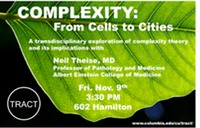
The emerging field of complexity theory defines a key paradigm for understanding the nature and behavior of complex systems such as cells, ant colonies, and ecomomic markets, spanning diverse disciplines, bridging the "soft" and "hard" sciences.
The concept of emergence--how simple interactions among a large number of individuals produce surprisingly complex and unpredicatable behavior on the level of the aggregate--is of great interest to TRACT, as it has potential to inform the gaps among different levels of scientific understanding--i.e. the relationship between the microsopic and macrosopic, between parts and aggregate.
Just as quantum mechanics shatters conventional notions of particles and the relationships among them, complexity theory challenges us to be flexible with how we think of building blocks and systems.
For example, although it has long been taught that the cell is the fundamental building block of organisms, the idea of "building block" actually depends on the scale of observation; the cell as an entity disappears on the scale of biomolecules. This suggests that given a system, there exists different ways of envisioning the "building blocks," each valid under different circumstances and offering different but not necessarily divergent insights. For more information, see the following article in Nature.