This was the first in a three-part invited lecture series “Between
a Rock and a Hard Place. Ukrainian Cinema Since Independence,
1991-2005” by Yuri Shevchuk, director of the Ukrainian
Film Club of Columbia University.
The event, as there entire lecture series, was sponsored
by the Petro
Jacyk Program for the Study of Ukraine, University of Toronto.
The program of the event included a 60-minute presentation,
in which Yuri Shevchuk discussed the economic, political,
and artistic aspects of Ukrainian cinema as it struggles
to shake off the crippling legacies of the Soviet colonialism
and increasingly aggressive Russian cultural neo-colonialism.
The lecture featured clips from such full-length feature
films as “OxygenStarvation” (1992), written
by Yuri Andrukhovych and directed by Andriy Donchyk, “Prayer
for HetmanMazepa” (2001), director Yuri Illienko, and “Fudzhou” (1993),
director Mykhailo Illienko. The lecture was followed
by a program of award-winning Ukrainian films made over the
last four years:
- Ihor Strembitsky's Wayfarers,
Palme d'Or for the best short, Cannes International Film
Festival, 2005;
- Valentyn Vasyanovych's Counterclockwise,
Special Jury Prize of the 27th International Short Film
Festival at Clermont-Ferrand, 2005, France;
- Taras Tomenko's Shooting
Gallery,
Grand Prix for Best Short, Berlin International Film Festival,
2001;
- Taras Tkachenko's Tragic
Love for Unfaithful Nuska, official selection
of 28th International Short Film Festival at Clermont-Ferrand,
2006, France;
- Oleksander Shmyhun's Play
for Three Actors, Proloh Film Festival, Kyiv,
2005;
- Stepan Koval's Streetcar
#9, Silver Berlin Bear, Best Short Film,
Berlin International Film Festival, 2003.
All the films were with English subtitles.
The evening ended with a lively and engaged Q-and A period.
The lecture (as the remaining two in the series) took place
in the Innis Town Hall, Innis College, University of Toronto,
2 Sussex Ave, Toronto, ON.
The second lecture of the series “The Little Engine
That Could: Ukrainian Documentary Cinema” is to take
place on February 2, 2006. It will be followed by a screening
of the most recent documentary films from Ukraine with English
sub-titles.
The third lecture entitled “Contemporary Ukrainian
Cinema and Identity Formation” is scheduled for April
28, 2006. There will be a selection of the most recent feature
films, short and full-length, screened after the lecture.
Eyewitness account of the event
On November 29, 2005, Centre for European, Russian, and
Eurasian Studies (CERES) hosted Dr. Yuri Shevchuk, the Director
of the Ukrainian Film Club, Lecturer of Ukrainian Language
and Culture at the Columbia University who spoke on “Oxygen
Starvation: The Defeated Expectation of Freedom.” The
talk was part of Between a Rock and Hard Place: Ukrainian
Cinema since Independence, a series of lectures and
screenings focusing on the current state of Ukrainian cinema.
The first lecture was followed by the screening of four
short films and two animations created by the country’s
young filmmakers. Paradoxically, all the films presented
to the audience at the University of Toronto have received
international recognition but have had some difficulty in
reaching an audience in Ukraine. The directors of the films—praised
in Cannes, Berlin, New York, and now in Toronto—are
hardly known to general public in Ukraine.
According to Professor Shevchuk, “if art [cinema]
is born of limitation, it is the case of Ukraine.” Since
independence, Ukrainian cinema production has been challenged
by the constant shortage of state or private finances and
an undeveloped distribution market. In addition, he argued,
fast proliferating video rental and distribution services
with cheap or pirated foreign production are overloading
the country’s TV and have influenced Ukraine’s
film market. As a result, domestic films rarely reach Ukrainian
mass audience and there is a common belief in today’s
Ukraine that the country lacks professional filmmakers and
screenwriters. The November screenings not only disproved
this belief, but also revealed an appealing originality and
novelty of the ideas born in the minds of today’s young
Ukrainian filmmakers.
Taras Tomenko’s Shooting Gallery impresses
with its striking image of a homeless boy who seeks to assert
himself in the world while being rejected by the society
he lives in. As a result, he develops a natural aggression
towards the adult world and finds asylum sitting on the top
of a building and smelling glue.
Valentyn Vasyanovych’s Counterclockwise shows
the life of a countryside Ukrainian artist whose creative
ideas have been constantly sidetracked by everyday routine
and his materially-minded wife. In order to escape, he secludes
himself on uninhabited island for a couple of days. There,
he peacefully creates his sculptures and communicates with
the nature.
Taras Tkachenko’s Tragic Love for Unfaithful Nuska is
a charming movie about two schoolboys falling in love with
an older girl from their village. Filled with bright images
and colours, this story of unrequited love evokes dreams
about childhood and about first love.
Ihor Strembitsky’s Wayfarers is the 2005
winner of the Short Film Palme d’Or at the Cannes International
Film Festival. Filmed at a mental institution and at the
House for Veterans of the Stage of Ukraine, this work’s
extraordinary theme and approach is striking. However, the
film confuses the viewer and remains unclear to many.
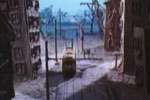
Stepan Koval’s The Tram #9 Was Going is a
plasticine cartoon that truthfully and hilariously portrays
commuters on a packed tram in rush hour. You can see everything
from people opening up to each other and telling jokes to
pick pocketing and fighting.
Oleksander Shmyhun’s cartoon Play for Three Actors portrays
how friendly characters become puppets in the hands of a
big and powerful man, who, while pulling the strings, forces
friends to fight each other against their will. This theme
offers a fitting metaphor for many events in the history
of Ukraine and beyond.
Yuri Shevchuk will return to the University of Toronto on
February 2 and April 27, 2006, when he will discuss the current
state of Ukrainian documentary cinema and the role of contemporary
Ukrainian cinema in the formation of the country’s
identity.
Oksana Polyuga, MA Candidate, CERES, University of Toronto.
|