
April 16 : Modern Art: Socialist Realism and the Sweet Teahouse Group
Modern Tibetan Teahouse Poster Art
What is the art that Tibetans surround themselves with today? What is the visual decoration on the walls of the average Tibetan meeting place? And are the signs of a Tibetan spiritual tradition still to be found among the bric-a-brac washed up by the tides of communism, quasi-capitalism and global influence that are swamping the modern Tibetan city?
Inserts in the Urban Foliage
This exhibition looks at the visual decoration that today's Tibetans put on their walls. It doesn't look at what we, the outsiders, think is art, or think is attractive. It looks at what is up there on the walls. And what is up there is not - to outsiders, and maybe not to all insiders - necessarily attractive. Some of it is mulch. Much of it is kitsch. Most of it is not Tibetan. But hidden amongst the foliage of modern visual paraphernalia are moments of visual reminiscence, recollection, high art and spiritual commitment to a past which is perhaps, for many Tibetans, still a present.
 The Sample Zone: the Teahouse
Our sample zone in this selection of modern urban art is not some average Tibetan's apartment, or the private altar - those are areas that are largely not accessible to outsiders - but the social territory in which people's lives are shared, where the individual encounters the public, and where the planned economy scarcely reaches: the Tibetan teahouse.
Tibetan urban society is built around three places - the home, the workplace and the teahouse. A fourth place, the monastery or temple, is of great importance, but only those Tibetans living and working outside the governmental sector are still allowed to enter there. The ja-khang or teahouse, especially for officials - since at least 1996 they have all been banned from visiting religious premises - serves as a premier site of cultural interaction, a place which is neither work nor home, neither government nor dangerously religious. The teahouse is so important an institution to town-dwelling Tibetans that the premier modern Tibetan art movement of the 1980s was even named after it - the Sweet Teahouse Group.
All Tibetans working in offices, and especially those working in government offices, who are typically paid relatively large amounts to occupy official sinecures with minimal workloads, will whenever possible go at around 11am each day to a particular house patronized by other members of their profession, region or social circle. One teahouse, a little north of the Tibetan Medicine and Astrology Hospital, is known as a haunt of journalists and writers, while another, south of the Agricultural Bureau, is associated with university lecturers. There they will talk, gossip, relax and exchange news. They are taking part in a social process that is of more than trivial significance in a society where the news media have for decades been heavily curtailed.
Many of the teahouses are frequented by people, mainly men, from widely differing classes, sitting all together in long lines. In the oldest ones, there are no chairs arranged around small tables as in the European cafë style, but benches running beside long tables, so that different groups and individuals are sitting side by side, often crushed together, while women refill cups endlessly with ja ngamo, or sugared tea with milk. The practice of sitting and gossiping around these cups of tea is so prevalent that many Tibetans, particularly of the older generation, regard the drinking of sweet tea, a practice allegedly imported by the British from colonial India, as a pernicious custom eroding social rectitude, since the menfolk dedicate so much of their time to drinking it.
The older teahouses with the long benches and communal tables typically have little or no decoration on the walls, and are probably much as they were during the pre-1980s era of Maoist scarcity and poverty. Several can still be found on the Lingkor, the Outer Pilgrimage Circuit, behind the Potala. But in the last ten years, this type of drinking place has mostly given way to a new kind of teahouse, where there are small tables and even booths, and where besides the sweet tea, traditional ja sruma or butter tea is also served.
 Poster Type No.1:
The Giant Unobtainable Dream Food Trope
Poster Type No.1:
The Giant Unobtainable Dream Food Trope

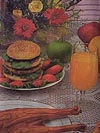
One of the standard accoutrements of the Chinese eatinghouse is that it boasts posters on the walls, bought from Chinese hawkers in the local market. The most visible, and the most often seen, are giant images of food - enormously enlarged, always western, idealized images of sumptuous continental breakfasts or summer lunches, blown up to 18 square feet and printed in lurid colour.
 Posters of this
type are expensive, and usually they mark the slightly wealthier, but still
basic, Chinese restaurants. But many also can be seen on the walls of Tibetan
teahouses that can afford them.
Posters of this
type are expensive, and usually they mark the slightly wealthier, but still
basic, Chinese restaurants. But many also can be seen on the walls of Tibetan
teahouses that can afford them. The important
message of these posters is, firstly, that they are huge, and therefore
expensive. Secondly, they are colorful. Thirdly, none of the dishes shown
in them are available in these restaurants. They are not visual additions
to the menu or advertisements of the food that can be eaten there. They
are reminders of what you cannot have, dreams of some imagined culinary
perfection that nothing in the real Tibetan world even vaguely resembles.
The important
message of these posters is, firstly, that they are huge, and therefore
expensive. Secondly, they are colorful. Thirdly, none of the dishes shown
in them are available in these restaurants. They are not visual additions
to the menu or advertisements of the food that can be eaten there. They
are reminders of what you cannot have, dreams of some imagined culinary
perfection that nothing in the real Tibetan world even vaguely resembles. Poster Types Nos
2 and 3: Careerist Babies and the Chinese Baby Butterfly
Poster Types Nos
2 and 3: Careerist Babies and the Chinese Baby Butterfly
But these are not the only images. There are also equally giant, but less commonly displayed, images of other kinds of dreams. These come in three types: babies, domestic pets, and European landscapes.
 The baby posters
show children who are angelic and usually Western. In one frequently encountered
poster, the babies are naked except for diapers and professional headgear
- a judge's wig, a teacher's mortar board, a doctor's stethoscope. They
are images of middle class aspiration, imprinting career attainment from
an early age.
The baby posters
show children who are angelic and usually Western. In one frequently encountered
poster, the babies are naked except for diapers and professional headgear
- a judge's wig, a teacher's mortar board, a doctor's stethoscope. They
are images of middle class aspiration, imprinting career attainment from
an early age.
Another poster of this type shows Chinese babies in diapers holding hands and releasing as if by magic a butterfly, perhaps symbolizing infant hope. Another shows idyllic, fair-haired western Children playing together.
 |
 |
 Poster Type 4: Ideal
Landscapes - Swiss Yaks and Western Motorways
Poster Type 4: Ideal
Landscapes - Swiss Yaks and Western Motorways
Pictures of still lakes with willows draped over the water's edge, or rock encrustations standing majestically beside river, are part of traditional Chinese notions of beauty - shanshui, mountain and water, essential ingredients to Chinese tourism and travel, and to the decoration of Chinese homes. In Tibetan teahouses and Chinese eating-houses too, these images proliferate on posters of serenely tranquil Chinese beauty-spots and parks of carefully tamed wildness. Some of these posters are enlargements of modern photographs, while others are copies of brush-stroke paintings in a more traditional style.
More recently, a third type of landscape has emerged in Chinese and Tibetan poster art - the ideal western countryside. This has two modes, the pastoral and the constructed. The pastoral ones show lush green Alpine fields below snow-topped mountains, with dappled cows grazing in the foreground. On the chalets can be seen clearly written their names in German: the scenes are quintessentially Swiss, reminiscent of 1950s chocolate box photography.
 These pictures
are sold by Chinese hawkers in the Lhasa market as photographs of Tibet,
and the cows are pointed out as yaks. The hawkers have probably flown
straight into Lhasa from China and never seen a yak; the German writing
looks just as foreign in their eyes as Tibetan script .
These pictures
are sold by Chinese hawkers in the Lhasa market as photographs of Tibet,
and the cows are pointed out as yaks. The hawkers have probably flown
straight into Lhasa from China and never seen a yak; the German writing
looks just as foreign in their eyes as Tibetan script .
There is a second sub-theme to the western landscape photographs: urban dream. These posters, also of the technicolor, giant type, show western country houses with patios, sloping rooves, lavish gardens and multiple floors. Or they show motorways, regal in their emptiness, carving their way through the countryside, celebrating man's ability to tame nature and extend the reach of concrete and modernity.
 Poster
Type No.5: Chinese Traditions, Bollywood Invasion
Poster
Type No.5: Chinese Traditions, Bollywood Invasion
There is a fifth type of poster, which is neither Chinese nor Tibetan in its origins. In Chinese eating-houses and shops, as opposed to places owned by Tibetans, these posters are specifically Chinese, like the brush-stroke landscapes - Chinese images of good luck, calendars and so on. But in a number of Tibetan establishments, a completely different cultural source is being drawn on: Indian musical film stars. These can be bought from one street seller on the corner of the night market street in Lhasa, and at about 18" by 12" are usually much smaller and rarer than the gargantuan modern Chinese posters. They almost all are of one type only: portraits.
 They show the
actors as characters from their films, and they almost always have the names
of the stars written in English alongside the portrait, or some slogan or
caption illustrating or commenting on the image, sometimes in jest. One
shows an actress in Indian clothes talking on the telephone, and beside
her head is the word "Hello…". Only a small percentage of the Tibetans who
see these posters will be able to read their slogans. The most popular image
in 2001, according to the street sellers, was the male actor Shahrukh.
They show the
actors as characters from their films, and they almost always have the names
of the stars written in English alongside the portrait, or some slogan or
caption illustrating or commenting on the image, sometimes in jest. One
shows an actress in Indian clothes talking on the telephone, and beside
her head is the word "Hello…". Only a small percentage of the Tibetans who
see these posters will be able to read their slogans. The most popular image
in 2001, according to the street sellers, was the male actor Shahrukh.
 |
 |
 |
 Amongst
the Indian film star portraits are another kind of poster - illustrated
sentimental aphorisms. These are in the tradition of Hallmark cards -
pithy statements of general advice or consolation about life, often Christian
in reference. Above a picture of a small road winding through country
fields is printed, in lavish cursive "May the Hope Light Your Path and
Guide You on Your Way". Above a picture of a tiger is written "GOD SHALL
SUPPLY ALL YOUR NEED" - in this case the relevance of the image to the
words is not obvious, unless we are supposed to think that the tiger is
contemplating his divine right to eat the photographer.
Amongst
the Indian film star portraits are another kind of poster - illustrated
sentimental aphorisms. These are in the tradition of Hallmark cards -
pithy statements of general advice or consolation about life, often Christian
in reference. Above a picture of a small road winding through country
fields is printed, in lavish cursive "May the Hope Light Your Path and
Guide You on Your Way". Above a picture of a tiger is written "GOD SHALL
SUPPLY ALL YOUR NEED" - in this case the relevance of the image to the
words is not obvious, unless we are supposed to think that the tiger is
contemplating his divine right to eat the photographer.
 A
picture of two puzzled-looking puppies playing in a wickerwork basket has
the more appropriate caption "Think Twice".
A
picture of two puzzled-looking puppies playing in a wickerwork basket has
the more appropriate caption "Think Twice".  Poster Type No.6: Hollywood
and Soccer
Poster Type No.6: Hollywood
and Soccer
Somehow, a number of Tibetan teahouse owners have been able to get posters of entirely western origin, European or American. Italian and British soccer is extremely popular among certain circles of cadres and others in Tibet, and reports of these teams even appear in the official Chinese newspapers, but it is still a little surprising to find a picture of Milan's premier Serie A soccer team, Juventus, together with a pin-up portrait of the team's main player, in a Tibetan eating house in Nyalam, in southern Tibet.
The soccer posters are on the same wall as the poster of the winding country road with its prayer "the Hope...to Guide You on Your Way". In another Nyalam roadside eating-house, a photograph showed Natassia Kinski, naked, wreathed by giant serpent, with a caption printed in English, clearly emanating from the U.S. rather than India - ironically, the caption declared that the photographer was Richard Avedon, whose son wrote "In Exile from the Land of Snows", the most famous of all modern studies in the West of the exile Tibetan predicament.
 Nyalam is the last major
town on the "Friendship Highway", the only major road that links Tibet
to Southern Asia, and less than 30 kilometres from Tibet's border with
Nepal. In principle its residents are even supposed to be allowed to cross
the border into Nepal for a short distance without passports to carry
out small amounts of trade, although very few from the Tibetan side are
in fact able to do so. Tibetans from Amdo in the far north-east of Tibet
have migrated to the area to take advantage of the border and the tourist
trade, along with Chinese prostitutes and traders from Sichuan servicing
the border troops and drivers stationed along the highway. So Nyalam lies
in a zone of cultural overlap, with small objects and images for sale
or gifts from Nepal and India brought up by truck drivers returning from
the border.
Nyalam is the last major
town on the "Friendship Highway", the only major road that links Tibet
to Southern Asia, and less than 30 kilometres from Tibet's border with
Nepal. In principle its residents are even supposed to be allowed to cross
the border into Nepal for a short distance without passports to carry
out small amounts of trade, although very few from the Tibetan side are
in fact able to do so. Tibetans from Amdo in the far north-east of Tibet
have migrated to the area to take advantage of the border and the tourist
trade, along with Chinese prostitutes and traders from Sichuan servicing
the border troops and drivers stationed along the highway. So Nyalam lies
in a zone of cultural overlap, with small objects and images for sale
or gifts from Nepal and India brought up by truck drivers returning from
the border.
 The décor in the Nyalam
eating-house reflects this overlap, so that the ornaments on the top of
the television range from a toy robot, probably of Japanese origin, to
glass "snow-bottle" images of Father Christmas, an ornamental plate showing
the Potala Palace, and artificial sunflowers, still popular in Tibet even
though they were the chief artistic representation of mass devotion to
Mao Zedong during his heyday in the 1960s.
The décor in the Nyalam
eating-house reflects this overlap, so that the ornaments on the top of
the television range from a toy robot, probably of Japanese origin, to
glass "snow-bottle" images of Father Christmas, an ornamental plate showing
the Potala Palace, and artificial sunflowers, still popular in Tibet even
though they were the chief artistic representation of mass devotion to
Mao Zedong during his heyday in the 1960s.
 Poster Type No.7: The Intermingled
Shrine - Scattered Memories of Tibet
Poster Type No.7: The Intermingled
Shrine - Scattered Memories of Tibet
The dominant images on the walls of teahouses, eatinghouses and beerhouses in Tibet are secular, modern, and transient, as we have seen - mawkish images of idealized children or pets, unattainable consumption of western food, western football teams, and Chinese landscapes and advertisements. The colours are brash, the dimensions often gargantuan, the sentiments cloying, the driving forces behind them are the forces of mass-marketing. The cultural references are mostly western or global: they are visual hymns to the pervasiveness of the world's market economy, or, if not, to the very similar spread of China's market economy. Culture reduced to garish consumerist dreams. But not everything is like this…
 Firstly, some
Tibetan businesses have emerged in the last ten years - extraordinarily
few, but they exist, and occasionally one sees advertisements for their
products in their own language, among the many other posters advertising
Chinese cigarettes, medicines and various commodities. The best known
advertisement currently on display as a poster is produced by a wine company
which presents its Tibetanness as something that can be consumed by others
- the Tibetanness is itself a selling point for an international and a
Chinese audience:
Firstly, some
Tibetan businesses have emerged in the last ten years - extraordinarily
few, but they exist, and occasionally one sees advertisements for their
products in their own language, among the many other posters advertising
Chinese cigarettes, medicines and various commodities. The best known
advertisement currently on display as a poster is produced by a wine company
which presents its Tibetanness as something that can be consumed by others
- the Tibetanness is itself a selling point for an international and a
Chinese audience:
 But not all posters
which refer to things Tibetan are directed outwards at foreigners. Hidden
among the dense foliage of externally-driven images and references can
be seen a softer, less evident, but nevertheless omnipresent set of specifically
Tibetan images. In the Nyalam eating-house we can see on one wall two
Chinese traditional landscape posters. They hang below traditional Tibetan
pleated curtain borders, on either side of the typically Tibetan emblem
of the horned yak and the snow mountain, in this case woven into cloth.
In front of them are paper lampshades with fish motifs, clearly from some
non-Tibetan culture.
But not all posters
which refer to things Tibetan are directed outwards at foreigners. Hidden
among the dense foliage of externally-driven images and references can
be seen a softer, less evident, but nevertheless omnipresent set of specifically
Tibetan images. In the Nyalam eating-house we can see on one wall two
Chinese traditional landscape posters. They hang below traditional Tibetan
pleated curtain borders, on either side of the typically Tibetan emblem
of the horned yak and the snow mountain, in this case woven into cloth.
In front of them are paper lampshades with fish motifs, clearly from some
non-Tibetan culture.
 In another corner, the
woven yak-head is hanging again, this time below a photograph of a giant
thangka or Tibetan religious embroidery displayed in front of the
Potala Palace, the former residence of the Dalai Lama. Besides this photograph
is a print, often seen in Lhasa too, of a modern Tibetan painting showing
a single pair of yak horns lying among rocks beside a giant lake. These
images are all quintessentially Tibetan in their reference; two are draped
with scarves to indicate respect.
In another corner, the
woven yak-head is hanging again, this time below a photograph of a giant
thangka or Tibetan religious embroidery displayed in front of the
Potala Palace, the former residence of the Dalai Lama. Besides this photograph
is a print, often seen in Lhasa too, of a modern Tibetan painting showing
a single pair of yak horns lying among rocks beside a giant lake. These
images are all quintessentially Tibetan in their reference; two are draped
with scarves to indicate respect.
 In
Lhasa, in an eating house besides the Jokhang Temple, we can see the owner
standing at the counter, with boxes of beer cans at his feet. He is standing
in front of a glass cabinet, with its racks of thermos flasks, alcoholic
beverages and cigarettes. To his left are posters of a Chinese pin-up girl
and besides the door to the kitchen, a rarely seen advertisement in English,
for the film Titanic: Jack and Rose are looking anxiously to the
left, presumably hoping for a lifeboat.
In
Lhasa, in an eating house besides the Jokhang Temple, we can see the owner
standing at the counter, with boxes of beer cans at his feet. He is standing
in front of a glass cabinet, with its racks of thermos flasks, alcoholic
beverages and cigarettes. To his left are posters of a Chinese pin-up girl
and besides the door to the kitchen, a rarely seen advertisement in English,
for the film Titanic: Jack and Rose are looking anxiously to the
left, presumably hoping for a lifeboat.
 |
 |
 Nyalam |
 Nyalam |
 |
 |
 On another wall, above
the Tibetan-style borders, are stencilled images of roses, popular from
Cultural Revolution-era Chinese peasant art, which are still frequently
found in the base of enameled Chinese plates and washing bowls. Between
two stenciled roses are three posters, two of them draped with white scaves.
One is the same portrait of the Panchen Lama that we have seen elsewhere.
On another wall, above
the Tibetan-style borders, are stencilled images of roses, popular from
Cultural Revolution-era Chinese peasant art, which are still frequently
found in the base of enameled Chinese plates and washing bowls. Between
two stenciled roses are three posters, two of them draped with white scaves.
One is the same portrait of the Panchen Lama that we have seen elsewhere. One is a plasticised
poster of the Potala Palace, with the great Bodhisatta Avalokiteshvara
framed in a halo above it. The Dalai Lama is regarded as an emanation of
Avalokiteshvara, known as Chenrezig in Tibetan, and this picture is a symbolic
representation of the exiled leader.
One is a plasticised
poster of the Potala Palace, with the great Bodhisatta Avalokiteshvara
framed in a halo above it. The Dalai Lama is regarded as an emanation of
Avalokiteshvara, known as Chenrezig in Tibetan, and this picture is a symbolic
representation of the exiled leader.  To the left of the Potala
Palace print is a framed poster that is less easily recognizable, even to
Tibetans. It is also swathed in a white scarf, indicated its special status
and respect. It shows an ancient warrior on a prancing white steed, before
a mountain of perfect cone-like shape, and a giant blue lake. The warrior
has his right arm up-raised, holding a golden vajra or thunderbolt,
image of the Vajrayana or Tibetan form of Buddhism; in his left hand he
holds a dpe-cha or religious text. The warrior is in fact a chosgyal
or Dharma-king - an ancient combination in Tibetan legend of the warlike
and the spiritual, encapsulated in the Tibetan mind by the 7th Century Tibetan
Emperor Srong-btsan sgam-po.
To the left of the Potala
Palace print is a framed poster that is less easily recognizable, even to
Tibetans. It is also swathed in a white scarf, indicated its special status
and respect. It shows an ancient warrior on a prancing white steed, before
a mountain of perfect cone-like shape, and a giant blue lake. The warrior
has his right arm up-raised, holding a golden vajra or thunderbolt,
image of the Vajrayana or Tibetan form of Buddhism; in his left hand he
holds a dpe-cha or religious text. The warrior is in fact a chosgyal
or Dharma-king - an ancient combination in Tibetan legend of the warlike
and the spiritual, encapsulated in the Tibetan mind by the 7th Century Tibetan
Emperor Srong-btsan sgam-po. The mountain
is Mount Kailash, the most sacred of Buddhist and Hindu mountains, far
to the west of Tibet, and the lake is Kokonor or Tsho-ngon, the
Blue Lake for which the Chinese province of Qinghai is named, far on the
eastern borders of Tibet as it was in Srong-btsan sgam-po's time. This
image is in effect a recollection of an imperial Buddhist and expanding
realm 1300 years ago; intriguingly, the caption says that it was painted
at the behest of the 10th Panchen Lama before his death in 1989.
The mountain
is Mount Kailash, the most sacred of Buddhist and Hindu mountains, far
to the west of Tibet, and the lake is Kokonor or Tsho-ngon, the
Blue Lake for which the Chinese province of Qinghai is named, far on the
eastern borders of Tibet as it was in Srong-btsan sgam-po's time. This
image is in effect a recollection of an imperial Buddhist and expanding
realm 1300 years ago; intriguingly, the caption says that it was painted
at the behest of the 10th Panchen Lama before his death in 1989.
Endnote
There are other images on the walls of Lhasa - official posters announcing the 50th anniversary of China's Peaceful Liberation of Tibet, for example - but these are found in government-owned offices and shops, not in places that are privately run.
 |
 |
 |
 In
the University of Tibet, the portrait of Mao, framed by the slogan UNITE-EFFORT-SEEK
TRUTH-INNOVATE, is found in almost every classroom.
In
the University of Tibet, the portrait of Mao, framed by the slogan UNITE-EFFORT-SEEK
TRUTH-INNOVATE, is found in almost every classroom.
The private tea-houses and hostelries are not obliged to show such materials. As we have seen, they choose, according to their income and their wall-space, a mix of Chinese, Western, Indian and Tibetan images. In many cases, the Tibetan images might be secular, as with yak-heads and ornamental borders. But in many other cases the idea of a Buddhist Tibet remains vividly recorded on the walls of modern Tibetan tea-houses.
