Introduction to Earth Sciences I
4.4.3 Structure of the Core-mantle Boundary
Open any High School or undergraduate science text book to the section on the
Earth's deep interior and you will see the core represented as a fairly passive
blob; more or less inert and not doing much. In fact we now know that a lot is
going on in the core. It has been known for quite a while that vigorous convection
in the liquid outer core is responsible for the Earth's magnetic field. It
works something like an electric dynamo but the motions are very complicated
and that statement simplifies things a lot (too much really). We also know
that the solid inner core rotates with respect to the liquid outer core. In
fact, it may be electromagnetic energy that is responsible for driving the
rotation. The core is actually quite and active body.
One of the most dynamic parts of the Earth turns out to be the boundary between
the core and lower mantle. This boundary (sometimes referred to as the Gutenburg
discontinuity) places liquid iron in contact with the perovskite of the lower mantle.
One thing that happens is that the core eats into and absorbs the lower mantle. As
a consequence the iron outer core gets contaminated with the material of the mantle
causing it to be perhaps 10% less dense than pure iron. Outer core and lower mantle
also react chemically and produce new compounds as reaction products. The liquid iron
is able to permeate upward into the lowermost mantle by a process called capillary action,
the same process that trees use to draw water from the soil through their roots and
up into the body of the tree. The liquid iron reacts with the lower mantle rocks and
creates a thin reaction zone. The reaction products are new materials, even more exotic
than those of the lower mantle. But the really intriguing part of the story involves
the dynamic interaction with the mantle. Convection, as we learned in Topic #3, stirs
the deep mantle and plumes rise from the surface of the core. These actions move the
mantle around and stir up the reaction zone. These motions entrain reaction zone products
and move them upward in regions of mantle upwelling, perhaps exposing mantle to the core
and initiating further reactions. The reaction zone products are both liquid and solid
(crystalline) and as they get entrained in the mantle flow and move upward the heavier
solids will drop out and fall toward the core. The figure below from a Scientific American
article by Ray Jeanloz and Thorne Lay in May 1993 gives a sketch of what might be going on.
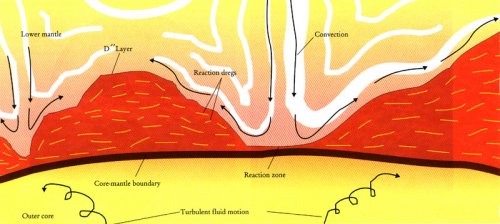
Figure 4.4.9
The uneven layer of entrained reaction products is called D'' and is a highly irregular
and dynamically variable feature of the core-mantle boundary. How can we possibly know
this? One way is direct simulations of the conditions present at the pressures and
temperatures of the core-mantle boundary. Jeanloz and Lay describe how a device called
a diamond anvil can be used to bring tiny samples of materials typical of the mantle and
core to the pressure and temperature of the core-mantle boundary. They react in the anvil
and their reaction products can be studied.
Seismic evidence involves the study not of the time of arrival of seismic energy but
the shape of the seismic waves. When seismic waves are emitted from their earthquake
source they travel away in a fairly smoothly expanding sphere (actually a half sphere
because they don't go into the air). So long as the structures in the earth through
which they pass are also smooth the wavefront will stay smooth and the shape roughly
spherical. But imagine the smooth wave encountering a rugged interface. The wavefront
will become distorted. Seismic energy propagating such that it just glances the core-mantle
boundary will pass along the highly variable D'' Layer described above and wavefronts
will become distorted as they travel through. This is shown schematically in the figure
below.
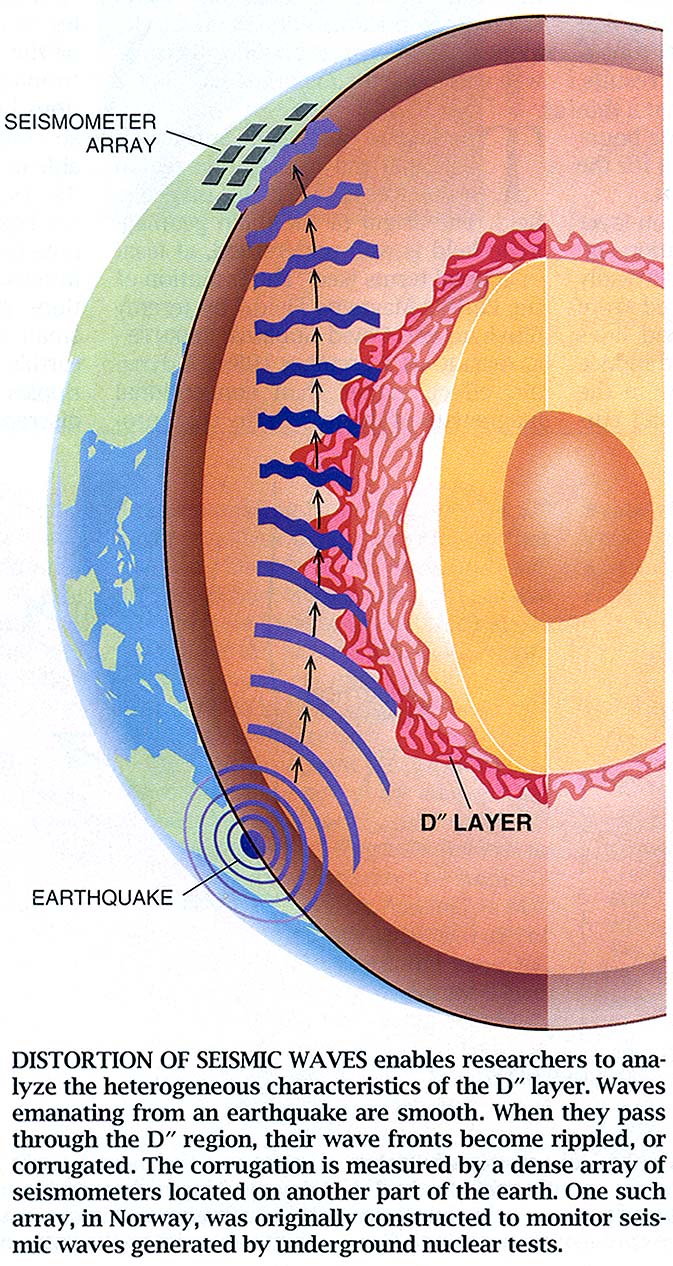
Figure 4.4.10
To detect these distorted waves we need many closely spaced seismic recording stations
set out in a dense array. These arrays can track the passage of a seismic wave across
the surface of the Earth and detect whether it is smooth or distorted. Studies of this
type have established that the D'' layer is indeed highly variable in shape and thickness
from place to place around the core-mantle boundary.
These studies tell us that D'' is quite variable but don't tell us much about its
internal properties. For that we must look closely at individual seismic records
from energy that has traveled for a while in D''. The figure below shows four
different interpretations of what the region of the core-mantle boundary might be
like. In the figure ULVZ means ultra low-velocity Zone.
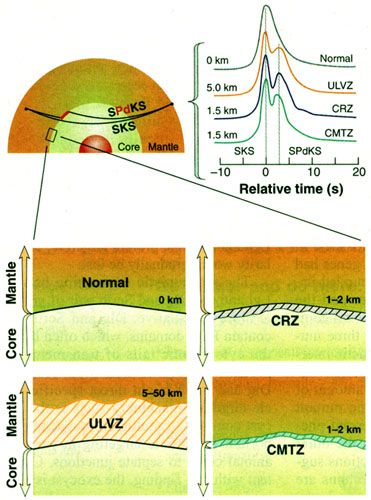
Figure 4.4.11
The above sketches are the seismograms expected for the energy that
travels in each of the possible D'' Layers. There are distinct but very small
differences between the seismic signals even though the D'' structures are really
quite different. The problem is one of resolution. At the depths of the core-mantle
boundary seismic energy has very long wavelengths - many kilometers -- and structure
can only be resolved to about a quarter of a wavelength.
Basically we are trying to examine structure in the deep Earth that is right
at the limit of our ability to resolve.
Study Exercises
Topic 1
/ Topic 2
/ Topic 3
/ Topic 5