

Lesson 2: Major
and Minor Scales
|
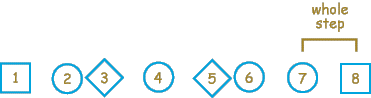
Major and Minor Scales The next step in learning to distinguish major from minor is learning to hear the difference between major and minor scales. A scale is a collection of tones arranged in a particular order. This collection of tones traverses the interval of the octave. The first note of the scale is particularly important; in tonal music it is called the tonic. There are two primary types of scale in tonal music, major and minor. A given scale takes its name from the first note and the type of the scale. For example, the major scale whose first note is C is called the "C major scale." When we speak of mode in relation to tonal music, we are referring to the scale type; thus music which uses a major scale is said to be in the major mode. Major and minor scales can be most easily distinguished by focusing on the relationship between the first and third pitches in the scale. The Major Scale The major scale is the simpler of the two main kinds of scale. It is represented graphically below.
|
|
You may want to play the example a few times to help you to recognize this scale later. The Minor Scale The minor scale is more complicated than the major scale because it comes in three varieties. Of the three kinds of minor scale, the first kind has the closest relationship to the major scale, but the second two are much more important for tonal music. The simplest minor scale is called the natural minor scale. If you have read the Sonic Glossary entry on Scale, then you have already encountered this scale, for it is specifically the natural minor scale that was denoted there by the term minor scale. The natural minor scale is represented both graphically and musically below.
Because the ways in which the natural minor scale is used in tonal music are less important than the ways in which its variants are used, the training in hearing kinds of scales will not use the natural minor scale. It is good to know what it sounds like, but it is not central to this training. The importance of the natural minor scale comes mainly from its interest to music theorists. Most importantly, it is a diatonic scale, and thus closely related to the major scale. (The concept of the diatonic scale is not central here; it is defined and discussed near the end of the Sonic Glossary entry Scale.) For tonal composers, however, the natural minor scale presents a problem. The problem is that the natural minor scale approaches the tonic from a whole step below.
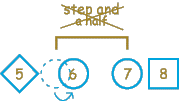
At least since medieval times, Western composers have recognized certain tones as points of arrival; we will call these goal tones. They have found it satisfying to reach these goal tones from tones that are a half step away. In general, the first and fifth tones of the scale have been seen as the most important goal tones. (Their technical names are the tonic and the dominant.) It was not necessary that all tones adjacent to goal tones be a half step away, but it was generally agreed that one of the tones next to the tonic should be. Whichever tone was a half step from the tonic was called the leading tone (because it "led" directly to the tonic). By the middle of the Renaissance, the leading tone was usually the tone below the tonic. Pieces in which the leading tone was the tone above the tonic stood out as very special; of these pieces, Josquin's Pange Lingua Mass is considered one of the most important. By the time tonal music emerged in the Baroque period, this exception to the rule had ceased to exist. In tonal music, the leading tone is always the tone below the tonic. The simplest way to fix this problem of the missing leading tone in the natural minor scale is to raise the seventh tone of the scale, so that in its new position it is a half step below the tonic, forming a leading tone. If this is done, the result is the harmonic minor scale. Because of this adjustment, the harmonic minor scale has an extra-large step, the step and a half. This sets it apart from diatonic scales, such as the major scale and natural minor scale, which use just two step sizes, the step and the half step. Listen for this third step size, the step and a half, in the harmonic minor scale.
|
|
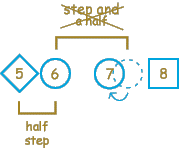
The step and a half, the most striking thing about the harmonic minor scale, occurs between its sixth and seventh notes. As an interval, this is called an augmented second, and it was considered to be dissonant by composers of tonal music. If you were singing this scale, the step and a half would feel like something of a stretch after all of the half steps and whole steps; it has a certain tension. Because of the strong effect made by the step and a half between the sixth and seventh notes of the harmonic minor scale, composers of tonal music rarely used it when writing melodies. Remember that a scale is a collection of pitches that can be thought of as a source or reservoir. Composers draw upon this collection in order to create melodies and harmonies. When tonal composers wrote music in the minor mode, they actually used two scales, so that they had two separate sources of pitches, one for harmonies and one for melodies. The harmonic minor scale is, of course, the one they used to make all of the most important harmonies in the minor mode. But for writing melodies, they wanted a smoother, less dissonant scale, one without the tense, stretched step and a half. They called this the melodic minor scale. The melodic minor scale provides the desired melodic smoothness by way of a clever compromise. Recall that the central issue in the formation of the harmonic minor scale was the importance of having tones which led to goal tones from a half step away. Using the most important goal tones, the tonic and the dominant, the melodic minor scale modifies the harmonic minor scale in a way that not only keeps these satisfying arrivals but smoothes out the journey. On the way up toward the tonic (here the eighth tone), the sixth tone is raised, bringing it closer to the raised seventh tone and eliminating the large step and a half.
This creates a smoother flow while keeping the arrival on the tonic from a half step below. On the way down, however, the tonic is the point of departure and the dominant (the fifth tone) the arrival, so the procedure is reversed. Now the seventh tone is lowered to smooth out the motion, while the sixth tone keeps its usual position in the harmonic minor scale, just a half step above the fifth note.
This, of course, preserves the half-step motion to the dominant. The result is the melodic minor scale.
|
|
Here's an example of a melodic minor scale used in the melody line of some real music (the Overture to Mozart's opera Don Giovanni). Audio Example 1, from Mozart's Don Giovanni You may have noticed that the ascending melodic minor scale sounds similar to the major scale. In fact, only one note is different between the two. |
|
|
| Lesson 2 consists of two pages. To continue with Lesson 2, click here. |

|
|
|


|
|
|
|
Lesson
2 written by:
John Ito |
Technology
& Design: Maurice
Matiz & Kristen Sosulski |