

Lesson 3: Major
& Minor Triads
|
Major and Minor Triads Major and minor triads are simple, consonant chords, containing three tones arranged in one of two ways. They are the primary harmonic building blocks of tonal music. Constructing Triads Triads are constructed within the context of scales. To construct a triad, first pick one tone of the scale as the starting point. Taking that pitch as your first tone, count upwards and take the third and fifth pitches you come to as the other two pitches of the triad. For example, if you start with the second pitch of a scale, the triad based on that pitch will also include the fourth and sixth pitches of the scale. If triads are formed on the basis of the major, harmonic minor, and melodic minor scales, then these triads will be of four types: major, minor, augmented, and diminished. (You can read more about augmented and diminished triads in the Sonic Glossary entry Third.) Here we will be concerned only with major and minor triads, which make up the majority of triads formed on the basis of the scales of tonal music. In both major and minor triads, the interval between the first and the fifth notes counted off is always a perfect fifth. The only difference between major and minor triads is in the third note. In the major triad it forms a major third with the first note, and in the minor triad a minor third. Rather than continuing to talk explicitly about the tones of a triad in terms of how they are counted off from the scale, from now on we will use the standard terms for them: the root, the third, and the fifth. As major and minor triads are the primary chords used in tonal harmony, let's look carefully at each one. The Major Triad The simplest way to construct a major triad is to take the tonic (that is, the first note) of a major scale as the root of the triad. The third and fifth notes of the scale will then form the third and fifth of the triad. The Minor Triad Likewise, the easiest way to construct a minor triad is to take the tonic of a minor scale as the root of the triad. Again, the third and fifth notes of the scale will then form the third and fifth of the triad. At the moment it suffices to think of this (taking the tonic of the scale as the root of the triad) merely as a convenient way of generating major and minor triads. Starting with Lesson 5, however, triads constructed in this way will come to have a special importance. Such triads are called tonic triads. Just as the tonic note of the scale is like a home base among the pitches, so the tonic triad is like a home base among the harmonies.
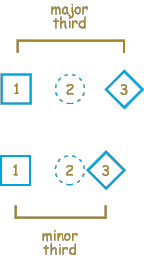
Just as the key to telling the difference between major and minor scales was focusing on the third note of the scale, so the way to distinguish major and minor triads is to listen for the third of the triad. To help focus on the interval between root and third, we'll take away the fifth for now, just listening to major and minor thirds as simultaneous intervals. Often we call the type of third the quality of the third; in this case the quality of the third will either be major or minor. Use the examples below to recall the difference from Lesson 1. If necessary, repeat them a few times; refresh your memory until you feel that you can tell the difference reliably. If this really presents problems, you should review Lesson 1 before proceeding.
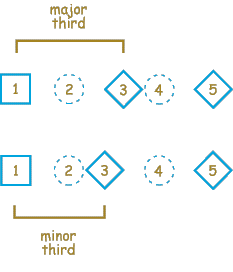
Now let's add the fifth back in to make complete triads. Remember, major and minor triads with the same root have the same fifth. Even with the fifth back, try to focus on the quality of the third between the root and the third. Again, listen repeatedly until you feel confident that you can tell the difference. If necessary, go back and listen to the thirds alone again.
Once you feel confident in your ability to distinguish between the two examples above, enter the training environment for major and minor triads. Use this environment until you feel that you have gained a solid ability to tell major and minor triads apart.
|

|
|
|


|
|
|
|
Lesson
3 written by:
John Ito |
Technology & Design: Maurice Matiz & Kristen Sosulski |