|
|
by Joseph Brennan. Copyright 2001, 2002. |
THIS STATION IS OPEN
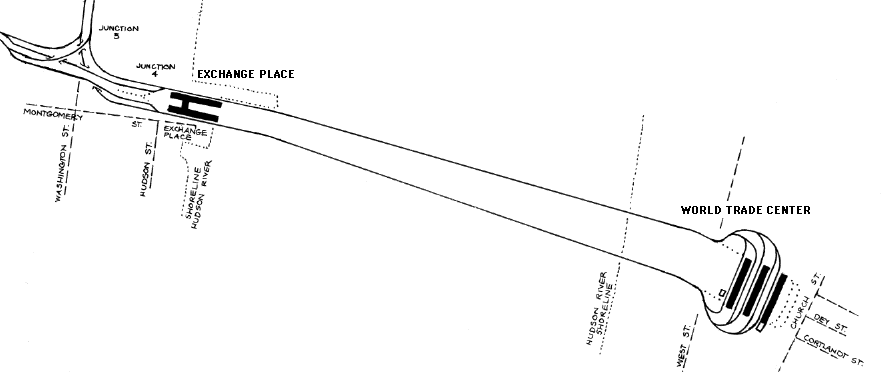
construction and operationThe Hudson and Manhattan Railroad route from Hoboken to Hudson Terminal opened in August 1909, the year after the first portion of the railroad from Hoboken to 33 St. The new route served the Erie Railroad terminal (at what is now Pavonia / Newport station) and the Pennsylvania Railroad terminal at Exchange Place. The station at Exchange Place is deep below the surface, where the two single-track tunnels begin to cross under the Hudson River. The Pennsylvania Railroad diverted part of its train service away from Exchange Place in 1911, when the long distance runs began using the new Penn Station in Manhattan. Local and commuter trains continued to run to Exchange Place, which was more convenient for lower Manhattan. For a time, the Hudson and Manhattan ran special trains just between Exchange Place and Hudson Terminal, connecting with Pennsylvania trains, which reversed in "Penn pocket", a stub track located between the main tracks west of Exchange Place. Over the years, more and more local trains were shifted to Penn Station. Midtown Manhattan became increasingly a center for offices, shopping, and theater, and the electrification of the Pennsylvania main line in 1935 eliminated the engine change that made it costly to run locals to Penn Station. By 1940, only certain peak hour trains ran to Exchange Place, but they held on until the last few were discontinued in 1961. The reduced railroad business was paralleled by reduced business from the cluster of surface lines, trolley routes converted to bus, as Jersey City declined after World War II. Exchange Place became a quieter station until the revival of the waterfront area began around 1985. Exchange Place enjoyed a renaissance from the 1990's. While the former railroad properties at Pavonia became the Newport Centre residential development, the former railroad and industrial properties at Exchange Place were built with office towers for an overflow of workers from Wall Street companies. PATH and the new ferries became the vital connection, and the new Hudson Bergen Light Rail passes through the new office district as well. It was as this momentum built that the September 2001 terrorist attack on the World Trade Center towers destroyed much of the World Trade Center PATH station, which forced closing of Exchange Place as well. Water from broken mains and firefighting in New York entered the river tunnel and flowed as far as Exchange Place, where at its peak a few inches were on the tracks. In the days after the attack, firefighters went in by boat to look for anyone who had tried to escape through the tunnel, but found no one. PATH was pumping water successfully by the end of September. It was proposed to build a concrete and steel plug in the tubes east of Exchange Place to prevent any possible flooding in New York from filling the system, most of which is below sea level. These were installed on 30 September (south tube) and 8 October (north tube). Exchange Place station was closed because there was no way to terminate trains from the New Jersey side without wrong-way running for some distance that would seriously interfere with the intensive service PATH needs to run. During 2002 and 2003, short sections of new tube were built to permit a crossover track, using in part the old "Penn Pocket" tube. The opportunity was also taken while no trains were running to extend the platforms to full train length, ending a long term operating problem. The station was reopened on Sunday 29 June 2003. |
diagram |
|
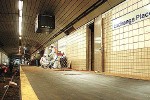
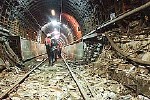
2 May 2002: Exchange Place station is in good shape, left. The damaged pipe galleries and cabling are being ripped out of the tunnel, right. Some of the debris on the track floor floated in from the World Trade Center. Photos by Bill Bayer, from the Jersey Journal tunnel tour. For full-size images and additional photos, please go to http://www.nj.com/photos/jjournal/tunnel/. |