The Nutritional Label and You
Every food product sold in retail stores is required by the FDA to have a Nutritional Facts label on it's packaging. This label has a variety of information that is extremely useful to the informed consumer. Becoming an informed consumer is the first step to healthy eating.
Being able to read the Nutritional Facts label is the starting step to being an informed consumer. By knowing what it is you are eating, you will then be able to make informed decisions and be able to tailor your diet to your needs. Join us as we venture into the Nutritional Facts label.
If you think you know your stuff already, try skipping ahead to the Give It a Try or Build your Day sections.
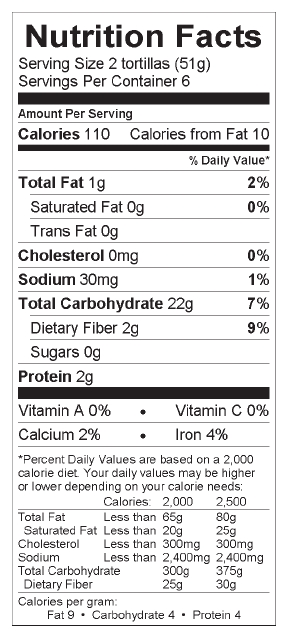
Reading the The Nutritional Label


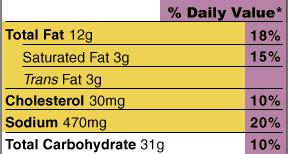
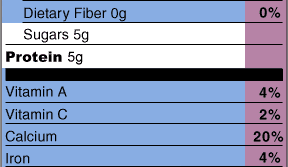
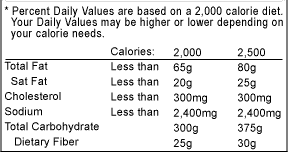
The Nutritional Facts label is divided into several segments. Here is a sample label for a container of Macaroni and Cheese. The different segments have been color coded to make it easier to read. Hover over each segment to learn about each section. For information about the Purple section and sections that are not colored, see below.
Daily Value (Purple)
The % DV indicates how much of your Daily Value of each nutrient a serving has. You should get your daily intake as close to 100% as possible. You can tell if an item is high or low in a nutrient with the table below.
| Less less than 2% of the Daily Value | Very low in that nutrient |
| Less less than 5% of the Daily Value | Low in that nutrient |
| more than 20% of the Daily Value | High in that nutrient |
| more than 40% of the Daily Value | Very high in that nutrient |
Carbohydrates Sugar and Protein
Carbohydrates, have no general risk associated with coming in under or going over the % DV. Aim for 100% but if you go don't get enough or go over it's not that big a deal.
Protein will not have a % DV most of the time. Only Ppoductes meant for children under 5 and those marketed as 'high in protein' have % DV.The FDA does not have a Daily Value reccomendation for Protein. We will give you a goal for Protein later.
Sugar is already included in the Carbohydrate total and the FDA does not have an individual % DV for it. In general less Sugar is better but as long as you monitor the Carbohydrate % DV you'll be ok.
What are calories?
| Maintain (Stay the same weight) | |
| Weight Lose 1lb per week (Maintain - 500) | |
| Weight Lose 2lbs per week (Maintain - 1000) |
Calories are the fuel that your body uses to run
In order for your muscles and organs to function they need energy. The way you get energy this is by digesting food.
Any excess calories you eat but don't burn gets stored in fat
Your body uses this stored energy when it doesn't get enough from eating. If you eat more calories then you burn, you gain weight. If you eat fewer calories then you burn, you loose weight.
So how many calories should you eat?
The five main factors that affect how many calories you should eat are weight, height, age, gender and activity level. Enter your information to the left to see how many calories you should eat.
Every 3500 calories under or over your maintain number is a 1lb gain or loss
If you eat 100 calories more than your maintain number every day, then you will gain 10lbs over the course of a year. 100 extra calories a day x 365 days = 36,500 extra calories = 10.4lbs.
Your Daily Values
How is the % Daily Value calculated?
All calories come from Carbohydrates, Protein, Fat and Alcohol. From a nutritional standpoint, Alcohol is bad so we will ignore it. A normal adult should have 45% of their calories from Carbohydrates, 35% from Protein and 20% from Fat. A 2000 Calorie gives the % DV below.
| Carbohydrates | 2000 Calories X 45% = 900 calories | 900 Calories / 4 calories per gram = 225 grams |
| Protein | 2000 Calories X 35% = 700 calories | 700 Calories / 4 calories per gram = 175 grams |
| Carbohydrates | 2000 Calories X 20% = 400 calories | 400 Calories / 9 calories per gram = 44 grams |
Below is the breakdown of your Calories from the previous page
| Calories | Carbs (grams) | Protein (grams) | Fat (grams) | |
|---|---|---|---|---|
| Maintain | ||||
| Lose 1lb | ||||
| Lose 2lbs |
So What Should I Do?
An excellent question! There are a lot of numbers that we threw at you. The good news is that you don't need to pay attention to all of them at once, at least not to start with.
You only need to track 4 numbers
To begin healthier eating, start counting your Calories, Carbohydrates, Protein and Fat. Ignore the % DV for Fat and Carbohydrates and use your numbers on below as your goal. As long as you don't go over those numbers you'll do great!
Then what were all those other numbers?
Once you feel comfortable tracking your Calories, Carbohydrates, Protein and Fat, you can begin to track the other nutrients. Start with the 'Bad' Nutrients then the 'Good'. These other nutrients (Sodium, Fiber, etc) and the Vitamins are not affected by your calories so you can use the % DV on the label
Your Goal Numbers
| Calories | Carbs (grams) | Protein (grams) | Fat (grams) |
|---|---|---|---|
Try it out!
In this section choose which goal you want and enter the required information.
Choose Your Goal
| Calories | Carbs (grams) | Protein (grams) | Fat (grams) |
|---|---|---|---|
Enter the Total % DV of the package for your goal
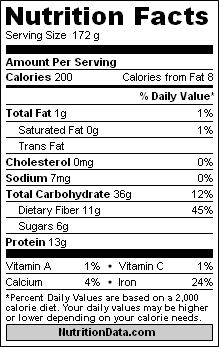
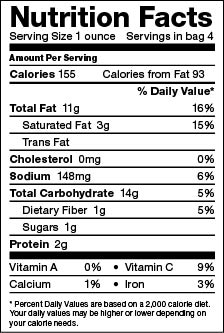
Results
| Question 1 | Correct! | Question 5 | Correct! |
| Question 2 | Correct! | Question 6 | Correct! |
| Question 3 | Correct! | Question 7 | Correct! |
| Question 4 | Correct! | Question 8 | Correct! |