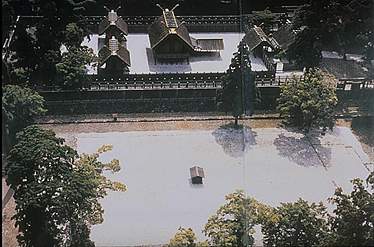
 So
we have seen that on the one hand Ise reflects the specific historical
conditions that lay behind its founding, in particular the political need
of the imperial clan to establish and perpetuate its authority. We have
also seen how imported Chinese ideas were essential in the planning and
ideological justification of the shrine. Yet in the end the basic message
of Ise seems to reach beyond both politics and Chinese influence to the
very heart of the primitive Japanese belief in the fundamental harmony
of nature, man, and gods, and in the unique importance of maintaining that
harmony through regular practice of purification and renewal.
So
we have seen that on the one hand Ise reflects the specific historical
conditions that lay behind its founding, in particular the political need
of the imperial clan to establish and perpetuate its authority. We have
also seen how imported Chinese ideas were essential in the planning and
ideological justification of the shrine. Yet in the end the basic message
of Ise seems to reach beyond both politics and Chinese influence to the
very heart of the primitive Japanese belief in the fundamental harmony
of nature, man, and gods, and in the unique importance of maintaining that
harmony through regular practice of purification and renewal.