Atmospheric Greenhouse Gas Abundances and Forcing

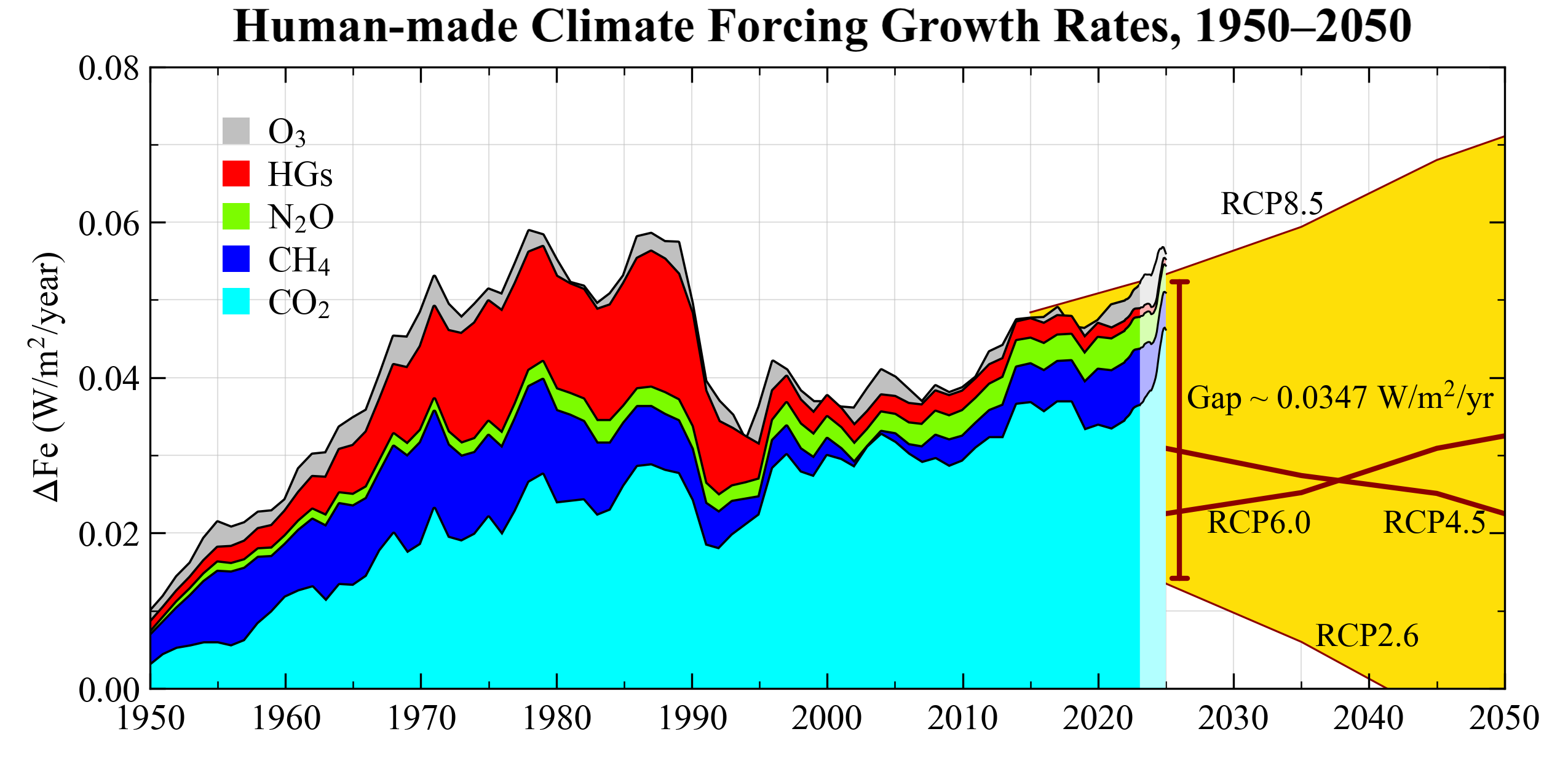
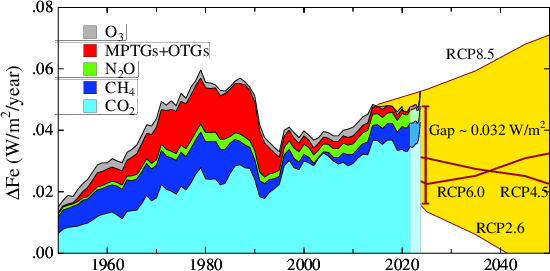
Greenhouse gas forcing from carbon dioxide, methane, nitrous oxide, halogenated gases, and ozone, 1850–2025.

Greenhouse gas forcing, 1850–2025. Human-made greenhouse gas forcing from carbon dioxide (CO2), methane (CH4), nitrous oxide (N2O), halogenated gases (HGs), and ozone (O3), compared with future forcing scenarios (RCPs). Darker shading reflects 5-year or 60-month running means, and lighter shading reflects progressively shorter n-month running means, where n = 60, 58, 56, ..., 12.
Figure available as PDF.
Figure updated 1 May 2026. Data sources and calculation methods: CO2 [1], CH4 [2], N2O [3], HGs [4], O3 radiative forcing [5], and forcing calculations [6].

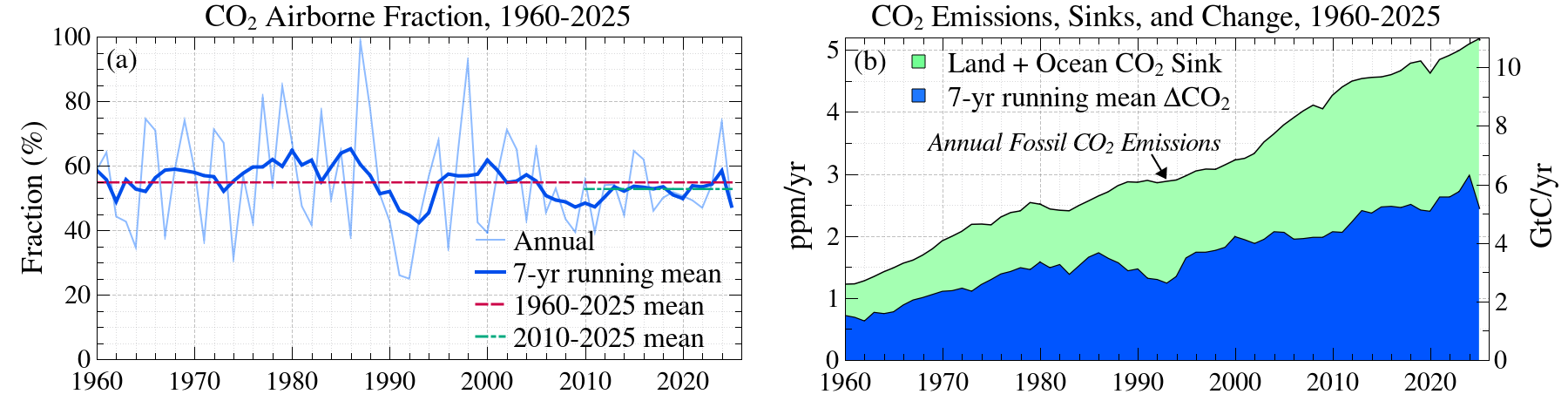
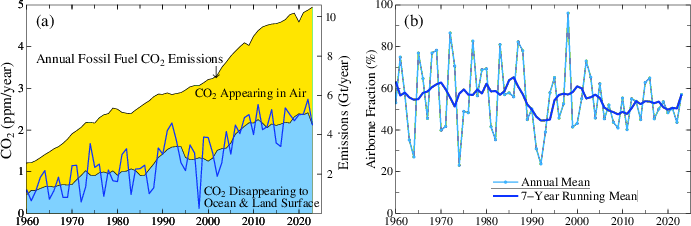
CO2 airborne fraction, emissions, sinks, and atmospheric change, 1960–2025.

CO2 airborne fraction, emissions, sinks, and atmospheric change, 1960–2025. Seven-year running mean values are extended for the first and last 3 years by using 1-year, 3-year, and 5-year means. Emissions are extrapolated through 2025 using energy consumption data.
Figure available as PDF.
Figure updated 1 May 2026. Data sources: [1] for atmospheric CO2, [7] for emissions, and [8] for energy consumption.

Legacy Figures

Carbon Dioxide (CO2)

Long-Term Annual Means with IPCC Scenarios

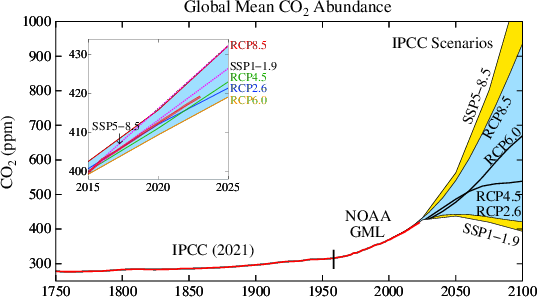
Long-term annual CO2 means with IPCC scenarios.

Figure in PDF. Data: CO2 (data through 2023, last updated 2024/08/15). Also comparison of A1B, etc. and RCPs from IPCC (2013) in PDF.

Recent Mauna Loa CO2

Recent Mauna Loa CO2.

Figure in PDF. Data through November 2024. Last updated 2024/12/05.

Recent Global CO2

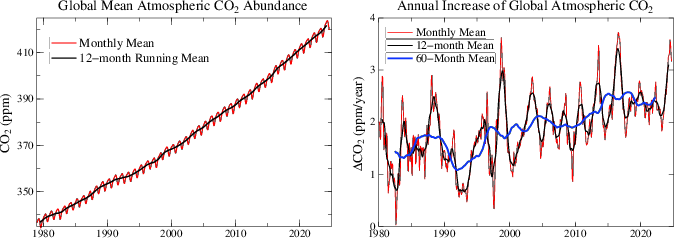
Recent global CO2.

Figure in PDF. Data through September 2024. Last updated 2024/12/05.

CO2 Emissions and Airborne Fraction

CO2 emissions and airborne fraction.

PDF.

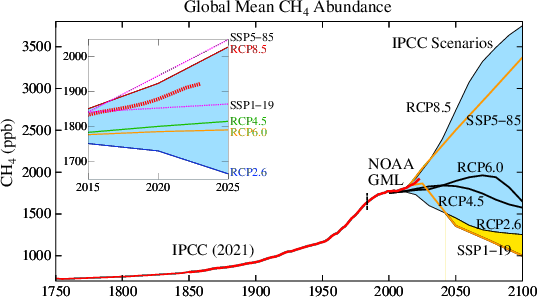
Methane (CH4)

Methane, 1750–2100.

Figure in PDF.

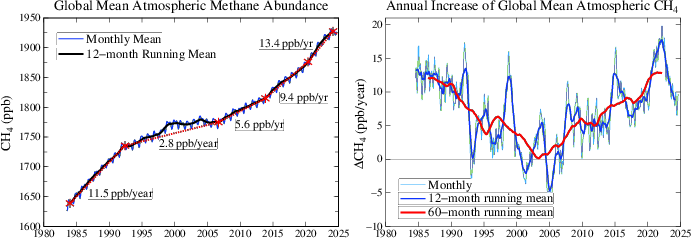
Recent methane and methane change.

Figure in PDF.

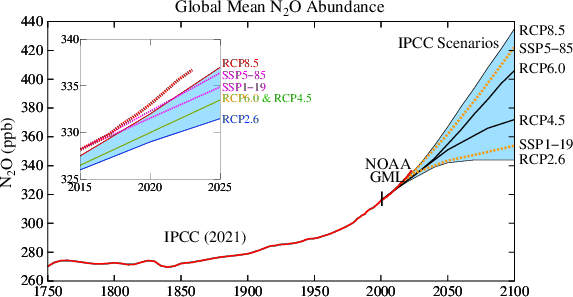
Nitrous Oxide (N2O)

Nitrous oxide, 1750–2100.

Figure in PDF.

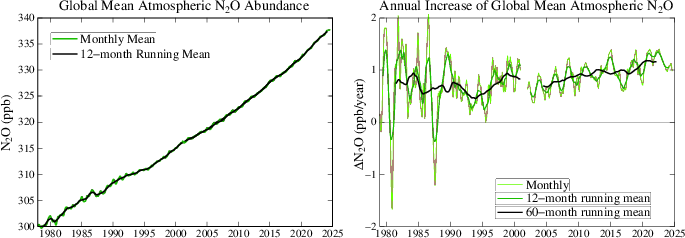
Recent nitrous oxide and nitrous oxide change.

Figure in PDF.

Other Trace Gases

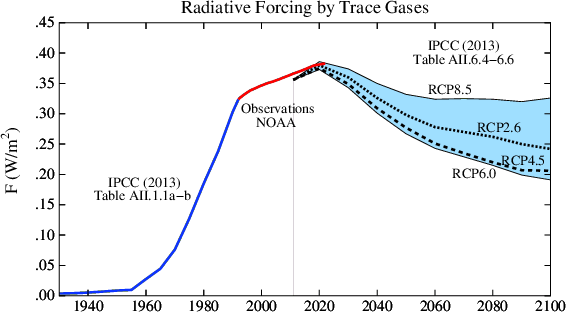
Other trace gas forcings, 1930–2100.

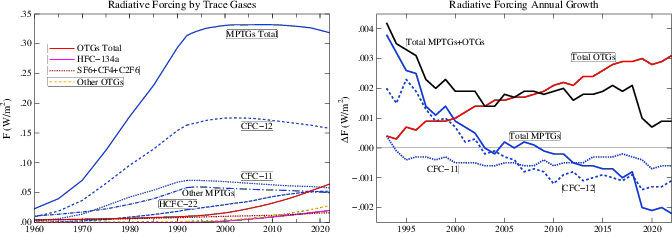
Other trace gas forcings and forcing growth rates.


Greenhouse Gas Forcing Compared with Future Scenarios

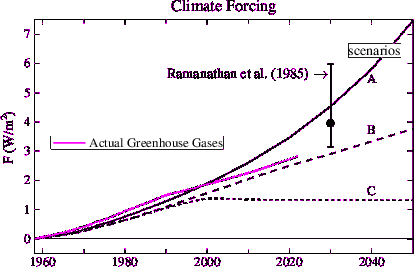
Greenhouse gas forcing compared with future scenarios.

Greenhouse Gas Forcing Growth Rates
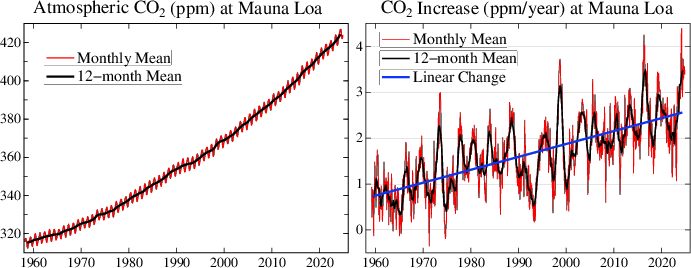
Greenhouse gas forcing growth rates.


References and data sources

  1. CO2 concentrations: 1850-1958 from IPCC AR6 (2021), Annex III and data archive; 1959-1978 from NOAA Mauna Loa data and 1979-present from NOAA marine data.
  2. CH4 concentrations: 1850-1983 from above IPCC sources; 1984-present from NOAA GML.
  3. N2O concentrations: 1850-2000 from above IPCC sources; 2001-present from NOAA GML.
  4. HG concentrations: from Forster et al. (2025), dataset archive.
  5. O3 radiative forcing: same as ref. [4].
  6. Radiative forcing calculations were performed using formulas from Table 1 of Hansen et al. (2023), Global warming in the pipeline, and radiative efficiency values from Table 7.SM.7 of IPCC AR6 (2021), Chapter 7 Supplementary Material: PDF.
  7. CO2 emissions: CDIAC fossil-fuel CO2 emissions datasets, Research Institute for Environment, Energy, and Economics, Appalachian State University.
  8. Energy consumption: Energy Institute, Statistical Review of World Energy.