Sea Ice
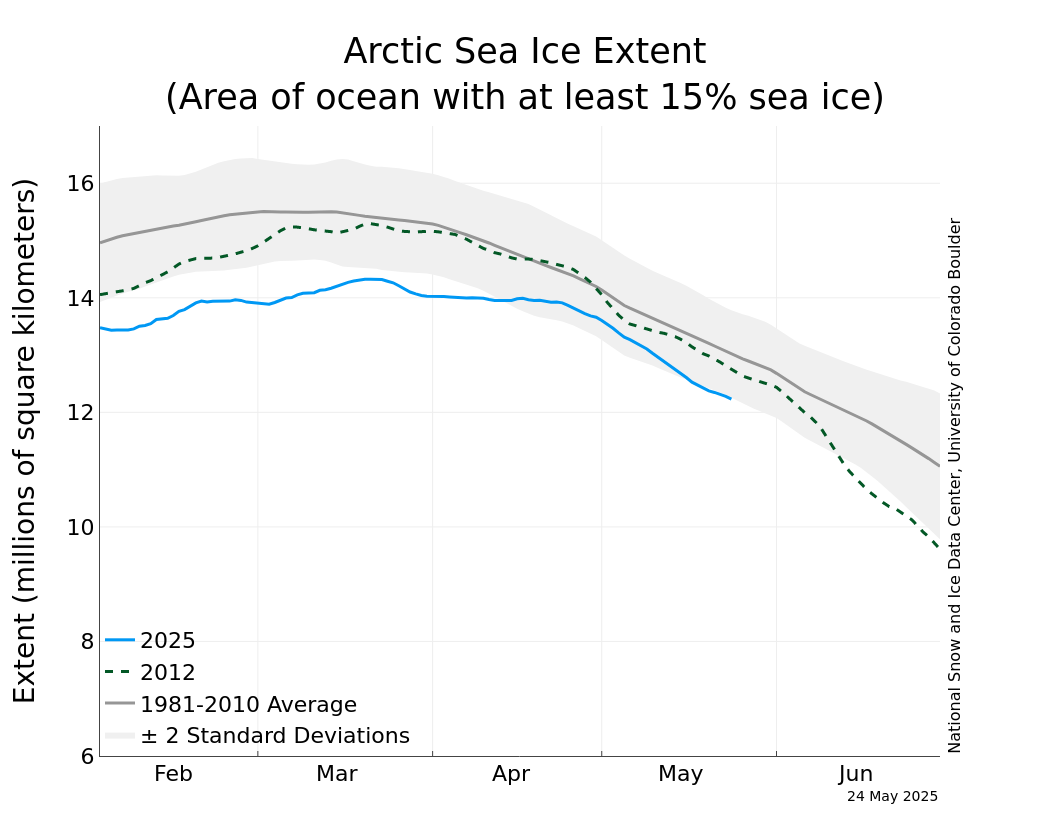
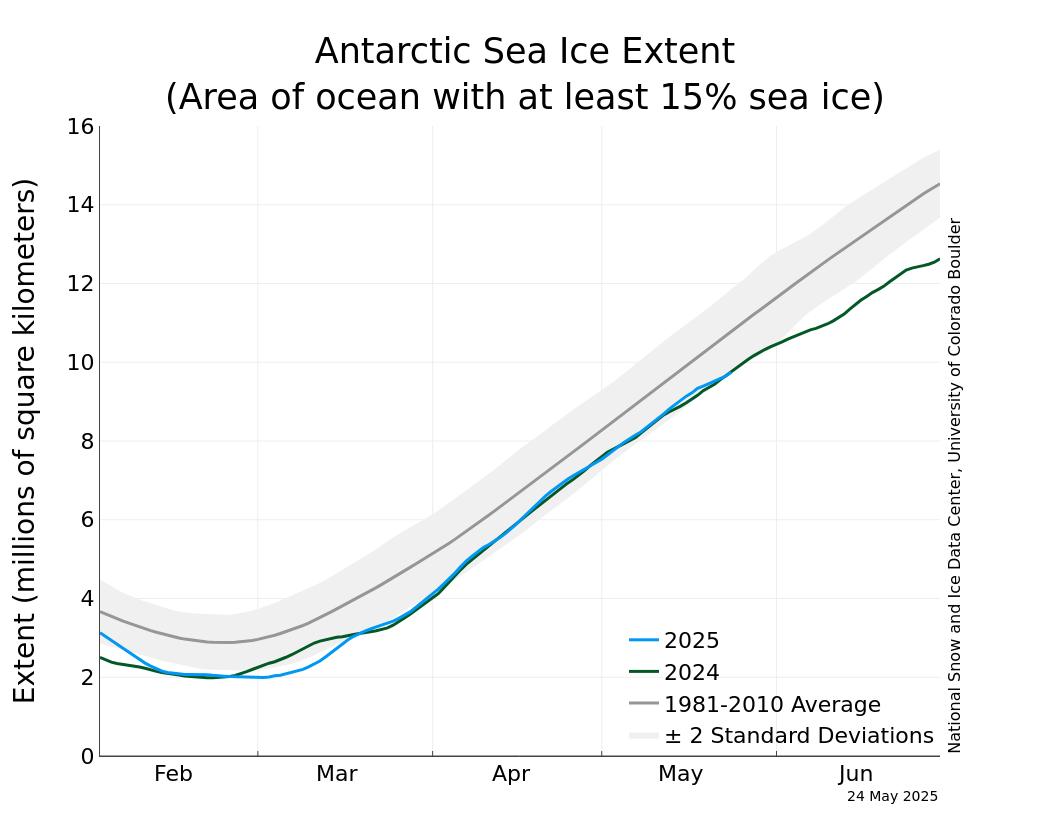
Sea ice area is an important, amplifying, climate feedback: as sea ice area decreases, for example, absorption of sunlight increases because open ocean is darker than sea ice. See our recent communication on this for more details.
Figure 1. Global Sea Ice Extent (millions of km2) based on daily sea ice extent data of the National Snow and Ice Data Center (ref. 1). These are 31-day running-means of daily data, as are the data in Fig. 2 below. The most recent 15 days (dotted line) are 29-day, 27-day, ..., 3-day, 1-day means, and are thus estimates that will be replaced as data are updated.
(Also in PDF. Data through 30 Mar 2025.)

Figure 2. Sea ice area in the Arctic and Antarctic.
(Also in PDF. Data from Ref. 1, through 30 Mar 2025.)

Figure 3. Arctic and Antarctic sea ice extent based on annual and 365-day running mean values.
(Also in PDF. Data from Ref. 1, through 30 Mar 2025.)

Figure 4. Sea ice volume: solid curves are 12-month running-mean of GIOMAS and 365-day running-mean of PIOMAS data, both from the Polar Science Center of the University of Washington (Ref. 2).
(Also in PDF. Data through 31 Dec 2023 [GIOMAS], 1 Mar 2025 [PIOMAS])
References:
1. Sea ice extent is defined by NSIDC (National Snow and Ice Data Center) as the ocean area with sea ice concentration exceeding 15%. NSIDC Artic Sea Ice News and Analysis and daily updates of sea ice extent for the Arctic and Antarctic are available from NSIDC.
2. Polar Science Center, Applied Physics Laboratory, University of Washington, https://psc.apl.uw.edu/data/
Back to Data page
Page last modified 2 Apr 2025.