Updated temperature tables are available in plain-text format:
Land-ocean temperature table:
view |
download
Land-only temperature table:
view |
download
Ocean-only temperature table:
view |
download
Note: Running-mean and seasonal curves end earlier than the final monthly datum.
Global
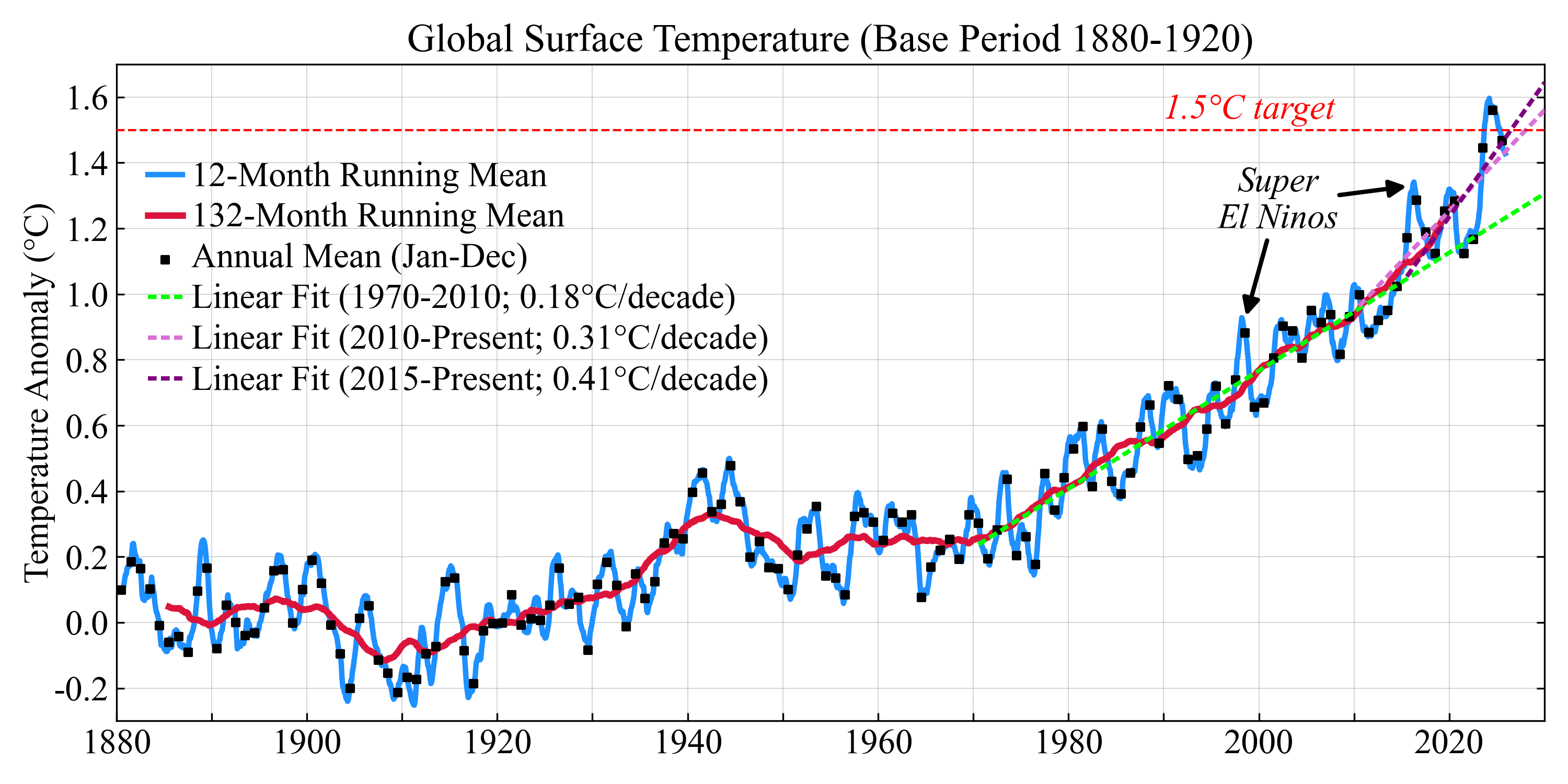
1a. Global mean surface temperature, 1880–present
Global mean surface temperature anomaly relative to the 1880–1920 mean.
Curves show the 12-month running mean, 132-month running mean, and annual
(Jan–Dec) means. Linear trends are shown for 1970–2010, 2010–present,
and 2015–present. For discussion of the choice of base period, see
“A Better Graph”.
Data through September 2026. Data source: ref. [1].
Figure available as
PDF.
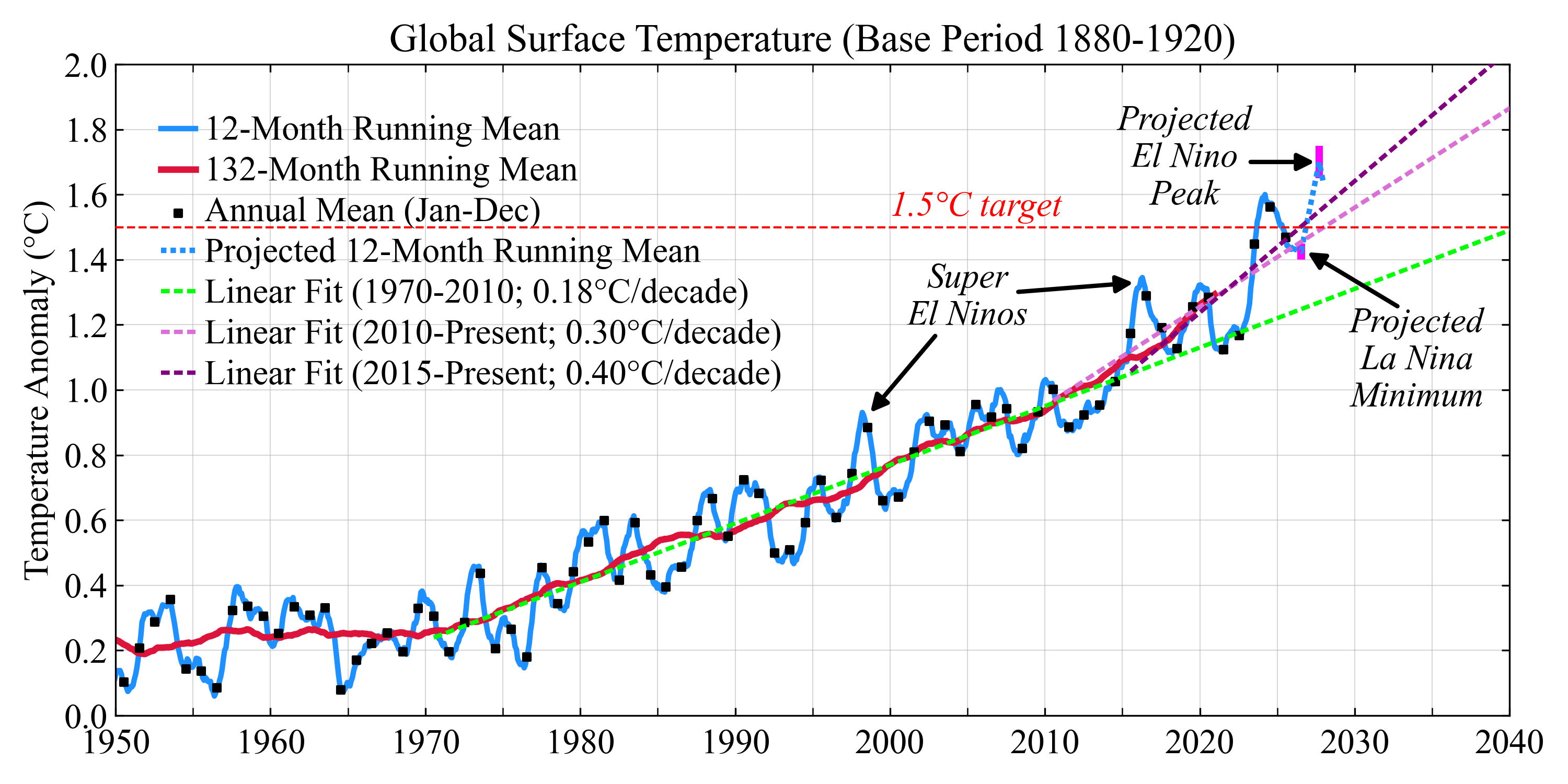
1b. Global temperature and ENSO projections, 1950–2040
Global mean surface temperature anomaly relative to 1880–1920, 1950–2040.
The plot shows observed annual means, 12-month running mean, and
132-month running mean, together with a projected 12-month running mean
extending from the 2026 La Nina minimum to a projected El Nino peak in the first half of 2027. Projections are based on the historical relationship between global temperature and the Nino3.4 index (NOAA Climate Prediction Center).
Data through September 2026. Data source: ref. [1].
Figure available as
PDF.
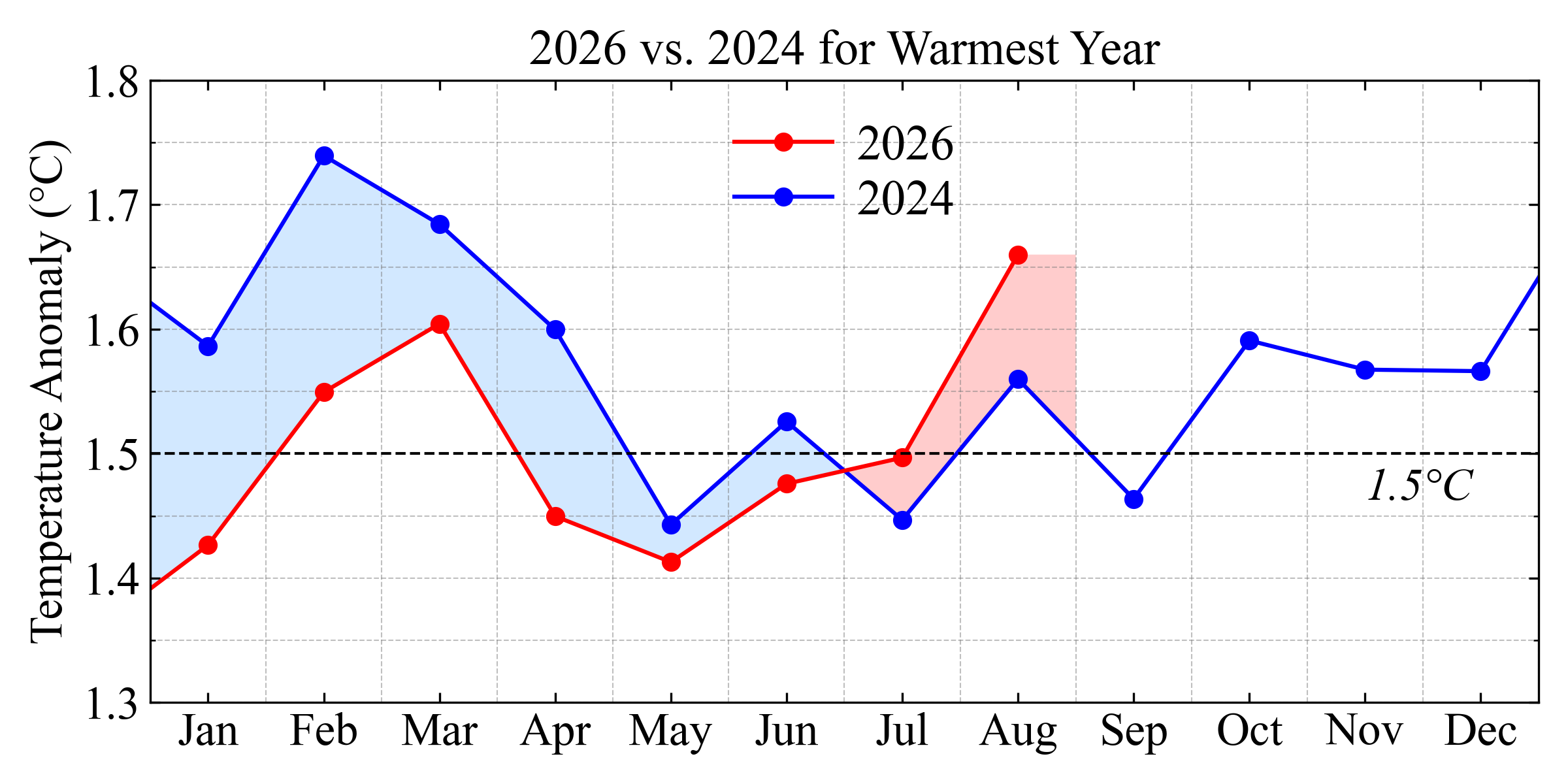
Monthly global surface temperature anomalies in 2026 and 2024 relative to
the 1880–1920 mean. Shading shows the month-by-month difference between the
two years. The dashed line marks 1.5°C above the 1880–1920 mean.
2026 data through September. Data source: ref. [1].
Figure available as
PDF.
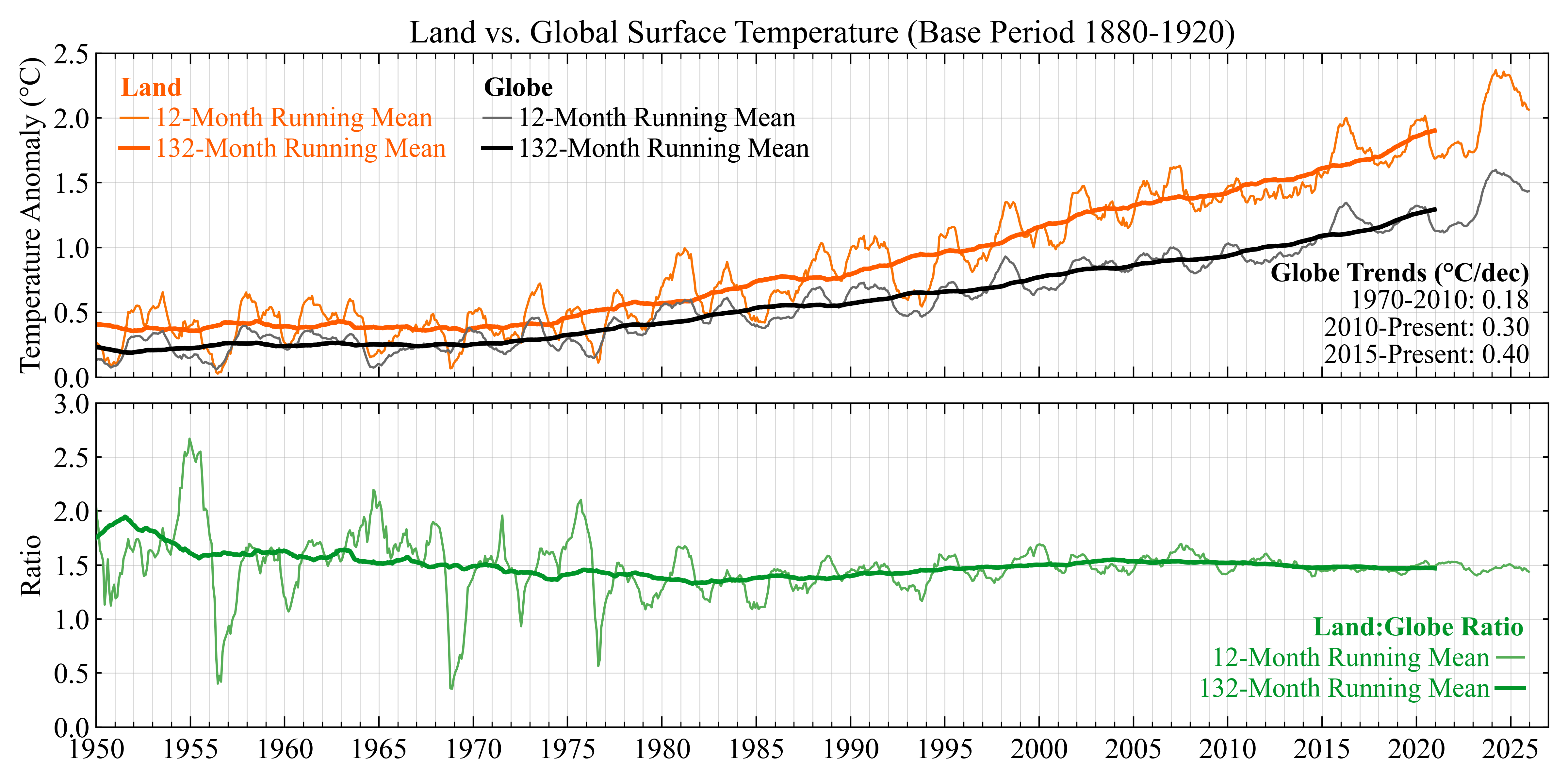
1d. Land and global mean temperature and land:global ratio, 1950–present
Global land-only and overall mean surface temperature anomalies relative to
1880–1920, with 12-month and 132-month running-mean curves for land and
globe. The lower panel shows the land:globe ratio for the same running
means, illustrating how land warms faster than the global mean as the
forced warming signal emerges from interannual variability.
Data through September 2026. Data source: ref. [1].
Figure available as
PDF.
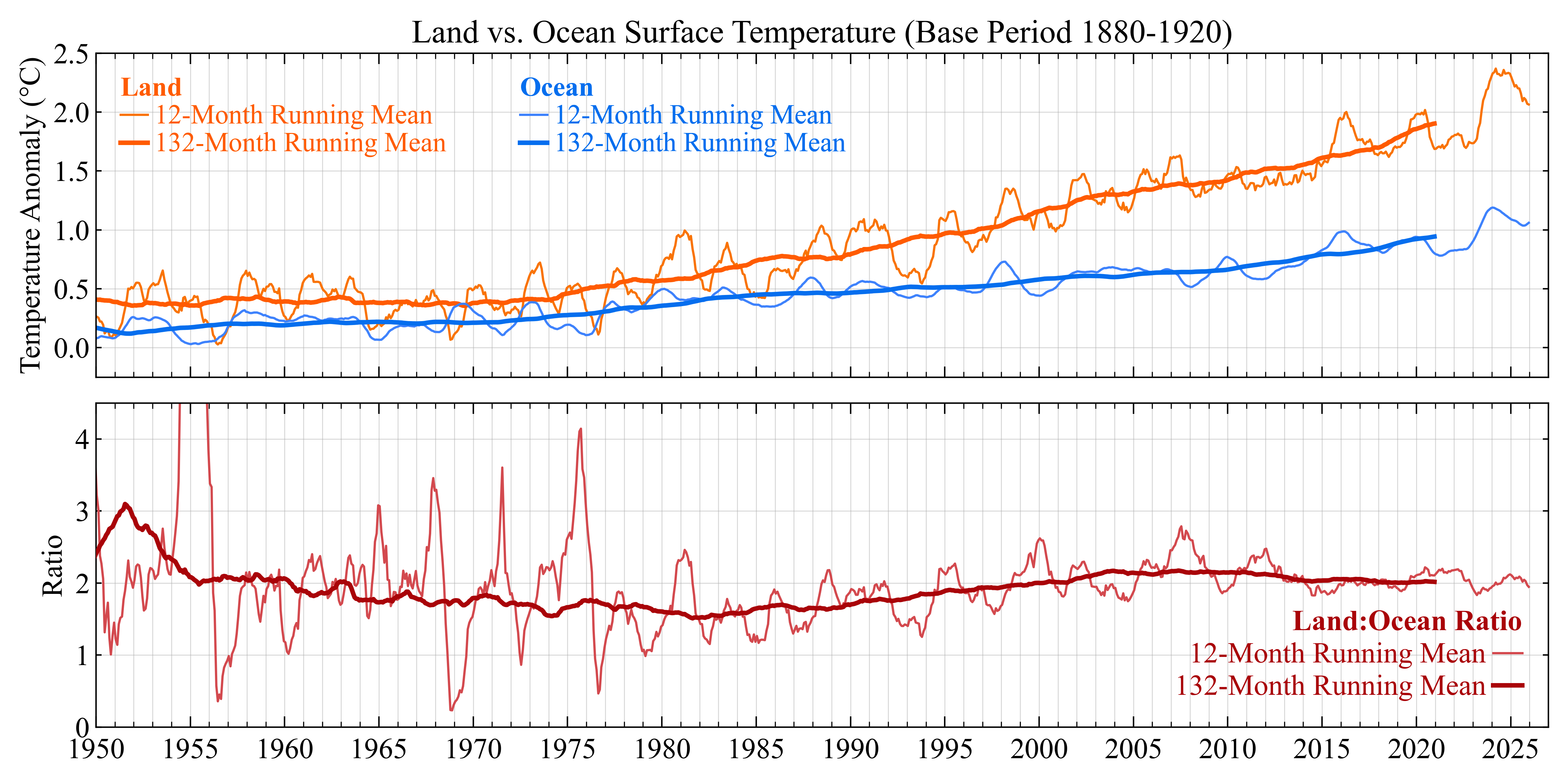
1e. Land and ocean mean temperature and land:ocean ratio, 1950–present
Global land-only and ocean-only mean surface temperature anomalies relative to
1880–1920, with 12-month and 132-month running-mean curves for land and
ocean, 1950-present. The lower panel shows the land:ocean ratio for the same running
means.
Data through September 2026. Data source: ref. [1].
Figure available as
PDF.
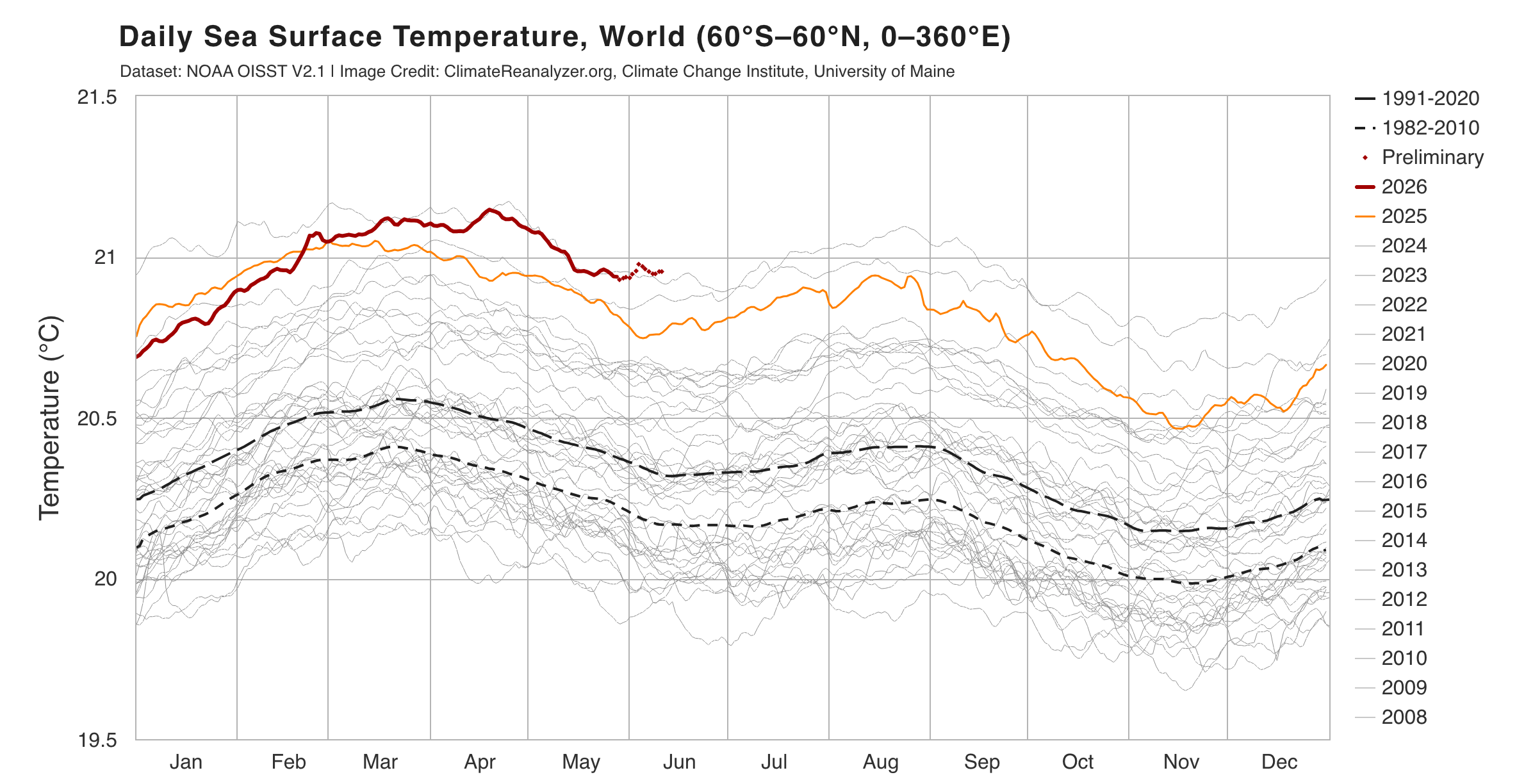
1f. Daily sea surface temperature, world
Daily sea surface temperature for the world (60°S–60°N, 0–360°E),
comparing 2026 with prior years, together with the 1991–2020 and 1982–2010
climatological means. Data through: 08 October 2026.
Dataset: NOAA OISST V2.1. Image credit: ClimateReanalyzer.org, Climate Change Institute,
University of Maine. Data source and interactive figure:
Climate Reanalyzer.
Figure available as
PDF.
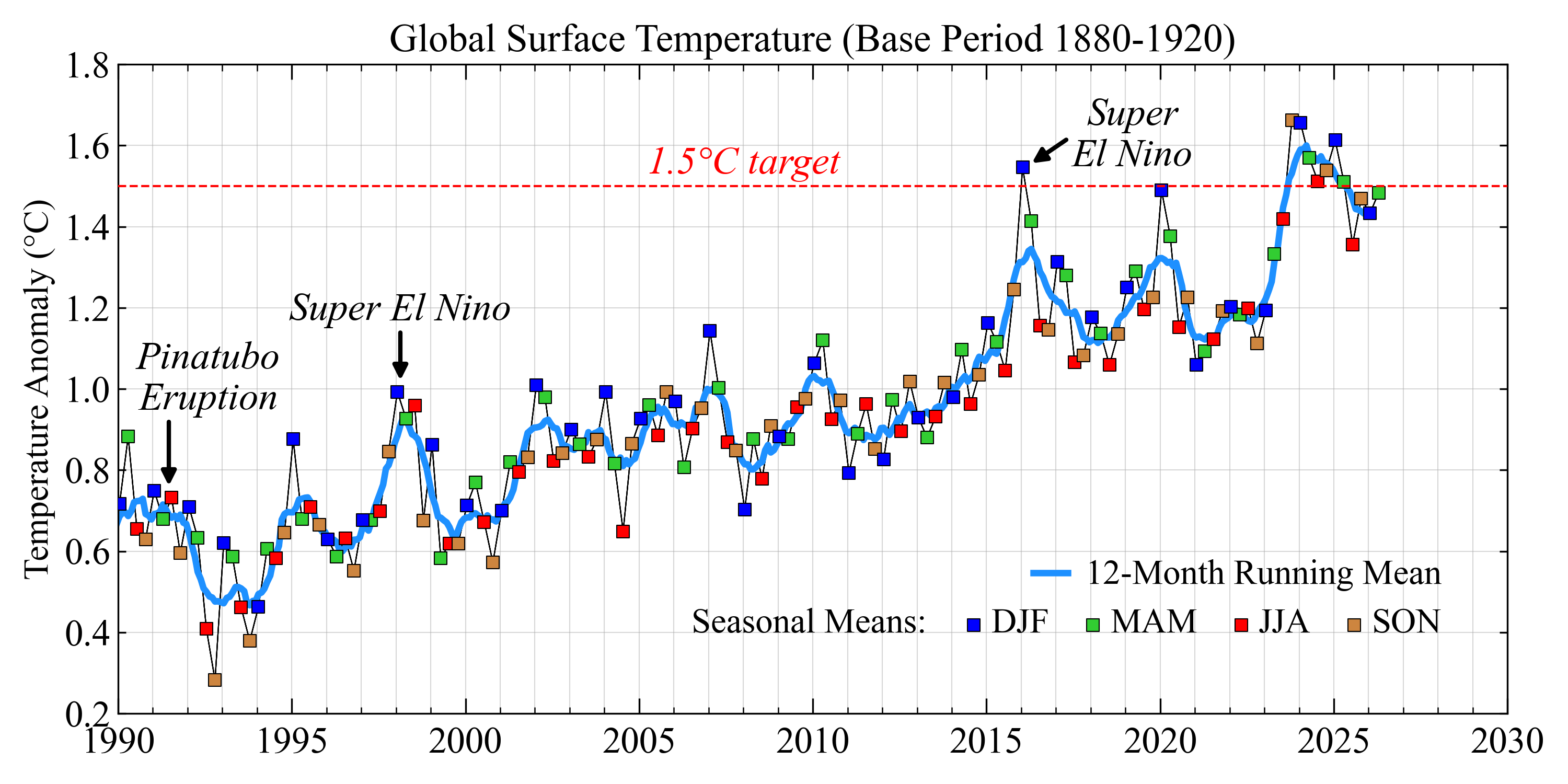
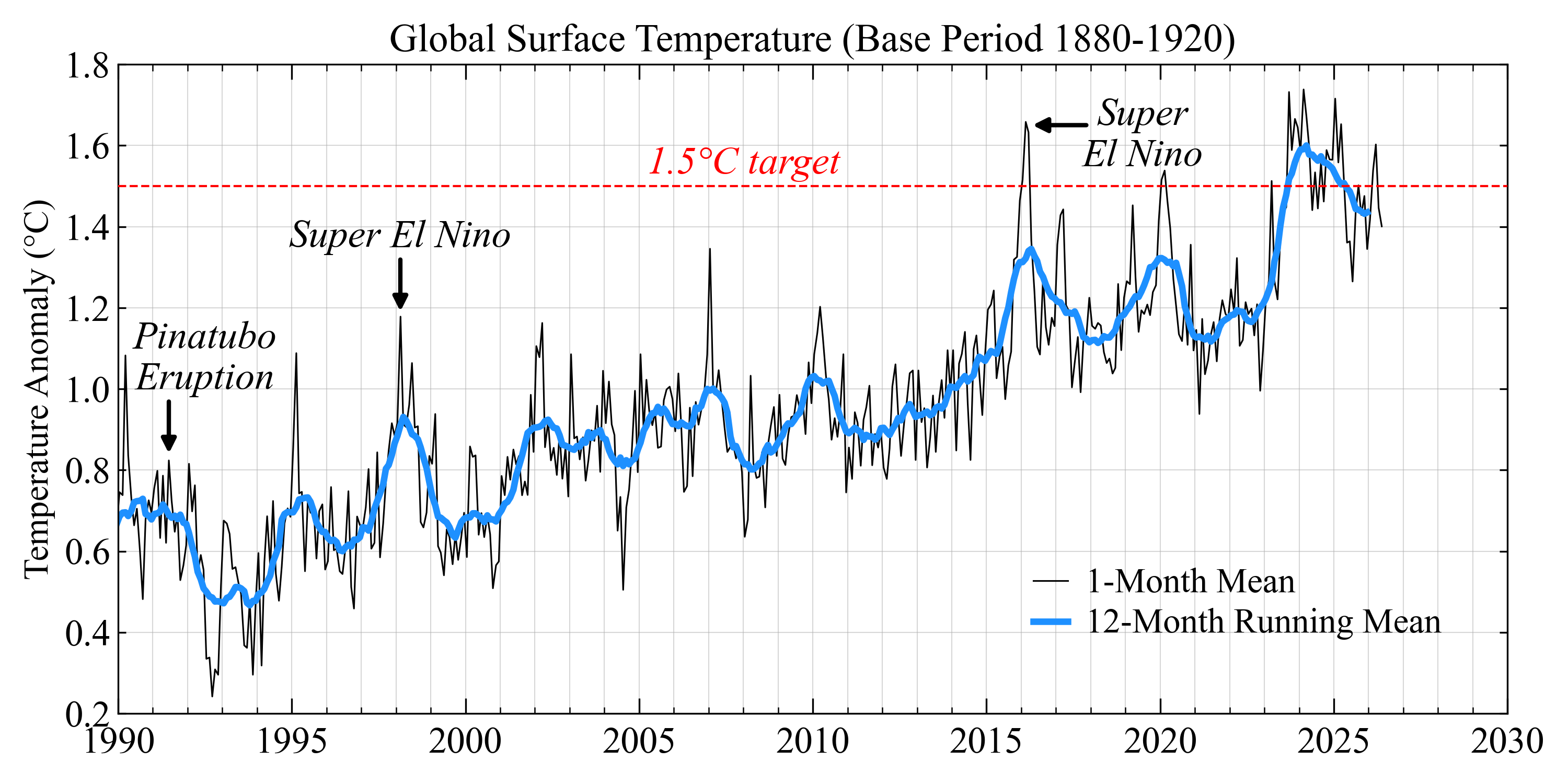
1g. Seasonal mean global temperature, 1990–present
Seasonal mean global surface temperature anomalies relative to the
1880–1920 mean, 1990–present, shown together with the 12-month running
mean. Seasonal means are plotted for DJF, MAM, JJA, and SON.
Data through September 2026. Data source: ref. [1].
Figure available as
PDF.
1h. Monthly global temperature anomalies, 1990–present
Monthly global surface temperature anomalies relative to the 1880–1920
mean, 1990–present, with a 12-month running mean overlaid. The plot
highlights recent years and the emergence of the long-term warming trend
above year-to-year variability.
Data through September 2026. Data source: ref. [1].
Figure available as
PDF.
Zonal
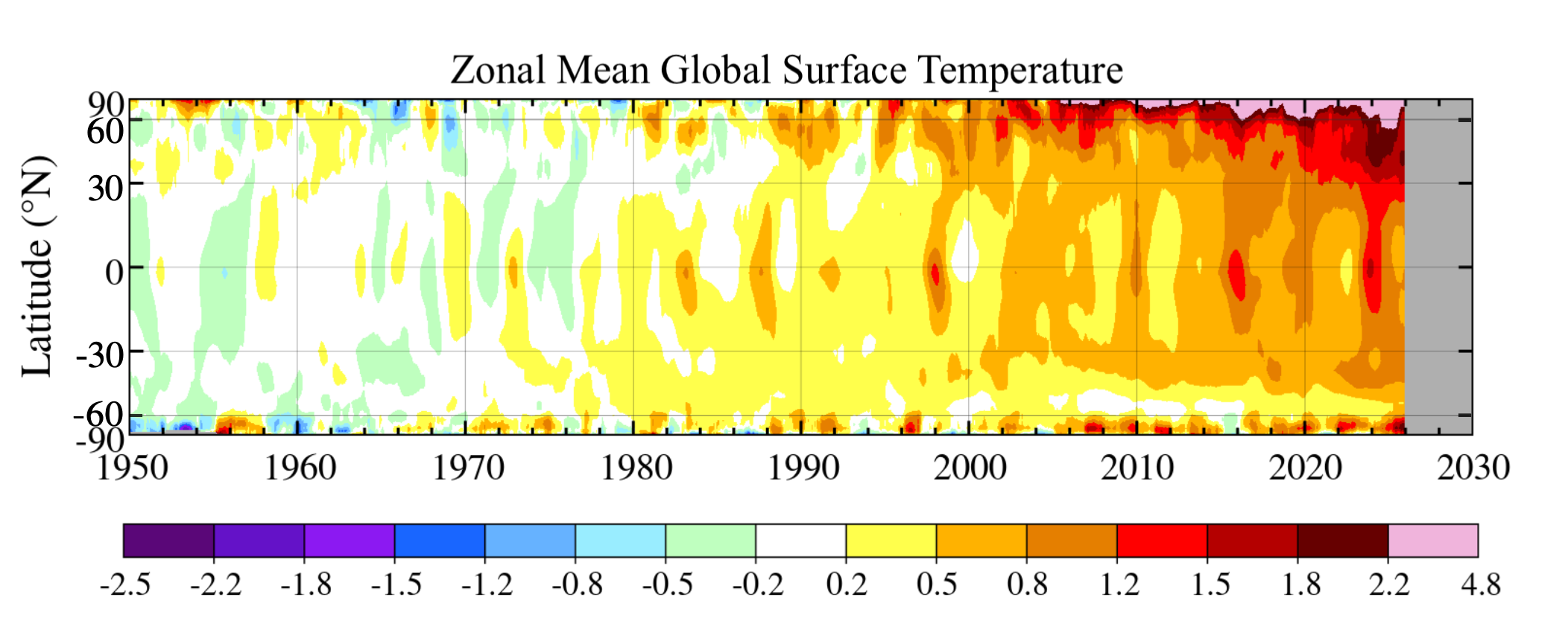
2a. Zonal mean surface temperature, 1950–present
Zonal mean global surface temperature anomalies, 12-month running mean,
1950–present, showing the latitude dependence of global warming.
Base period: 1951–1980. Data through September 2026. Data source: ref. [1].
Figure available as
PDF.
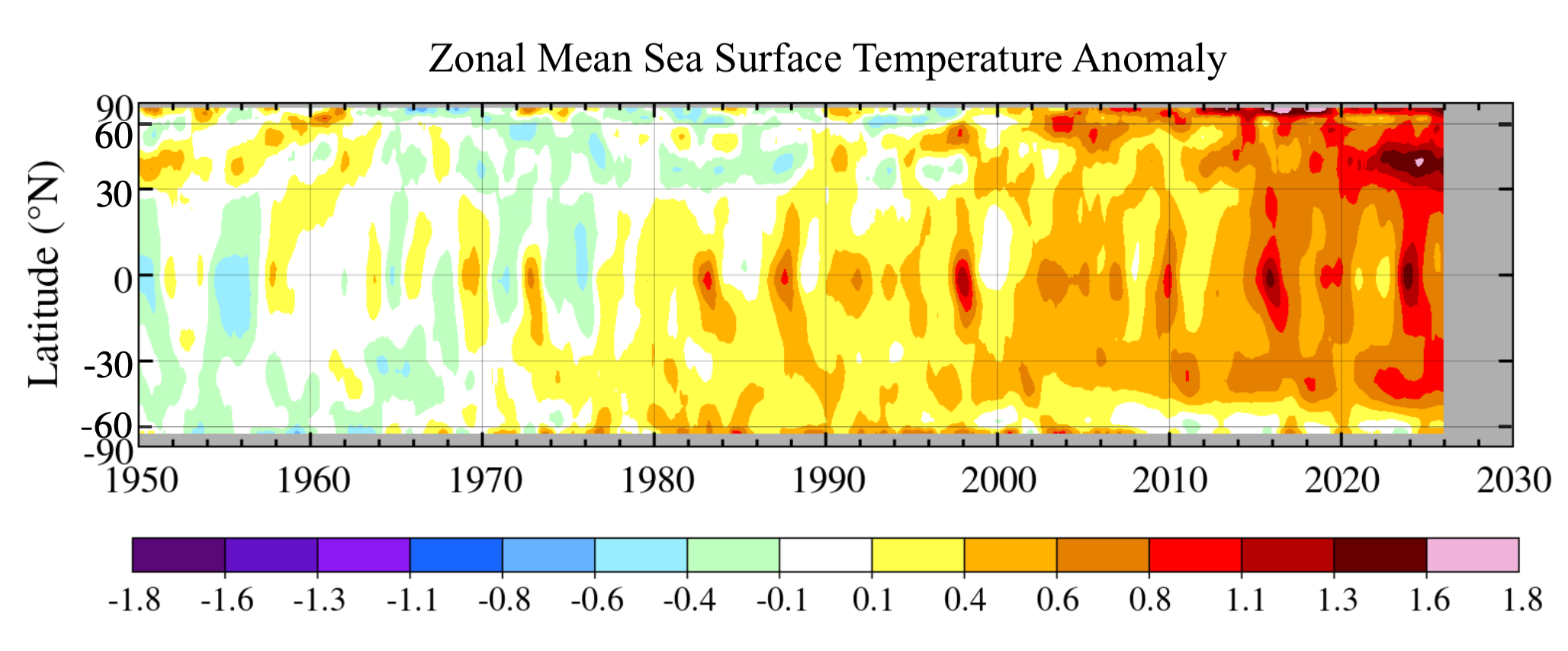
2b. Zonal mean sea surface temperature, 1950–present
Zonal mean sea surface temperature anomalies, 12-month running mean,
1950–present.
Base period: 1951–1980. SST source: NOAA ERSSTv5, used in the GISS analysis; ERSSTv5 anomalies are defined relative to a 1971–2000 base period. Data through September 2026.
Data source: ref. [1].
Figure available as
PDF.
2c. Global and regional land-ocean temperature, 1950–present
Land-ocean temperature anomalies, shown as 12-month running means for the globe
and three latitude bands: 20°N–20°S, 20°–60°N, and
20°–60°S, 1950–present.
Base period: 1951–1980. Data through July 2026. Data source: ref. [1].
Figure available as
PDF.
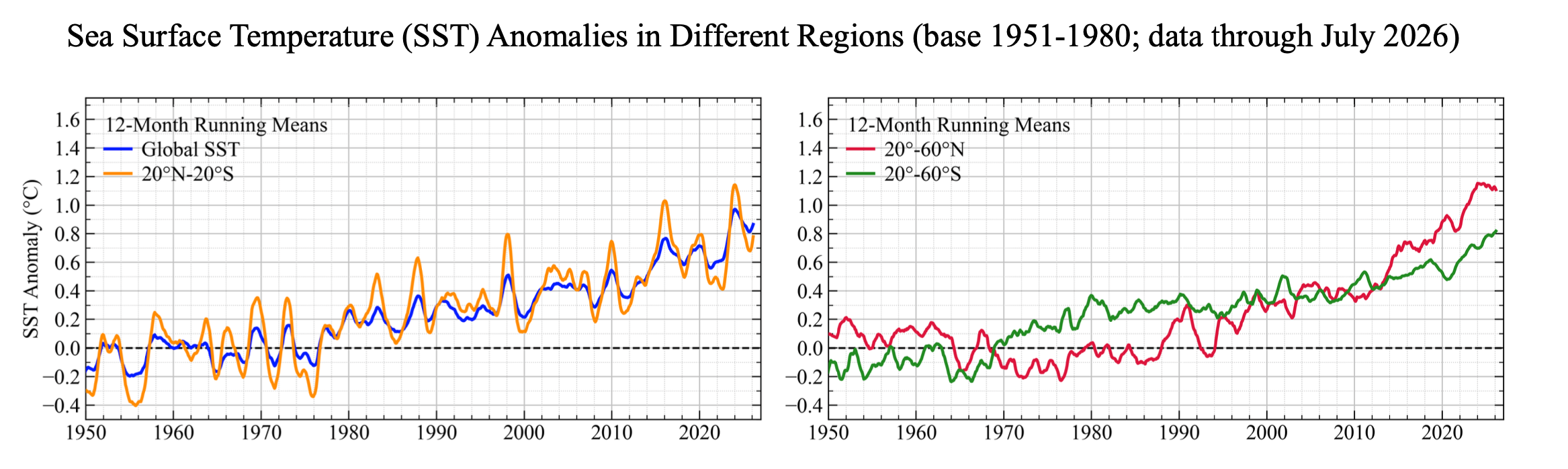
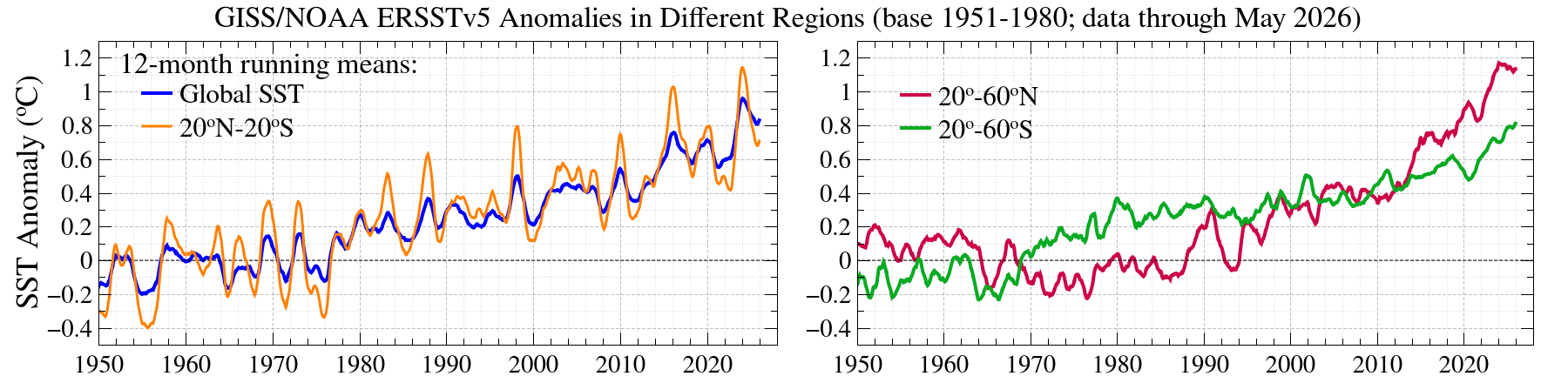
2d. Global and regional sea surface temperature, 1950–present
Sea surface temperature anomalies, 12-month running means, for the global
ocean and three latitude bands: 20°N–20°S (tropical), 20°–60°N, and
20°–60°S, 1950–present.
Base period: 1951–1980. SST source: NOAA ERSSTv5, used in the GISS analysis; ERSSTv5 anomalies are defined relative to a 1971–2000 base period. Data through July 2026. Data source: ref. [1].
Figure available as
PDF.
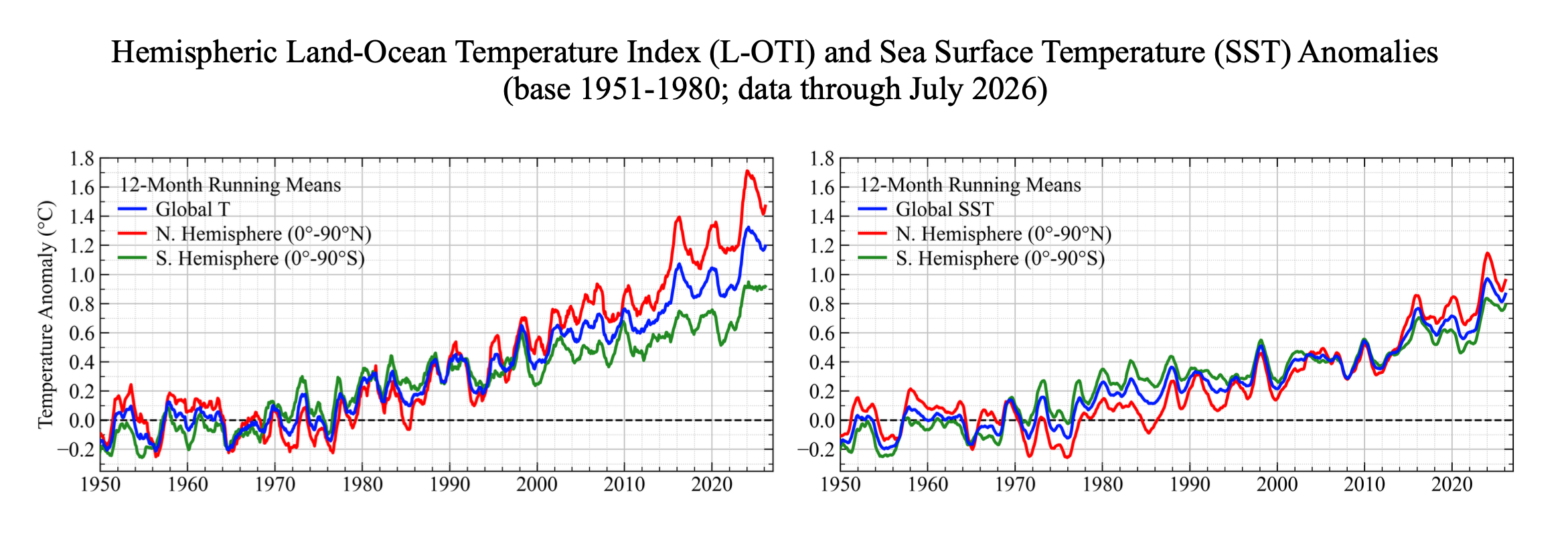
2e. Hemispheric land-ocean and sea surface temperature, 1950–present
Hemispheric land-ocean temperature (left) and sea surface temperature (right)
anomalies, shown as 12-month running means for the globe, Northern Hemisphere
(0°–90°N), and Southern Hemisphere (0°–90°S), 1950–present.
Base period: 1951–1980. Data through July 2026. Data source: ref. [1].
Figure available as
PDF.
Maps
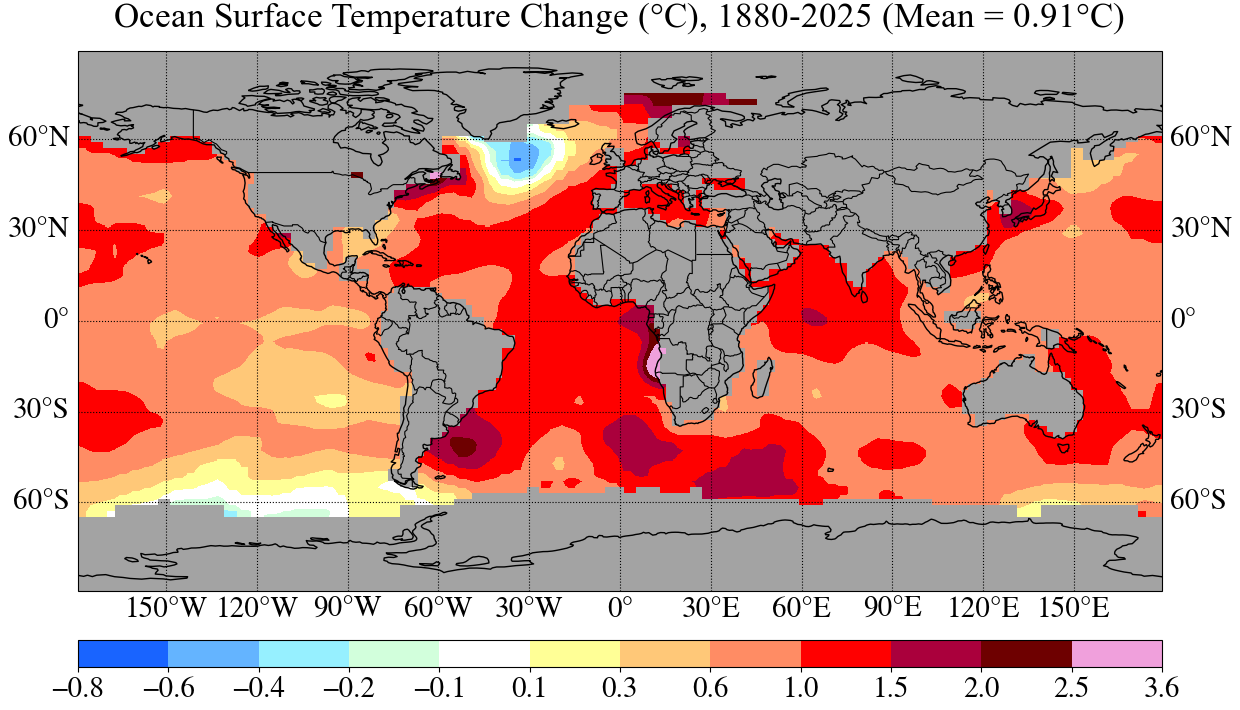
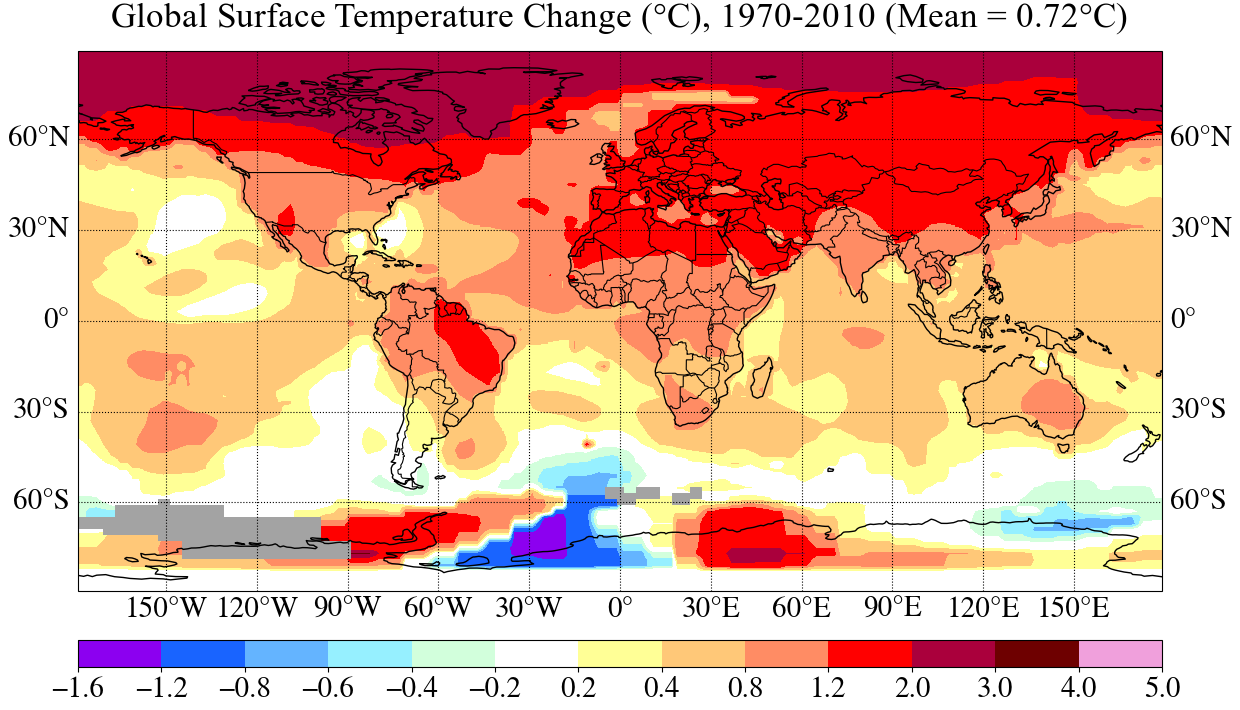
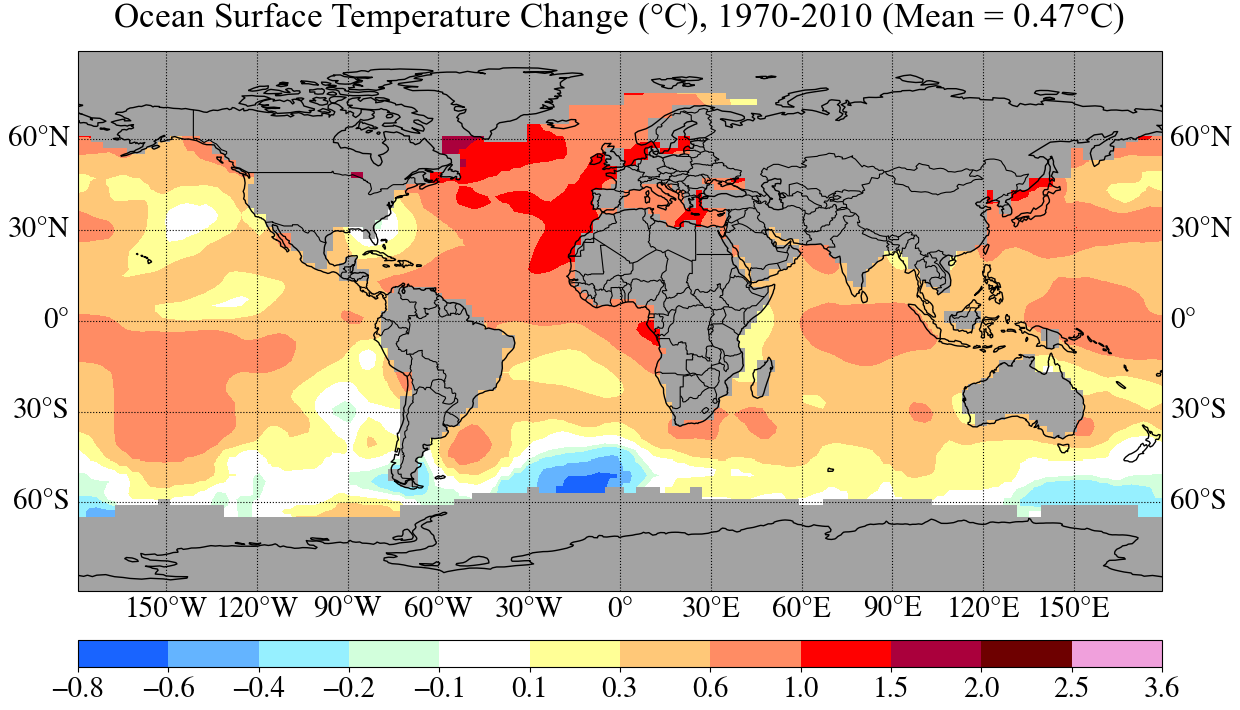
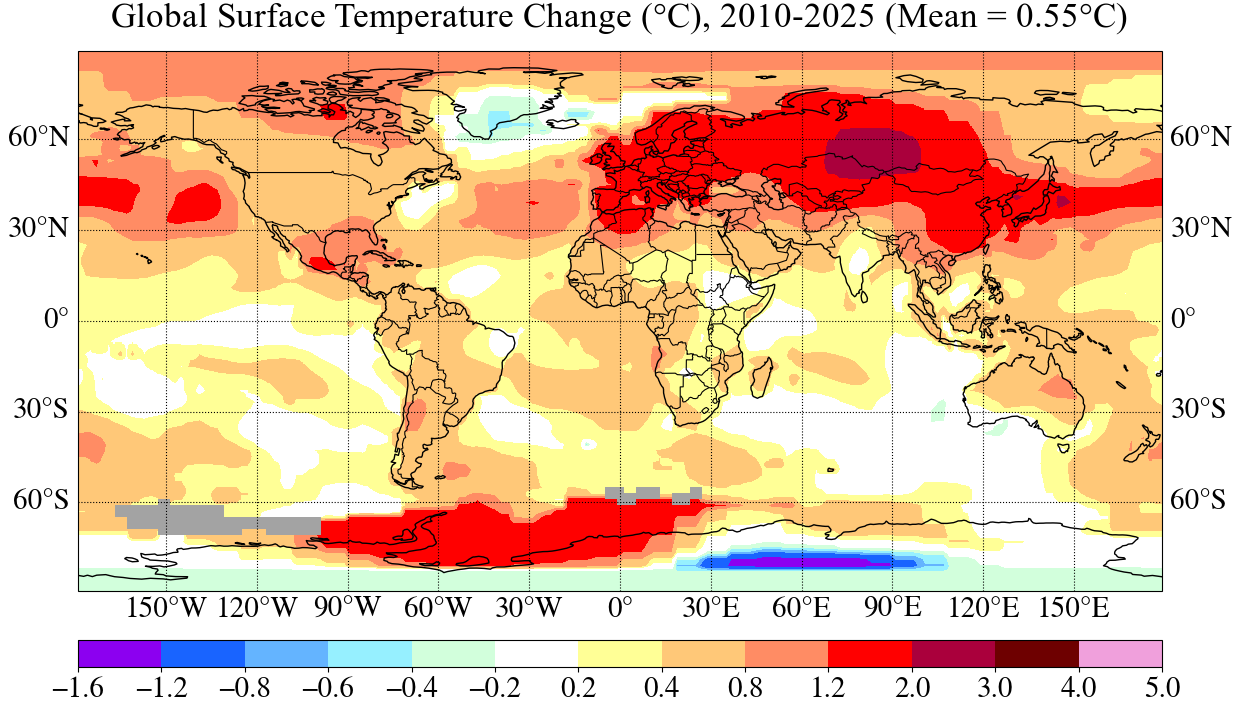
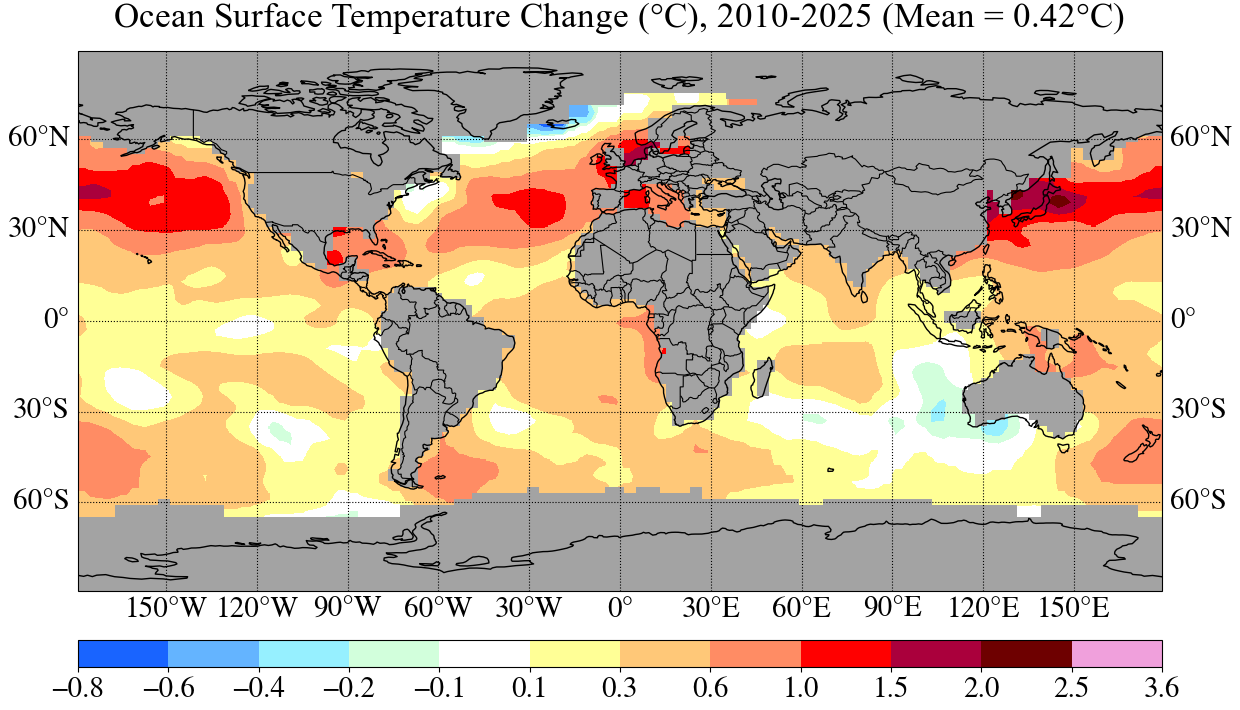
3a. Global temperature change based on local linear trends
These maps compare regional temperature change over three scientifically useful
intervals: the full period with broad instrumental coverage, the period of rapid
near-linear warming, and the recent period of accelerated warming. Because the
intervals have different lengths, the maps can be viewed both as total temperature
change and as the rate of temperature change per decade.
Showing: temperature change
1880–2025
Full period with broad instrumental coverage
Land-ocean surface temperature
Ocean surface temperature
1970–2010
Period of rapid near-linear warming
Land-ocean surface temperature
Ocean surface temperature
2010–2025
Recent period of accelerated warming
Land-ocean surface temperature
Ocean surface temperature
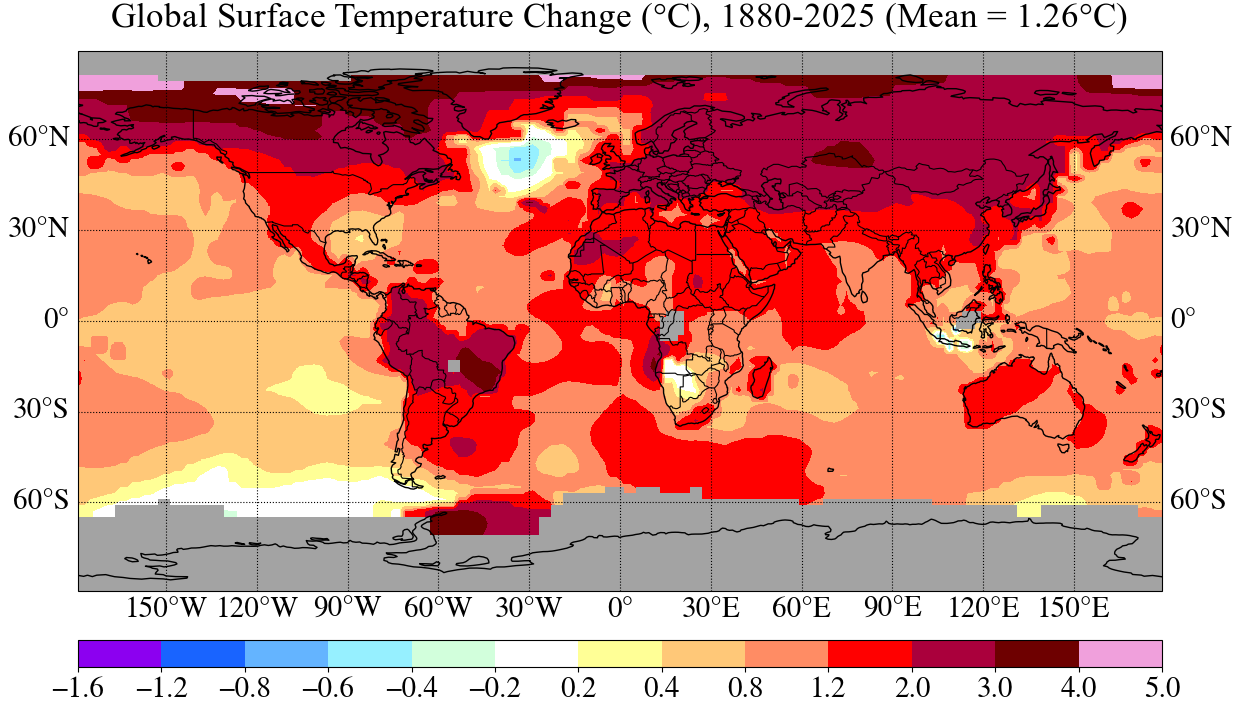
Global maps of land-ocean surface temperature and ocean surface temperature
are shown for 1880–2025, 1970–2010, and 2010–2025. The total-change maps
show the cumulative temperature change over each period; the rate maps show
the corresponding rate of change per decade. Maps are based on local linear
trends, use the GISS 1200 km smoothing option, and are expressed relative to
the 1951–1980 mean.
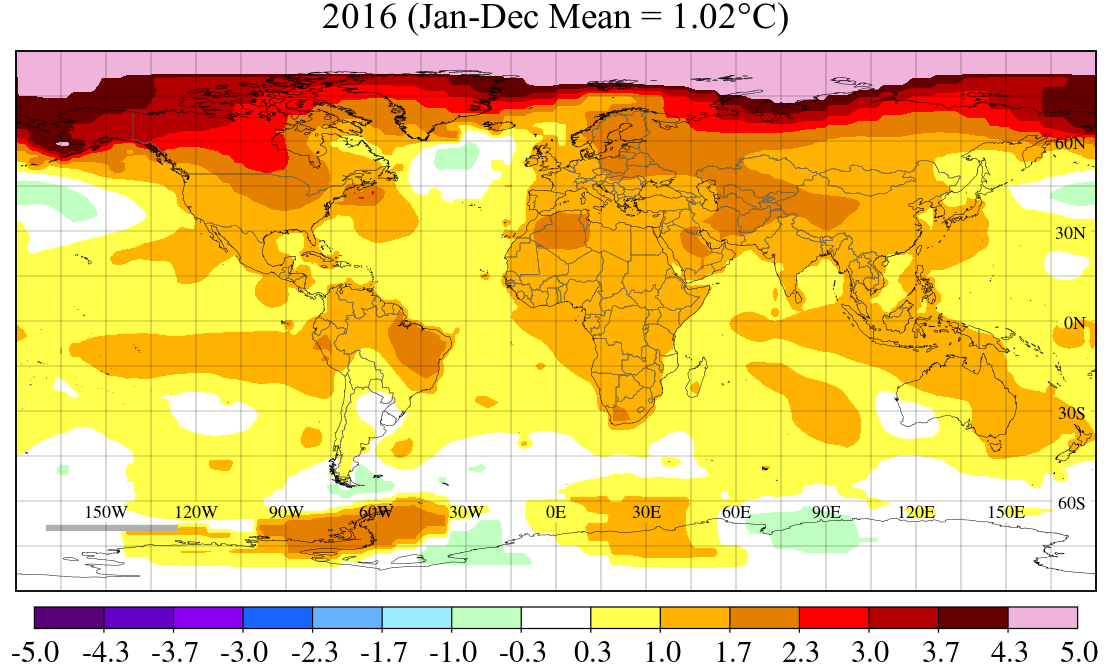
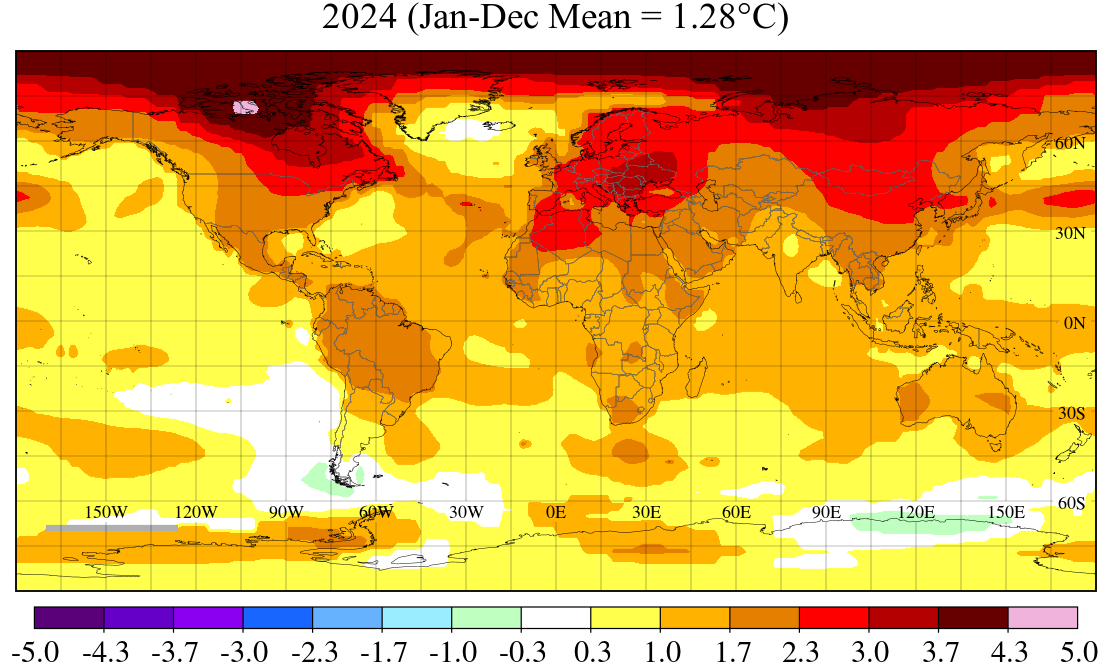
Annual mean global surface temperature anomaly maps for the past ten years
(2016–2025), relative to the 1951–1980 mean. These maps show the spatial
pattern of recent warming and allow comparison between different El Nino
and La Nina years.
A full archive of annual maps beginning in 1990 is available on the
More Figures page.